
by Tony Orman
Currently the Department of Conservation (DOC) is increasingly carrying out aerial 1080 poison drops over large areas of public land, particularly on the West Coast.
Some persons, knowledgeable of individual areas, may be puzzled by that in most cases, the current aerial drop of indiscriminate toxin is over areas that were poisoned just a year or two or three ago – no more.
The drops cover vast areas of public lands, whether National Parks or Conservation estate.
Current examples that have undergone 1080 poison drops this year are:-
(1) Eglinton valley, 44,532 Ha. Last poisoned February 2024.
(2) Kahurangi National Park, 235,308 Ha. Last poisoned February 2023.
(3) Te Maruia area, (Lewis Pass) 43,113 Ha. Last poisoned November 2024.
(4) Arawhata River valley (South Westland), 84,450 Ha. Last poisoned June, 2023,
(5) Landsborough, Clarke and Wills valleys 55,000 Ha. Last poisoned January 2024,
(6) Oparara/Karamea area of the West Coast. 39,000 Ha. Last poisoned February, 2023.
(7) Dart/Caples/Routeburn, 53,000 Ha. Last poisoned March, 2024.
(8) Mohikinui/Karamea 235,000 Ha. Last poisoned 2023.
A Pattern Emerges
Examination of the Department’s 1080 drops reveals a pattern. Quoting from Landcare scientists, “Two years after the poisoning operation, rat abundance was about four times greater than it had been before.” Many recent 1080 poison operations are chronological proof that DOC’s poisoning is for rats that are the outcome of poisoning.
The trend is unmistakable – two years. In some cases DoC openly admits the pattern – “The Abbey Rocks area in South Westland receives regular 1080 drops, often every two years,” says DoC.
Note by DoC’s admission, “Often every two years.”
It may be three or four years in some cases —but re-poisoning “every few years”.
Referring to the eight examples above:-
Eglinton valley – 2 years
Kahurangi National Park – 2 years
Maruia (Lewis Pass) – 1 year
Arawhata valley – 2.5 years
Landsborough, Clarke and wills valleys – 2 years
Oparara/Karamea – 3 years
Dart/Caples/Routeburn 1.75 years
Mohikinui/Karamea – 2.5 years
The pattern exists because, as Landcare Research studies show, rat numbers surge back following 1080 drops.
It is necessary to understand the incredible breeding powers, indeed explosive, under optimum conditions.
A female rat can become pregnant at just six weeks of age.
Ship rats breed seasonally from spring to autumn in most areas, but this can extend to year-round, including winter breeding in years with abundant food. When much of the forest life has been killed by 1080 (which kills everything that breathes oxygen), the rodents excel in breeding up on the food going uneaten (e.g. nectar, fruit, seeds).
AI explains it – “a single female rat, under ideal conditions and with an available male, can be responsible for an exponential population increase that can reach hundreds or even over a thousand descendants within just 12 months.”
A pattern emerges that every few years, as rat numbers explode after a 1080 aerial drop, and numbers soar, the Department decrees that another 1080 drop is needed.
Rat survival figures vary depending on many conditions.. A review noted the variability in rat kill achieved in DoC’s large-scale ‘Battle for our birds’ response to a 2015 beech forest mast: ”While all operations killed most rats present only 19 operations of 25 (76%) got the rats below 10% rat tracking, and 15 (60%) of the operations got the rats to 1% rat tracking or less (Brown et al., 2015).
Research by Landcare Research scientists Peter Sweetapple and Graham Nugent before and after an aerial drop of 1080 – entitled “Secondary Effects of Possum Control 2007” – examined two 1080 drops, one at Mokau in north Taranaki and the other at Waihaha, Western Bays, Lake Taupo.
The two scientists found there was an initial collapse of rat populations following an aerial 1080 operation — then rats recovered numbers to around the pre-poisoning level—-within twenty months.
Tsunami of Rats
Sweetapple & Nugent (2007) reported, “At Mokau, possum control in 2002 using aerially sown 1080 baits reduced possum and rat populations to near zero…In the poisoned block, the number of large invertebrates known to be eaten by rats soared after rat numbers were reduced to near zero, and then plummeted as rat numbers exploded to very high levels.”
“In contrast, in the un-poisoned area, the numbers of rats and of the common large invertebrates remained more or less stable.”
The recovery in the form of a population explosion tsunami surges onwards and upwards with the momentum generated.
Resurgence of Rats and Stoats
Rat numbers recover with incredible speed, testimony to their incredible reproductive ability. A year or two after the 1080 event, both birds and insects will be under pressure from plagues of rats.
Then there is a developing complication with stoats.
Rats are the number one prey of stoats.
At the initial knock back of rat numbers by 1080, surviving stoats are known to switch diet from rats – no longer immediately available – to birds. Then as rat numbers climb back and surge upwards, this massive disruption to the ecosystem can bring in an explosion of stoats which thrive and accelerate their breeding with the increased food supply of rats.
So what the Department of Conservation has achieved with aerial 1080 drops is firstly potential stoat predators switching to birds from rats, followed by a population explosion of rats followed by a potential population explosion of stoats.
But the ecological mayhem does not stop there. Birds get poisoned in the 1080 drop due to varying character and circumstances between species:-
(1) Birds that survive by being generalist, inquisitive, opportunistic feeders such as robins, weka and kea will peck at baits.
(2) Predators such as kiwi (with worms) or more-porks (with insects or mice), or native falcons (with birds and perhaps mice) will be attracted by their prey’s distress since 1080 kills slowly and convulsively. Predators are opportunistic by nature.
(3) Any carcass killed by 1080 retains its toxicity. So scavengers such as hawks and weka get poisoned too.
Insects
While the science points to devastating effects by 1080 on birds, other species suffer, e.g. insects. The poison 1080 was originally patented in 1927 as an insecticide.
Noted entomologist the late Mike Meads in the mid-1990s examined the effect of aerially spread 1080 on the forest floor following a poison drop at Whitecliffs, Taranaki.
Invertebrates are vital in the ecological life of the forest floor’s litter. Following his field research, Mike Meads expressed alarm that the forest floor insects and micro-organisms responsible for the natural breakdown of forest litter were severely and adversely impacted by aerial 1080.
In an interview with “Rural News” in 1995 he was reported as warning “continue to apply 1080 and you will end up with knee deep leaves because they are not breaking down.”
Natural Composting
He warned the loss of forest floor insects and organisms so important to the natural process of decomposing would deprive the kiwi and other ground living creatures of much of their diet. The Meads study found about 50 percent of the invertebrates were killed with each 1080 drop.
Mike Meads had dared to challenge the traditional culture and poison policy of the Department of Conservation.
The onslaught was devastating and stressful on the scientist. He was vilified within the Department with a “kangaroo court” style departmental peer review rubbishing his studies and he (and his assistant Peter Notman) were soon “awarded” redundancy for their integrity.
The under-attack scientist had urged the department to implement “long term monitoring” in order to assess and understand the ecological damage that was ongoing.
In an interview shortly before his death, Mike Meads said DoC was “just fiddling around, not knowing what was killing what by what rate.” He rued that in 14 years since his Taranaki study that despite “everyone in the department agreeing, not even one long term monitoring had been started.”
Beech Mast Years
Frequently the Department of Conservation endeavours to justify a 1080 aerial drop by citing an anticipated beech mast year. A mast year is when beech trees flower and produce a large quantity of seeds. In New Zealand, beech trees generally have a “mast year” or widespread seeding event every 2-6 years, with a significant event, a “mega-mast”, happening less frequently.
But beech mast years are far from a new event.
Beech trees have a long evolutionary history, with their lineage dating back to the Late Cretaceous period, about 81-82 million years ago during which time, mast years have naturally occurred. It is very likely that in pre-rat times this resource was once taken up by massive numbers of fast breeding insects (e.g. grasshoppers) and native predator species then flourished.
The alibi of a beech mast year just doesn’t stand up to scrutiny.
Following a mast, the food supply drops and the mast effects come to an end. The cold of winter can quickly kill off rodent populations too.
Nature knows
The intervention of a widespread and intensive 1080 drop throws the natural cycles into catastrophic disarray.
It is self-perpetuating and self-benefiting the department, with naive government politicians giving vote allocation money to the bureaucracy. The Department’s spin doctors go into high gear to ring alarm bells.
A typical 1080 aerial drop is estimated to cost between $2 million and $3 million.
An old bushman summed it up, “All DoC is doing with 1080 is causing population booms in rats and stoats, and knocking birds and insects around. You might say DoC are farming rats and stoats.”
Footnote: Books for further reading are “The Third Wave” and “At War with Nature” by conservationist Bill Benfield, available from Tross Publishing via Google.

© In May 2025, the Nelson Lakes National Park was dowsed with 1080 by the Department of Conservation. National Parks are not exempt as nearby Kahurangi National Park received an aerial 1080 poison drop in 2025, previously poisoned early 2023
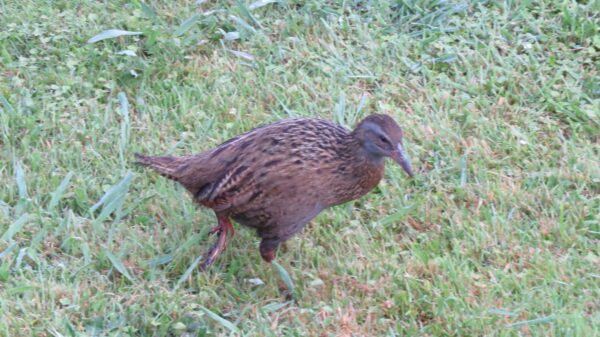
©Inquisitive wekas will peck at 1080 baits. Not surprisingly weka population fares badly in a 1080 poison drop
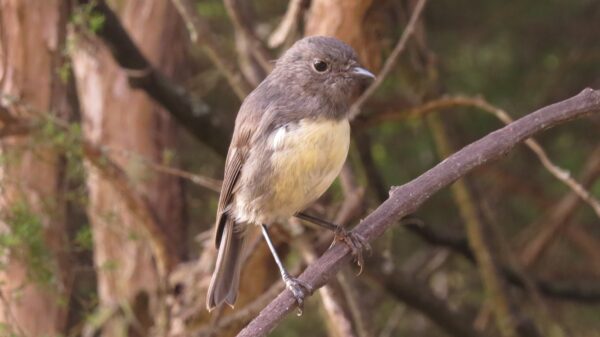
© Curious by nature, South island bush robins fare badly in the face of 1080
The components of the food web and predator-prey relationships are inter-related. Remove most of one (i.e. rats) with mass killing in this case by poison and the ripple impacts turn things topsy turvey.
DoC and other authorities don’t understand, or is it that with the subsequent “tsunami” of rats and then stoats, DoC – by design as suggested – can cry out for more public money to fund the threat, it has created?
This article highlights the uncomfortable elephant in the room: if aerial 1080 is the silver bullet it’s sold as, why are we back over the same valleys every one to three years? DOC’s own schedules for Eglinton, Kahurangi, Lewis Pass and others show a treadmill of repeat drops, which looks a lot like managing the consequences of earlier poison operations rather than fixing the underlying problem.
Landcare’s work has long acknowledged that rat numbers collapse after a drop, then rebuild rapidly and can overshoot previous levels within a couple of years. That in turn fuels stoat booms, while non-target species – birds and invertebrates alike – wear the collateral damage. Yet we still don’t see robust, independent long-term monitoring of full ecosystem effects, despite scientists like the late Mike Meads calling for exactly that decades ago.
Before pouring more millions into copy-paste 1080 campaigns, DOC and ministers owe the public an honest review of whether this strategy is genuinely working, or just locking us into permanent poison cycles.
Rat resurgence is a real problem caused by these 1080 poison operations. Where are the real ecologists warning of this? Seems like DoC’s “ecologists” are only interested in hugging trees and saving whales. Must’ve got their woke “conservation science” degrees from Waikato University.
Einstein is credited with saying: “Insanity is doing the same thing over and over again and expecting different results”. Whether he actually did say that or not the truism applies equally to the DOC DG Penny Nelson, and Minister Hon Tama Potaka.
If all they can come up with is more of the same expecting a different result – well maybe Einstein was right on the money – YES MONEY. How else do you explain the pursuit of something proven to fail yet hurtling headlong along the well-worn path to extinction of so many of our once abundant flora and fauna.
As Fraser from Dad’s Army might say “They’re Mad I tell ye, Mad, Mad, Quite Mad”
Excellent su.mary. let’s also include the mice. They produce a new litter every 24 days. At 6 per litter you do the math’s to see their annual output per pair. Their offspring are sensually mature at 42 days and these Casanova do not much around. Without predators they are in heaven.
I would like to see an inquiry into the purchasing agreements for 1080 also. It is disturbing that the rest of the world bans 1080.
I understand that New Zealand, with a tiny percentage of world land mass, uses over 90 percent of world 1080 production. Doesn’t that alone tell the 1080 brigade something?
And the manufacturers of 1080 used to put on their packaging that all untouched baits should be retrieved after the drops…….
David, also the manufacturers instruct no baits in waterways and dead animals to be retrieved as carcasses are toxic and anything scavenging gets poisoned, killed by a slow agonising death too.
BUT DoC ignores the manufacturers instructions.