
The aging brain can regenerate.
That is the central finding of new research into so-called “SuperAgers” - people in their 80s and 90s who retain exceptional memory and mental sharpness. Scientists found that these individuals produce significantly more new, adaptable neurons than cognitively healthy peers, and far more than those with dementia.
The message is not that aging stops.
It is that resilience can be sustained.
And that should change how we think about recreation.
Engagement, Not Withdrawal
SuperAgers share certain traits. They remain socially active. They continue learning. Many are physically engaged. They volunteer. They participate in community life.
They are not passive observers of old age.
They are engaged in it.
Research increasingly shows that physical movement, cognitive challenge and social connection all support brain plasticity - the brain’s ability to adapt and repair. The hippocampus, central to memory, responds to activity much like muscle responds to exercise.
The brain, it seems, follows the same principle as the body:
Use it, or lose it.
The Outdoor Dimension
Outdoor recreation combines all three protective factors in one setting:
- Physical movement
- Environmental navigation and problem-solving
- Social interaction
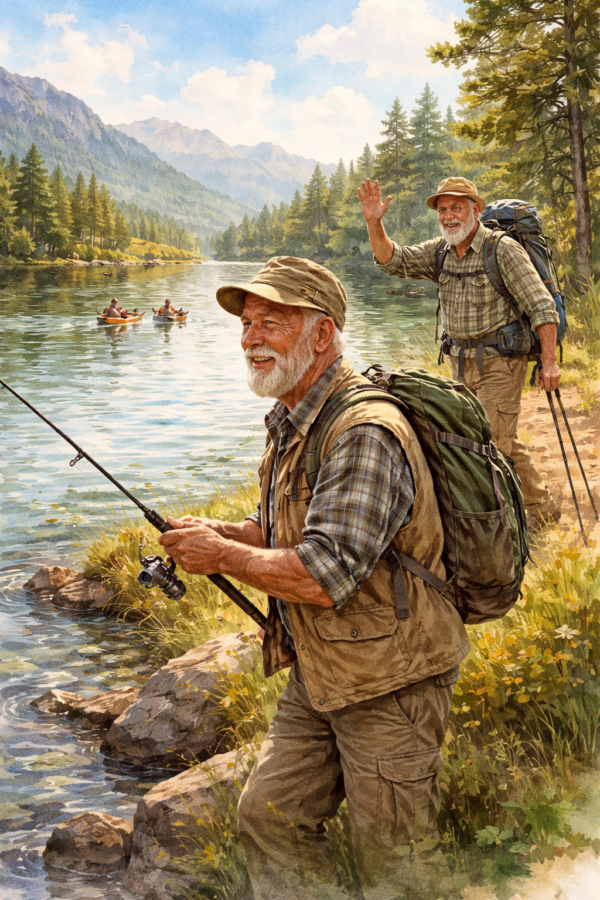
An angler reading water flow.
A tramper navigating terrain.
A volunteer restoring habitat.
A duck hunter scanning wetlands at dawn.
These are not idle pastimes.
They are cognitively rich activities.
They demand attention, adaptation, and environmental awareness. They strengthen both body and mind.
Recreation as Preventative Infrastructure
New Zealand is aging. Dementia and cognitive decline carry enormous social and economic cost.
Yet discussions of public health rarely include outdoor access as preventative policy.
If active engagement supports cognitive resilience - and emerging evidence suggests it does - then maintaining access to safe, healthy outdoor spaces is not simply a lifestyle issue.
It is a long-term public health investment.
Closing access, degrading waterways, or reducing community participation weakens more than recreational opportunity.
It weakens resilience.
Public resource, public responsibility.
Environment and Mind Are Linked
There is another implication.
If wetlands decline, rivers become unsafe, or coastlines are polluted, participation falls. When participation falls, engagement falls. When engagement falls, isolation increases.
Healthy ecosystems support healthy communities.
This is not metaphor.
It is structural.
A degraded recreational estate limits opportunities for physical, cognitive and social stimulation - precisely the factors associated with sustained mental sharpness.
Limits before tools.
Longevity With Purpose
SuperAgers are not defined by gym memberships or perfect diets. Research shows they are a mixed group in terms of traditional health metrics.
What unites them is engagement - purpose, curiosity and connection.
Outdoor recreation provides that in abundance.
It offers structure without rigidity. Challenge without hostility. Community without coercion.
It is one of the few domains where older adults can remain fully competent, autonomous and socially relevant.
The Outdoor Advantage
The science of neurogenesis may be complex.
The implication is simple.
Brains that remain engaged remain adaptable.
As New Zealand considers the future of its public lands, freshwater systems and recreational access, it would do well to recognise that these spaces are more than scenery.
They are arenas of lifelong resilience.
Protecting them protects more than biodiversity.
It protects the capacity of communities to remain sharp, connected and capable well into old age.
That is not leisure.
That is longevity.