Why the Outdoors Matters
Guest post by Steve Hodgson
From time to time, medical research lands uncomfortably close to everyday life. Not with dramatic breakthroughs or miracle cures, but with quieter observations about how the way we live shapes how we age.
A recent study from Lund University in Sweden is one of those. Researchers followed nearly 500 people with normal cognition and examined how a wide range of factors – some fixed, some changeable – related to early biological changes in the brain associated with dementia.
The factors studied included heart disease, blood pressure, cholesterol, diabetes, smoking, alcohol consumption, sleep, depression, social isolation, body weight, education and genetics. What makes this work important is that it didn’t wait for dementia to appear. Instead, it looked at early brain markers – changes that often develop years before symptoms.
The results were not surprising, but they were clarifying.
Risk accumulates quietly
The study reinforced a message that has been emerging for years: dementia risk is rarely the result of a single cause. It accumulates quietly through a combination of cardiovascular health, lifestyle, mental engagement and social connection.
Several modifiable factors – particularly smoking, heart disease, high blood pressure and diabetes – were associated with changes in brain white matter, often linked to vascular dementia. Others, such as diabetes and very low body weight, were associated with the accumulation of proteins linked to Alzheimer’s disease.
Importantly, genetic risk did not operate in isolation. Even people carrying high-risk genes showed differences depending on how they lived.
This is not a promise of prevention. It is, however, a strong reminder that how we live matters long before illness appears.
Where the outdoors quietly fits in
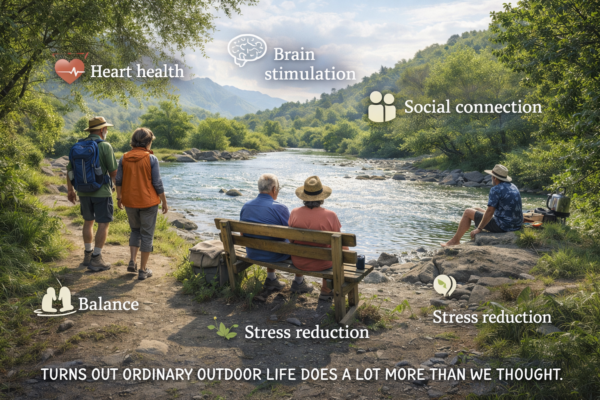
What is striking, when reading studies like this, is how many of the protective behaviours they point to overlap naturally with everyday outdoor activity.
Not extreme sports. Not fitness regimes. Just ordinary time spent outside.
Movement that doesn’t feel like exercise
Regular physical activity was one of the strongest protective factors identified. But the study – like most in this field – does not suggest that people need to train hard or chase athletic goals.
Walking, gentle cycling, swimming, paddling, even unhurried movement through parks and reserves all support cardiovascular health. They help regulate blood pressure, improve glucose control, and reduce the risk factors most strongly associated with cognitive decline.
One of the advantages of outdoor movement is that people tend to do it more consistently. It feels purposeful, pleasant and sustainable in a way that structured exercise often does not.
Balance, awareness and injury prevention
The research also highlighted the role of head injury and falls in later dementia risk. Outdoor environments, when approached sensibly, help maintain balance, coordination and situational awareness.
Uneven ground, changing conditions and natural surfaces encourage attentiveness. Over time, this builds physical confidence and stability – the very things that reduce fall risk later in life.
Avoiding all risk is not the same as managing it.
Social contact without effort
Social isolation and loneliness were strongly associated with higher dementia risk in the Lund study. Again, this is consistent with a wide body of international research.
Many outdoor activities are quietly social by default. Walking with a neighbour, sharing a picnic, swimming with friends, barbecuing by a river, or simply being present where others are around all involve interaction, conversation and shared experience.
This kind of social engagement stimulates different parts of the brain than solitary mental tasks. Crucially, it often happens without being labelled as “social participation”.
Learning through place
The study also reinforces the importance of mental engagement and novelty. The brain responds best when it is challenged gently but consistently.
Outdoor recreation is full of low-level learning: reading water before swimming, navigating a track, judging weather, noticing seasonal change, finding new places. None of this feels like education, but it all builds what researchers call cognitive reserve – the brain’s capacity to adapt and cope with age-related change.
Even small changes, such as taking a different walking route or exploring a new reserve, introduce novelty that matters.
Mood and mental health
Depression was another factor associated with brain changes in the Lund study. Time outdoors is not a treatment for depression, but there is strong evidence that regular exposure to natural environments supports mood, reduces stress, and improves sleep.
Better sleep, in turn, is increasingly recognised as important for brain health, including the clearance of metabolic waste products linked to neurodegeneration.
This is not a prescription
It’s important to be clear about what studies like this do not say. They do not guarantee protection from dementia. They do not eliminate the role of genetics or ageing. And they do not suggest that lifestyle changes later in life can undo everything that came before.
What they do suggest is something more modest and more useful: risk is shaped over time, and everyday habits play a role.
From a CORANZ perspective, this matters because it reinforces the value of accessible, ordinary outdoor recreation. Not as a health intervention, but as part of a life well lived.
People who regularly spend time outdoors tend to move more, connect more, learn more, and notice changes in themselves and their environment sooner. These are not medical outcomes, but they are human ones.
Why access still matters
If outdoor activity quietly supports behaviours linked to better long-term brain health, then access to outdoor spaces becomes more than a recreational issue. It becomes part of how communities support wellbeing across the lifespan.
Clean water, safe access, usable reserves, and places where people feel welcome are not luxuries. They are foundations that allow healthy habits to develop naturally.
The Lund University study does not mention rivers, parks or beaches. But its findings point repeatedly back to the same conclusion: the healthiest behaviours are often the simplest, and the easiest to sustain when the outdoors is part of everyday life.
Sometimes science doesn’t tell us to do something new. It simply confirms the value of what many people already know – and what is worth protecting.