New Zealand made a deliberate choice in 1996.
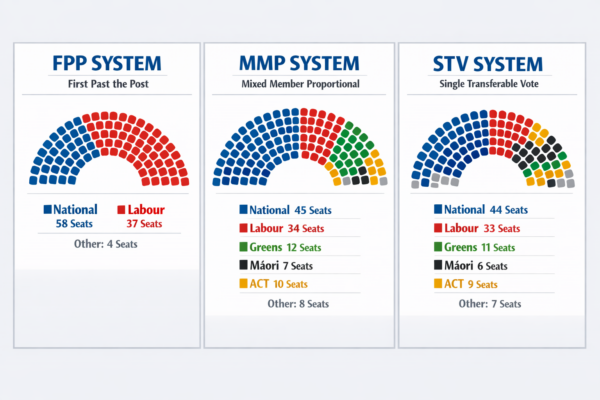
After decades under First Past the Post (FPP), voters chose Mixed Member Proportional (MMP) to correct what many saw as a fundamental imbalance: governments wielding full power without majority support.
MMP delivered what it promised.
Parliament now reflects the party vote.
Minor parties have a voice.
Large majorities built on minority support are far less common.
That was a significant shift - and, in many respects, a necessary one.
But nearly thirty years on, it is reasonable to ask:
Is the system still delivering what it was designed to achieve?
What Was the Problem MMP Solved?
Under FPP, the issue was clear.
A party could win less than half the vote and still control Parliament.
Policy direction could shift rapidly, with limited structural restraint.
The system produced clarity - but not always legitimacy in the eyes of voters.
MMP addressed that.
Representation became proportional.
Parliament became more diverse.
Power became more distributed.
Those are enduring strengths.
What Has MMP Introduced?
Every system solves one problem and introduces another.
Under MMP:
- Coalition governments are the norm
- Minor parties can hold decisive influence
- Manifesto commitments are negotiated post-election
- Policy direction can shift through coalition agreements
None of this is unconstitutional. It is how proportional systems operate.
But it does raise a question of accountability.
When voters cast a ballot, they are voting for a party - not a coalition agreement.
Yet it is the coalition agreement that ultimately governs.
Representation vs Clarity
MMP improves representation.
That is not in dispute.
But accountability also depends on clarity.
Under FPP, voters knew:
Who would govern.
What platform they were elected on.
Under MMP, voters often know:
Which parties they support - but not how those parties will combine, or what compromises will be made.
That is not a flaw.
It is a trade-off.
The question is whether that trade-off is still the right one.
A Wider Perspective
Proportional systems are not unique to New Zealand.
At the extreme end, proportional systems have produced highly fragmented governance. Italy’s post-war experience saw frequent changes of government as coalitions formed and dissolved. New Zealand has avoided that level of instability under MMP - but the example illustrates the outer edge of what highly proportional systems can become if balance is lost.
Are There Other Models?
FPP and MMP are not the only electoral systems available.
Other models attempt to balance representation and accountability differently.
One of the most commonly discussed alternatives is Single Transferable Vote (STV).
Single Transferable Vote (STV)
Under STV, voters rank candidates in order of preference within multi-member electorates.
Seats are allocated proportionally, but without relying on party lists.
Supporters argue that STV:
- Preserves proportional outcomes
- Gives voters more direct control over individual candidates
- Reduces the influence of centralised party lists
- Strengthens the link between voter and representative
Critics argue that STV:
- Is more complex to understand
- Can produce less predictable outcomes
- Requires larger electorates, potentially weakening local connection
STV is already used in some New Zealand local body elections. It is not unfamiliar - but it is not used nationally.
The Threshold Question
Under MMP, a party must reach 5 percent of the vote or win an electorate seat to enter Parliament.
That threshold matters.
Lower it, and more voices enter Parliament - but fragmentation increases.
Raise it, and Parliament becomes more stable - but less representative.
The current threshold sits between those two outcomes.
Whether it remains appropriate is an open question.
Māori Representation
The Māori seats existed before MMP and were retained after its introduction.
Their role sits alongside the electoral system rather than within it.
Some argue that proportional representation makes dedicated seats unnecessary.
Others see them as an important part of New Zealand’s constitutional framework.
This is not simply a structural issue.
It is historical, political and cultural.
Any discussion of electoral reform must recognise that.
The Real Issue
There is no perfect system.
FPP delivered clarity, but concentrated power.
MMP delivers proportionality, but diffuses accountability.
STV offers a different balance again.
The question is not which system is ideal.
It is which system best serves New Zealand now.
Does the current system:
- Reflect how people vote?
- Provide clear lines of accountability?
- Deliver stable and durable policy?
- Maintain public confidence in how decisions are made?
Or is there a growing gap between representation and outcome?
Change Should Be Rare - But Not Unthinkable
Electoral systems should not be altered lightly.
They shape how power is exercised.
They shape how governments are formed.
They shape how trust is maintained.
But they are not fixed for all time.
New Zealand has changed its system before - for considered reasons.
It can ask the question again.
A Conversation Worth Having
This is not a call for change.
It is a call for reflection.
Thirty years after adopting MMP, New Zealand is entitled to ask whether the system continues to strike the balance it intended.
Not in haste.
Not in reaction.
But with the same care that led to its adoption in the first place.
Because the purpose of any electoral system is not simply to count votes.
It is to ensure that those who govern remain accountable to those who elect them.
It’s all about Transparency 😪