
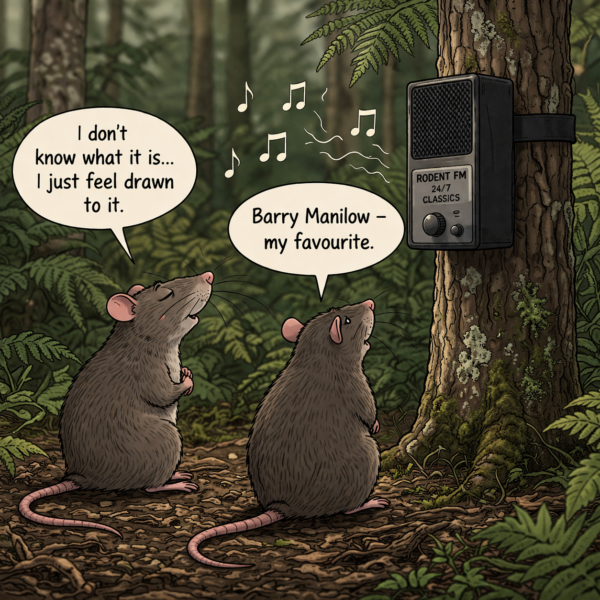
Research from Radio New Zealand has explored the use of recorded rodent sounds to attract rats toward traps. Speakers placed in forest areas broadcast calls continuously, encouraging movement toward specific locations rather than relying on chance encounters. The approach is presented as a way to improve efficiency and reduce the time required for trapping. That may prove effective, but the broader significance lies in what this represents.
What changes here is the method of intervention. Traditional approaches often depend on passive mechanisms, waiting for animals to encounter traps or bait. This shifts toward influencing behaviour directly, using sound to alter movement patterns. Taken together, this is not simply a new tool, but a different way of interacting with the system.
Ecosystems operate through relationships rather than isolated species. Predator and prey dynamics adjust continuously, and the removal or reduction of one species can alter the behaviour of others. These responses are not always predictable, and they do not occur in isolation. Interventions, whether broad or targeted, become part of that system rather than external to it.
Where intervention is considered, the method becomes critical. Broad approaches can have effects beyond their intended target, particularly in complex environments where interactions are closely linked. Techniques that are more selective, or that rely on behavioural responses rather than blanket application, may reduce unintended impacts. This does not remove the need to understand system effects, but it does influence how those effects arise.
There is also a question of proportion. Increasing effort does not always lead to better outcomes if the underlying behaviour of species is not understood. Approaches that work with those behaviours may achieve results with less intrusion into the wider environment. At the same time, any intervention alters the balance in some way, and those changes need to be recognised.
The principle is straightforward. The issue is not only whether to intervene, but how that intervention interacts with the wider system. Methods that are more targeted may offer advantages, but they still operate within a connected environment.
This is not about promoting one approach over another. It is about recognising that how we intervene shapes the outcomes we see.
Anything the replaces poisons like 1080 or Brodifacoum is welcome.
Targeting rats on their own creates imbalance. Mustelids and Cats that rely on a plentiful supply of rats will switch prey to other vulnerable fauna such as nesting birds, reptiles etc.