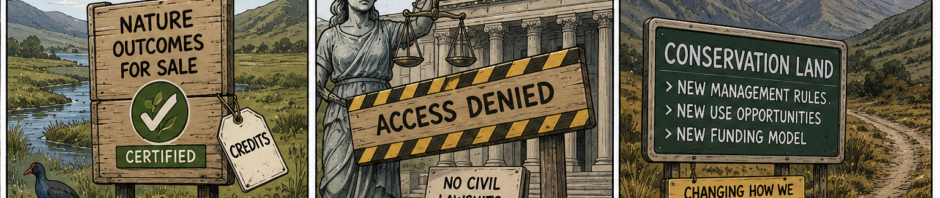
A series of recent announcements has brought environmental policy into sharper focus. A voluntary carbon market framework, changes to climate litigation, and a proposed overhaul of conservation management have all emerged within a short period. Each has been presented on its own terms, often with different objectives. Taken together, they point to a broader shift in how environmental decisions are structured.
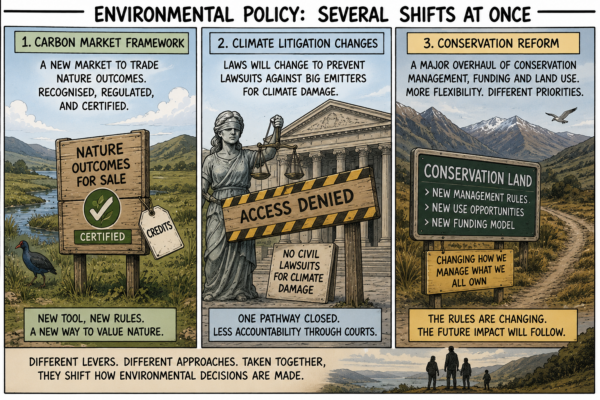
The proposed carbon market introduces a new mechanism for recognising and trading environmental outcomes. At the same time, legislative change removes a legal pathway for pursuing claims against emitters through the courts. Alongside this, the Conservation Amendment Bill reshapes how conservation land is managed, including changes to planning, funding, and land use. These are distinct proposals, but they operate within the same system.
Combined, these changes expand the role of administrative and market-based mechanisms while narrowing the role of judicial oversight. Decision-making becomes more centralised within defined frameworks, and the pathways through which decisions can be challenged or reviewed are altered. That may improve efficiency and provide greater certainty in some areas, but it also changes how accountability is exercised.
This pattern is not new. Environmental management has increasingly relied on structured systems, whether through markets, regulation, or centralised decision-making. Each approach has its place, but the balance between them shapes how decisions are made and how visible they are. Shifts in that balance tend to emerge gradually, rather than through any single policy change.
Natural resources are held in trust for the public, and their management depends on systems that remain visible, accountable, and durable over time. Where those systems evolve, the way decisions are made evolves with them. The effect is not always immediate, but it becomes evident through how the framework is used in practice.
This is not about any one proposal in isolation. It is about how several changes, occurring together, reshape the structure within which environmental decisions are made.
Wake up New Zealand. The current coalitions donors are hell bent on taking from you everything your forefathers thought they were working and fighting for. Get your heads out of the sand. Tell the politicians that it’s time to pause for a cup of tea, a scone, and a change in direction or we will vote ALL of them out!!!
The Ministry for Environment is to be abolished. Yes it’s been bureaucratic and lethargic. But that’s the fault of a succession of ministers of Environment. Anyone of them could have given the ministry a shakeup.
So could director generals of the ministry. Inefficient.
That’s no reason to chuck it out. A revitalised, alert Ministry of Environment is very much needed in the face of Philistines like Jones and Bishop.
Probably those two environmentally insensitive, arrogant MPs conceived doing away with ministry?