A proposal to reroute part of the Tasman Great Taste Trail along a paper road has highlighted a familiar tension between public access and private land use. The route, following storm damage to an existing section, would pass through working farmland. Objections from affected landowners have focused on disruption to stock, operational difficulty, and safety concerns. At the same time, the route relies on land that is legally available for public use.
Paper roads are a long-established feature of New Zealand’s land system. They exist on maps whether formed or not, and they carry with them a public right of passage. In many cases, these routes have seen little active use, particularly where they pass through private farmland. That has allowed adjoining landowners to incorporate them into farm operations over long periods.
Land composing paper roads has often been used informally by neighbouring landowners for extended periods, including grazing and day-to-day farm operations. That use has generally gone unchallenged where public access has been minimal or infrequent. As recreational use increases and access is exercised more actively, that long-standing arrangement comes under pressure. The issue is not the existence of access rights, but how those rights are applied in a way that recognises both public entitlement and practical impact.
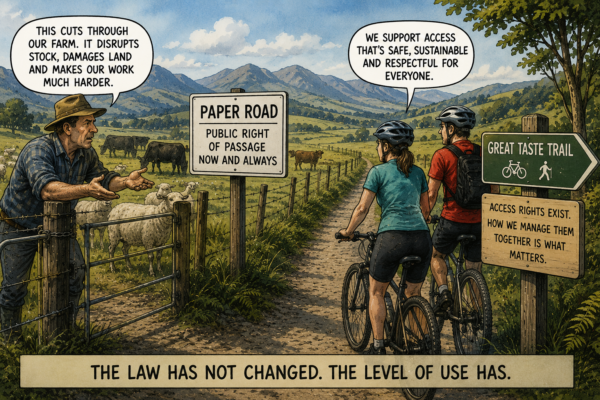
The current proposal reflects that shift. Recreational demand for off-road cycle trails is growing, and routes that avoid traffic are increasingly preferred. Where those routes intersect with working land, the interaction becomes more direct. Fencing, gates, and alignment adjustments can reduce impact, but they do not remove it entirely.
This pattern is not unique to one trail. Across the country, increasing use of public accessways is bringing greater attention to land that has long been treated as effectively private in practice. The legal position has not changed, but the level of use has, and that changes how the system operates.
Public access remains a core principle, particularly in a country where outdoor recreation is widely valued. At the same time, the exercise of that access carries consequences where it intersects with working land. Managing that balance requires more than relying on legal rights alone.
This is not a question of whether access should exist. It is a question of how it is applied in a way that recognises both its value and its impact.
Many years ago now, a group from Upper Hutt known as ARAC had to fight long and hard in the Environment Court to retain access on a “Paper Road” known as Johnsons Road. Well done guys.
The photo shows the ringleaders removing a fence erected deliberately by the landowner to block access. Cops agreed it was lawful, despite landowners objections. Johnsons Road (the paper road) runs through hobby farms not agricultural land!
The Environment Court Decision is here: https://www.arac.org.nz/download/decision.pdf
Once a road, always a road. An old maxim that landowners should remember. They have had free use, free grazing, free agriculture – in some instances even free land to grow trees – yet pay no rates on the road. Now its payback time – that land is not theirs, never has been, never will be.