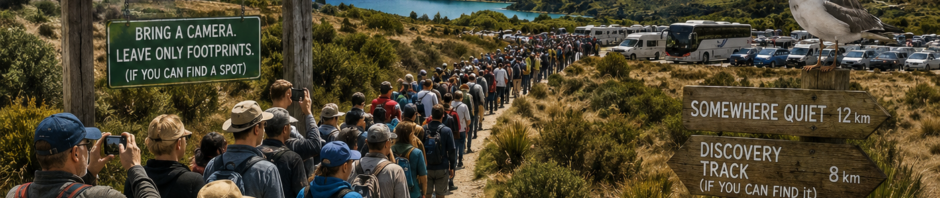
New Zealand ranks among the most peaceful countries in the world (actually 2nd behind Iceland ~ed). The Global Peace Index places it near the top based on low levels of conflict, high social stability, and a strong sense of public safety. That ranking reflects the strength of institutions and the relative absence of the pressures seen elsewhere. It also creates a set of conditions that are not universal.
What changes with that level of stability is opportunity. A peaceful environment supports tourism, outdoor recreation, and a way of life centred on access to land and water. It allows people to move freely, to use public spaces with confidence, and to engage with natural environments without the constraints found in more heavily conflicted regions. Taken together, these factors form part of New Zealand’s identity and appeal.
This also shapes how the country is perceived externally. Visitors are drawn not only by scenery, but by the experience of safety and openness. Investment, where it occurs, is often linked to that same perception of stability. These are advantages, but they depend on more than reputation. They rely on the continued condition of the environments that underpin them.
This creates a point of tension. The qualities that make New Zealand attractive are closely tied to its natural systems and public access. Pressure on those systems, whether through increased use, infrastructure strain, or competing demands, can begin to erode the very attributes that define the experience. Individually, these pressures may appear manageable. Taken together, they affect how the country is both used and understood.
A peaceful society is not defined only by the absence of conflict. It is also reflected in how shared resources are managed and how competing uses are balanced. Public land, water, and coastal environments carry both economic and social value. Decisions about their use must account for both, particularly where long-term effects are involved.
This is not about the ranking itself. It is about what sits behind it and what sustains it over time. The issue is not whether New Zealand is seen as peaceful, but whether the conditions that support that perception are maintained as pressures increase.
The full article is here
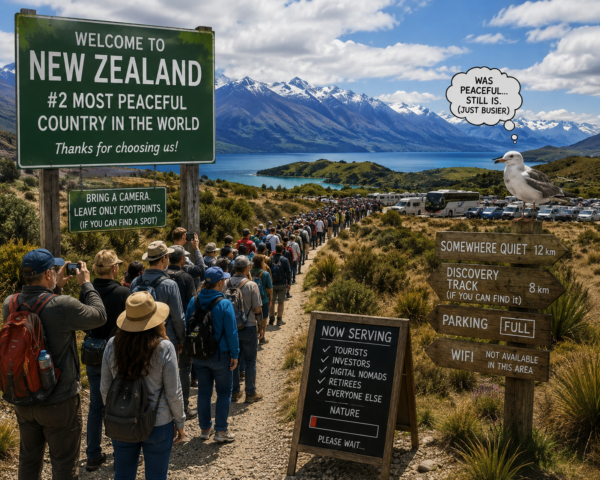
Which makes it all the more insane that we are importing so many people from the third world who bring with them their alien cultures and hostilities. Import the third world, become a third world country.
Absolutely .. the three biggest threats to how New Zealand is ranked in terms or safety .. are (1) organised crime; (2) drugs, and drug criminality; and (3) immigration.
These three are all highly linked.
The first thing people want to do, when they have assets and a lucrative business, is protect them. The rest of us do so with mechanisms such as insurance, and rely on the police to enforce laws to protect our property rights.
Organised crime cannot rely on the police .. because of the obvious, illegal nature of their activities. So they must provide their own protection.
It’s not rocket science.
One aspect that is not reflected in this ranking .. is how protected people in New Zealand are, from the impact of heinous drugs, like methamphetamine.
Sweden has had a crackdown on gangs, gang criminality, and drugs .. which has included a crackdown on immigration (demonstrating the link) .. and this has resulted in a reduction in firearms-related crime, and homicides.
In Switzerland, anyone over 18 can apply for a firearms permit, with the exception of people with a criminal record ..”and nationals of certain countries listed as sensitive by the authorities” (again, demonstrating the link between immigration, and its impact on public safety).
Night follows day. If we want to experience the societal deterioration and unrest being seen in other countries of the world (eg the UK, Ireland, the U.S., and many countries in Europe) .. then we should maintain the current “she’ll be right” approach to Immigration. “Let,’em in, and she’ll be right.”
Everything will sort itself out.
Well .. it won’t.
It is demonstrably unrealistic to expect people to come to New Zealand .. from countries that variously may have dysfunctional societies, vastly different laws (indeed relative lawlessness), and whose cultures clash with our own .. and expect them to assimilate without serious problems.
Immigration
Failed immigration policies, overseen by shinybums (eg politicians and bureaucrats) has led to massive problems oversees.
New Zealand must take a different path .. if it wants a different outcome.
Immigration requires *effective* resourcing.
Otherwise, police just become the ambulance at the bottom of the cliff.
Where policy settings, and immigration resourcing, are poor .. without a shadow of a doubt .. immigration is linked to increases in organised crime, drugs, and drug criminality.
New Zealand has a large and growing problem with drugs, partiviiarly methamphetamine. This is like a cancer, threatening our safe society.
In order to protect our high ranking as a safe country .. our shiny bums need to get their act together .. and keep it together.
NZ is safer than Switzerland? Who are they trying to kid? Never heard of any Swiss mosque being attacked, no Swiss motorists killed by kids fleeing the cops high on drugs. In NZ we have far too much fatal family violence and even the odd public display of violence.