
The recent approval of a major housing development at Ōrewa has highlighted an important planning principle that extends well beyond one subdivision. During the first stage of the development, treated wastewater may be transported off-site under defined circumstances until a permanent solution is established. The independent expert panel has been careful to explain that it has not approved unrestricted or indefinite wastewater tankering. Nevertheless, the proposal raises a broader question about the role of temporary infrastructure in long-term planning.
Temporary arrangements are often both sensible and necessary. Construction projects frequently rely on interim roads, temporary utilities or staged infrastructure while permanent works are completed. Used appropriately, they allow development to proceed without waiting for every element to be finished before the first home is occupied. There is nothing inherently wrong with that approach.
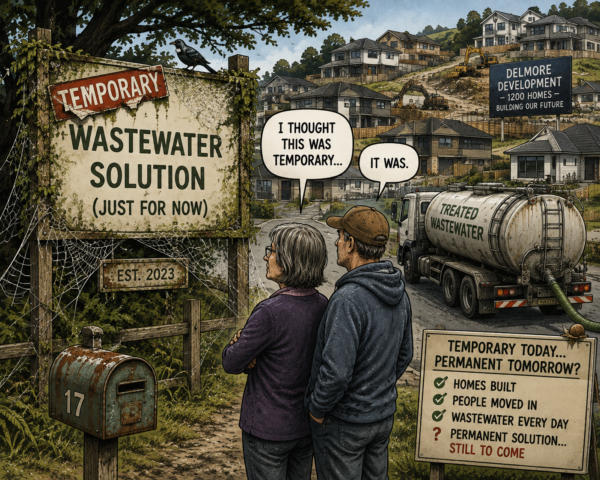
The challenge begins once people move in. Homes generate wastewater every day. Families cannot simply pause essential services while infrastructure catches up. If permanent disposal systems are delayed for financial, technical or regulatory reasons, the temporary solution cannot simply stop. It must continue until something better is available.
This changes the nature of the temporary arrangement. What begins as an interim measure gradually becomes essential infrastructure because there is no practical alternative. The larger the community becomes, the more difficult it is to replace the temporary system without significant disruption. Over time, “just for now” can quietly become “this is how we do it.”
That is why good planning has traditionally sought to secure permanent infrastructure before large-scale development reaches full occupancy. Roads, water supply, wastewater, stormwater and other essential services are not optional extras. They are fundamental components of a functioning community. Temporary measures may help bridge the gap, but they should never become a substitute for completing the permanent solution.
The issue is not whether treated wastewater can be transported safely under carefully controlled conditions. The expert panel has determined that, in specific circumstances, it can. Nor is this an argument against new housing or against practical staging of major developments. New Zealand needs both.
The more important question is whether planning systems create sufficient incentives to complete permanent infrastructure once a temporary arrangement is already working. Once hundreds of families depend upon an interim solution every day, the pressure to simply continue becomes considerable. The temporary system acquires a momentum of its own.
Good planning looks beyond today’s consent to tomorrow’s reality. Temporary solutions have an important place in modern infrastructure, but only when they remain genuinely temporary. Communities deserve confidence that the essential services they rely upon are designed not merely to get a development started, but to support it safely and sustainably for generations to come.
One of the ongoing problems in past developments is that they never planned for the future, it has always been for the, now, wastewater is still an ongoing problem in many areas throughout New Zealand, the Bays on the Northshore in Auckland are a good example of poor planning which still sees raw sewerage spilling into the harbour.