Somewhere between childhood and midlife, play becomes something we apologise for.
We replace spontaneity with busyness. We trade imagination for obligation.
Recent research suggests this is not progress. Adults who engage in playful activity cope better with stress, report higher life satisfaction and show greater resilience in the face of challenge.
Play, it turns out, is not childish.
It is foundational.
Outdoor recreation has quietly embodied that principle for generations.
What Adult Play Actually Looks Like
Play in adulthood is not necessarily toys or games.
It is:
- Curiosity without fixed outcome.
- Movement for its own sake.
- Exploration without performance pressure.
- Shared effort without formal structure.
That describes much of what happens outdoors.
Casting a line not because it is efficient, but because it is absorbing.
Balancing across river stones simply because the footing demands attention.
Choosing a longer route because the view is better.
There is no scoreboard. There is no feed to curate.
There is engagement.
Stress Does Not Survive Engagement
Research suggests playful adults regulate stress more effectively.
Outdoor activity produces that reset naturally.
You cannot scroll while negotiating a steep descent.
You cannot multitask while launching a kayak into crosswind.
You cannot remain abstract while reading a river current.
Attention narrows. Pressure disperses.
This is not escapism. It is recalibration.
Skill and judgment are essential. So is mental space.
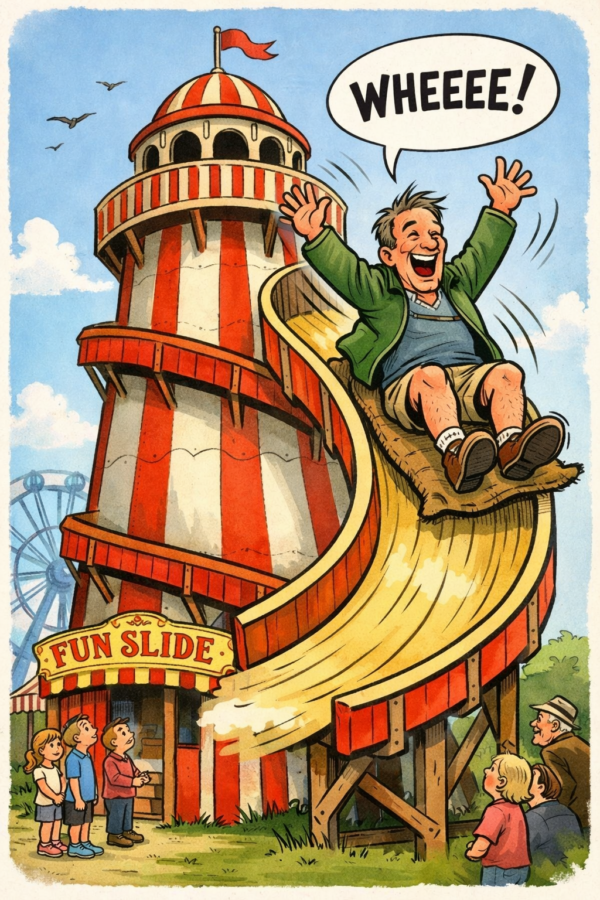
Play Cuts Across Age
One of the strongest findings in play research is that it dissolves hierarchy.
Age and status matter less when people engage in shared activity.
Outdoor recreation does this without ceremony.
A grandparent teaching a child to tie a knot.
Friends laughing at a missed cast.
Strangers sharing track conditions.
The interaction is reciprocal.
Stewardship and use can coexist.
So can seriousness and play.
We Already Have the Infrastructure
The article suggests cities should embed playful design into public space.
In New Zealand, much of that infrastructure already exists in another form:
Tracks that invite exploration.
Riverbanks that reward curiosity.
Coastal margins that demand balance.
Bush that encourages imagination.
Outdoor recreation does not announce itself as “play”.
It simply allows it.
Access matters.
If public land narrows, opportunities for unstructured adult play narrow with it.
Public resource, public responsibility.
Play Is Not Indulgence
In adult life, play is often framed as a luxury.
The research suggests the opposite.
Play supports emotional regulation, resilience and social connection.
Outdoor recreation delivers those outcomes without branding them as therapy.
It embeds them in habit.
You do not attend a session.
You go outside.
A Cultural Asset Worth Protecting
Modern life is structured and scheduled.
Outdoor recreation remains one of the few domains where outcome is not always the primary driver.
You may return with fish.
You may not.
You may reach the summit.
You may turn back.
The value lies in engagement.
In a world that rewards productivity, the outdoors still rewards participation.
That distinction matters.
The Quiet Conclusion
Adults do not outgrow play.
We outgrow permission.
The evidence is increasingly clear: maintaining playful engagement supports wellbeing across the lifespan.
Outdoor recreation has always provided that permission.
Provided access remains intact.
Movement without metrics.
Challenge without performance.
Shared experience without hierarchy.
Adults need to play.
The outdoors has been offering that invitation all along.