
Rangitoto rises from Auckland’s Waitematā Harbour as a singular form: broad-based, symmetrical, and unmistakably volcanic. Visible from much of the city, it appears close and familiar, yet remains separate in character and experience.
Access is straightforward. Engagement is not.
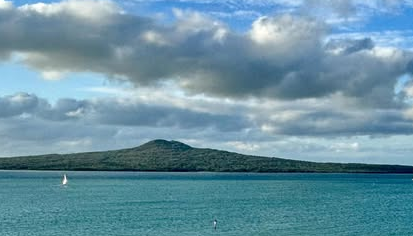
The island
Rangitoto is the youngest and largest volcano in the Auckland volcanic field, formed approximately six centuries ago. In geological terms it is recent; in human terms, long settled into stillness. Its lava fields, thin soils, and slow vegetation growth give the island a raw, unfinished appearance that sets it apart from older landscapes.
That youth defines much of what follows.
Reaching Rangitoto
Most visitors arrive by ferry from central Auckland. The crossing is short and predictable, allowing the island to be visited within a single day. In that sense, Rangitoto offers a form of access that does not depend on distance travelled or extended absence from daily life.
However, once ashore, the nature of access changes.
Effort on land
Unlike some smaller harbour islands, Rangitoto is not well suited to brief or static visits. Its terrain is rough, uneven, and largely exposed. Walking is the primary means of engagement, and even short distances demand attention.
The island’s main tracks lead upward toward the summit, reinforcing the idea that movement - and effort - are central to the experience. Footing on lava rock can be tiring and unforgiving. Shade is limited. Weather conditions have a direct and immediate impact on comfort and safety.
This is not incidental walking. It is deliberate.
What Rangitoto requires
Rangitoto asks visitors for:
- sustained walking ability
- tolerance for uneven, abrasive surfaces
- careful attention to weather and heat
- sufficient time to move without rushing
These requirements do not make the island inaccessible, but they do make it selective. The experience is shaped less by transport and more by physical capacity once on land.
That distinction matters.
Choice, not obligation
Rangitoto is often spoken of in terms of summits and achievement. Yet nothing on the island requires completion. The value of the place does not lie in reaching a particular point, but in engaging with a landscape that is direct, exposed, and uncompromising.
Visitors are free to turn back, pause, or limit their engagement to what suits their capacity. The island does not reward haste, and it does not diminish those who choose restraint.
Who this place suits
Rangitoto is best suited to people who:
- enjoy sustained walking as an end in itself
- are comfortable with rough terrain
- value scale and geological presence
- are prepared to manage exposure and fatigue
It is less suited to:
- short time windows
- limited mobility
- casual stopping without walking
Recognising that distinction allows the island to be approached honestly rather than idealised.
Why Rangitoto belongs in “Places”
Rangitoto earns its place in this series because it represents a different model of access: easy to reach, demanding to engage.
In contrast to places where transport enables inclusion, Rangitoto demonstrates that proximity does not guarantee ease, and that accessibility can shift sharply once effort is required.
Understanding that distinction helps people choose places that align with their capacity and intent, rather than expectation alone.
A place defined by restraint
Rangitoto does not need embellishment. Its scale, youth, and terrain speak clearly. It is not softened by convenience, nor diminished by selectivity.
As with all places worth attention, its value lies not in how many people go there, but in how it asks to be approached.
Note on perspective
This entry reflects Rangitoto as understood through documented history, geography, and observed use rather than personal experience. It is included here to illustrate how access, effort, and proximity intersect - not to recommend or rank the place.
Getting there
Rangitoto Island is accessed by ferry from central Auckland, departing from the Downtown Ferry Terminal on the city waterfront. The crossing is relatively short and weather-dependent, and services are typically operated by commercial ferry providers under DOC conditions.
Ferries land at Rangitoto Wharf, from which all on-island movement is on foot. There is no vehicle access for the public. Visitors are required to comply with strict biosecurity controls before boarding, reflecting the island’s protected status.
Because return services operate to fixed timetables, time on the island is defined by ferry availability rather than personal pace. This makes planning and self-assessment important, particularly given the effort required once ashore.