
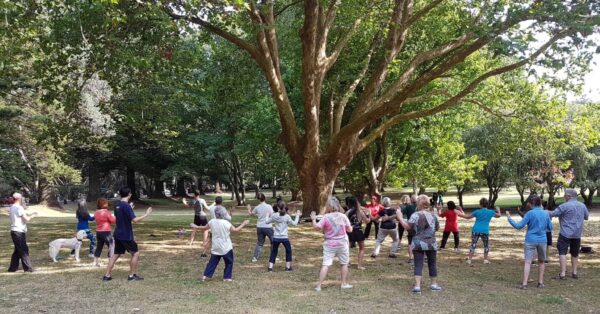
Tai chi is a slow, controlled movement practice that combines balance, posture, breathing, and awareness. In New Zealand it is commonly practised outdoors, using public parks, reserves, waterfronts, and town green spaces rather than purpose-built facilities.
For many participants, the outdoor setting is not incidental - it is part of the activity.
How people actually do it
Outdoor tai chi is usually:
- Practised in small groups
- Led by an experienced practitioner or teacher
- Slow, quiet, and non-competitive
- Done in ordinary, comfortable clothing
- Practised for 30–60 minutes at a time
Sessions are often held in the morning, when parks and waterfronts are calm and lightly used, but some groups meet later in the day depending on season and location.
People commonly join casually, attend when they can, or observe before participating.
Where it happens
Tai chi is typically practised:
- In public parks and reserves
- On flat grassed areas
- Along waterfronts and harbours
- In town belts and urban green spaces
- Near suburbs and town centres
Suitable places tend to share a few characteristics:
- Level ground
- Open space
- A sense of calm
- Easy access without barriers
These are places designed for shared public use rather than specialised activity.
Access realities
Outdoor tai chi relies on:
- Open public space
- Predictable access at regular times
- The ability to gather without booking or infrastructure
- Quiet corners within otherwise busy places
When access is restricted - through closures, loss of open space, or increasing exclusion - groups often have to move or disband, even though the activity itself leaves little trace.
Shared use
Tai chi groups typically share space with:
- Walkers
- Dog walkers
- People sitting or passing through
- Other informal park users
Because the practice is slow and contained, it usually coexists easily with other activities. Courtesy is simple and informal: choosing appropriate locations, avoiding bottlenecks, and remaining aware of others.
Who this suits
Outdoor tai chi suits:
- Older adults
- People returning to movement after illness or injury
- Those seeking balance and coordination
- People who prefer calm, non-competitive activity
- Anyone who enjoys being outdoors without exertion
Many people practise tai chi for years without changing location, increasing intensity, or seeking progression.
Learning and participation
Some people begin tai chi through:
- Local classes that move outdoors
- Community groups meeting regularly in parks
- Word of mouth and observation
Others simply watch at first, join partway through a session, or return another day. Participation is typically welcoming and flexible, with no expectation of commitment.
Finding a local tai chi group
Outdoor tai chi groups in New Zealand are often informal, lightly organised, and long-running, which means they don’t always advertise widely. Most people find them through a mix of observation, local networks, and simple searches.
1. Look in familiar public spaces
Many groups meet:
- In the same park or reserve each week
- At consistent times (often mornings)
- In visible but quiet locations
If you regularly walk in a park or along a waterfront, you may simply come across a group in practice. Watching quietly from a distance is normal, and groups are usually open to questions afterwards.
2. Use local online groups
A common starting point is local community pages on Facebook, particularly:
- Town or suburb community groups
- “What’s on” or “community activities” pages
- Local wellbeing or seniors’ groups
Searching for “tai chi” plus the town or suburb name will often turn up informal listings or past posts.
3. Community noticeboards and centres
Many groups share information through:
- Community centres
- Libraries
- Recreation centres
- Council-run noticeboards
These are often low-key flyers rather than formal advertising.
4. Word of mouth and observation
Tai chi groups frequently grow through:
- Friends inviting friends
- People joining after watching several sessions
- Casual conversations in shared spaces
It’s common for people to attend a few times, pause, and return later.
5. Expect flexibility, not formality
Outdoor tai chi groups typically:
- Don’t require bookings
- Don’t expect long-term commitment
- Allow people to join or leave quietly
- Welcome observers
If a group doesn’t feel like the right fit, there are often others nearby with a different pace or style.
A simple way to begin
For many people, the easiest approach is:
- Notice a group in a park or reserve
- Observe from nearby
- Ask politely after a session if newcomers are welcome
- Try a session without pressure
Comfortable clothing and curiosity are usually all that’s needed.