
Guest Post by Andi Cockroft, Chair, CORANZ
1. The Government’s Announcement
In mid‑2025 the New Zealand Government announced a sweeping shake‑up of local government: elected regional councils are to be abolished. In their place will be newly created Combined Territories Boards (CTBs), made up of the mayors from each city and district across a region. In some cases these boards may also include Crown‑appointed commissioners, with options for veto — or even majority — control over decisions.
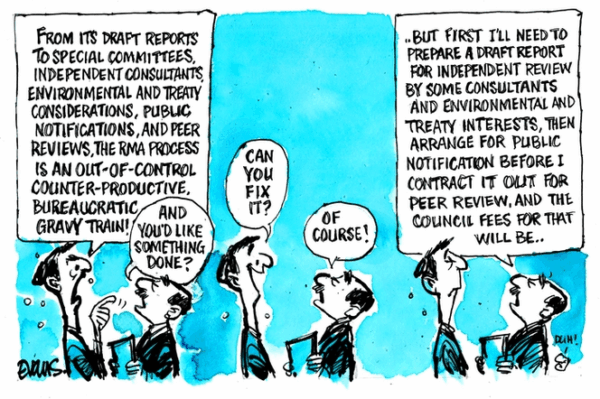
Who would have thought 11 years ago this cartoon would be so prophetic
These CTBs will take over the functions currently held by regional councils. They will also write the new “natural environment” and “spatial planning” chapters under the Government’s RMA replacement law, and within two years they must propose how local government in their region will be permanently reorganised.
For many in the outdoor recreation and angling communities, the first reaction is simple: about time. Regional councils have often failed rivers and recreation. But the real question is not whether regional councillors should disappear. The real question is:
Who will now act as the referee for our rivers?
2. Regional councils: why anglers won’t mourn them
It would be dishonest to pretend that regional councils have served freshwater interests well. In many parts of the country, they have not.
The clearest example is the Rakaia and its Water Conservation Order (WCO). Despite the Rakaia holding one of the strongest statutory protections available in New Zealand law, the regional council argued in court that while it had to apply the WCO when granting consents, it did not have a wider duty to enforce the protection the WCO was supposed to guarantee.
In other words: the council helped write the rules, but then argued it was not truly responsible for making sure those rules were honoured in practice.
Only after action taken by environmental and recreational interests was the legal responsibility clarified. Even then, the outcome revealed a broken system – one in which:
- The Minister has an overarching monitoring duty for WCOs
- Regional councils only enforce the conditions of specific consents
- No one body is clearly responsible for defending the river as a living system
Add to this the many other failures anglers and outdoor users have observed:
- Weak or inconsistent enforcement against polluters
- Tolerance of over‑allocation in stressed catchments
- Heavy influence from commercial and political interests
- Statements of concern not matched by decisive action
Given this history, members are not inclined to shed a single tear over the disappearance of regional councils.
But anger at failure is not the same as confidence in what comes next.
3. The replacement model – and why it matters
Regional councils are not simply being abolished. They are being replaced by a political governance model based on mayors, supported – or controlled – by central government.
Under the proposal:
- All mayors in a region will sit on the CTB
- CTBs will control environmental planning and management at the regional level
- Crown commissioners may sit on the boards, with veto powers or even majority voting power
- There will be no elected regional councillors at all
- There will be no Māori or general regional constituencies
At first glance, this may look like a cost‑saving or simplification exercise. But from the perspective of river protection it raises several serious red flags.
First: most mayors campaign on growth, development, and keeping rates low. Water protection often conflicts directly with those goals. Now the same people driving development approvals may also be the ones expected to restrict or regulate them.
Second: inland waterways do not respect district boundaries. Rivers are catchment‑wide systems. A mayor focused purely on conditions inside their own district is not naturally positioned to think in true catchment terms.
Third: Crown commissioners sitting on boards with veto or majority powers moves decision‑making further away from the people who actually use and care for the rivers. That is not “localism”. It is centralisation in disguise.
Fourth: the removal of dedicated regional representation means there is no longer anyone elected specifically to take a regional environmental view. Everything is filtered through mayors whose primary loyalty is to ward politics and local economic pressure.
This is not just an administrative change. It is a change in who gets to speak for the rivers.
4. Why this matters for recreation and freshwater fisheries
For anglers, paddlers, swimmers, trampers, hunters and outdoor families, the risks are very real.
If the proposed system fails, the outcomes will likely include:
- Weaker enforcement of water quality standards
- Greater pressure to approve water takes and discharges
- Reduced seriousness around maintaining minimum river flows
- Increased conflicts between local economic interests and long‑term ecological health
- Less ability for recreation groups to influence decisions before damage is done
High‑value fisheries require three things:
- Clean water
- Stable, adequate flows
- Strong protection from cumulative harm
Without an independent, competent and legally responsible referee, those three things slowly disappear.
International angling visitors do not care about council structures or political reforms. They care about one thing: the quality of their experience. If our rivers are muddied, over‑extracted or polluted, they will go elsewhere.
At roughly $340 per angler‑day, those visitors are worth far more per person than the average tourist. When the river loses, rural communities lose with it.
5. If not regional councils… then what?
We do not need to defend the old system. But we must be clear about what the new system must include.
Any replacement for regional councils needs to meet at least these tests:
a) One body with a clear, non‑negotiable duty to protect rivers and enforce WCOs
No more confusion. No more buck‑passing. WCOs must be directly enforceable by a clearly identified authority, with funding and teeth.
b) Independence from development pressure
The same people who gain politically and financially from growth cannot also be the final judge of its environmental cost. Separation of powers matters.
c) True catchment‑based management
Rivers must be managed as whole systems, not chopped up along arbitrary district lines.
d) Transparency and access for the public
Recreation groups must retain the right to submit, challenge, and participate in environmental decisions. This should be expanded, not reduced.
e) Retention of technical expertise
Regional council scientists, hydrologists and compliance officers are critical assets. Their functions must not be lost in a political restructure.
If these elements are not guaranteed, then the reform will represent another step backwards, even if it feels satisfying to see familiar buildings empty.
6. Reform should mean strength, not silence
There is nothing wrong with saying regional councils failed. In some areas they clearly did.
But anger alone is not a strategy. Replacement must be better — not just quieter, cheaper or more convenient for Wellington.
For decades, New Zealand has prided itself on wild rivers, healthy fisheries and backcountry access that does not exist in most industrialised countries. That reputation has already suffered damage in some areas. This reform process could either:
- Be the start of genuine renewal and protection, or
- Become the moment when effective guardianship finally disappears
If the rivers lose their referee, every other outdoor value will be next.
7. The position we can take
This is not a political stance. It is a practical one.
You can say, very simply:
We will not defend failed institutions.
But we will defend our rivers.
We support reform only if it results in:
- Stronger protection of freshwater
- Clearer enforcement responsibilities
- Greater transparency and participation
- Real penalties for damage and non‑compliance
Otherwise, “simplification” is just another word for surrender.
Clean rivers and streams and lakes was the number one issue in voters’ minds at the 2017 election. Consequently Labour promised a clean up and restoration of waterways. It never happened. A broken promise.
The issue is still strong but has been overshadowed by cost of living, the mismanaged economy, crime etc.,. People still want clean, flowing rivers.
Labour fiddled with doing something about rivers and minister David Parker and agriculture minister Damien O’Connor got their heads together but went nowhere.
National in coalition became government and unleashed NZ First’s Shane Jones and National’s Chris Bishop on the “dog chasing its tail” course of growth and more growth, despite the country bogged down with a debt that has spiralled upwards under the Key government’s mismanagement.
The panic stricken scramble for more economic growth has resulted in undemocratic, dictatorial snub to the environment (and rivers) in the Fast Track Approval Bill. Ego-inflated Jones and Bishop are at the wheel.
The outlook for the environment and rivers is bleak. It must become a major public concern again.
I noticed Frank Henry’s response and reference to the economic mismanagement by John Key. It was all smoke and mirrors with Key claiming NZ was a “rock star” economy.
By 2016 when Key resigned —-household debt, (excluding investment property) had climbed to a historic $163 billion dollars!
Labour similarly borrowed and overspent plunging NZ further into debt.
The point is a bankrupted economy means politicians get even more fixated on growth at all costs, and among the costs is a deteriorating environment. Key ‘s sacking of ECan (Nick Smith an accomplice by the way) was undemocratic and opened the way for corporate dairying and more irrigation. The state puppets then on ECan council obeyed Key’s bidding and opened the gates for corporate dairying to flood in. More irrigfation, more nitrate contamination.
And John Key was knighted.
Politicians continually make the mistake of thinking that the problems with the RMA can be corrected by re-writing the legislation and re-organising Councils. How many taxpayer millions have been wasted doing this? No – the problems lie with the Council staff and other bureaucrats who administer the RMA. Most of them are at least 2 of the following: lazy, woke, self-serving and/or stupid. The RMA has spawned an out of control bureaucracy in local government. The Ministry for the Environment (MfE) was supposed to act as the overseer of the RMA, monitoring Council behaviour, providing advice and getting involved when things went bad. None of this happened, because the MfE bureaucrats are just as lazy/woke/self/serving/stupid as their Council counterparts.
What guarantee is there that a group of mayors will have an environmental awareness and a sense of duty to the public interest? In my district a succession of mayors have been weak and ineffective and self-serving in one case.