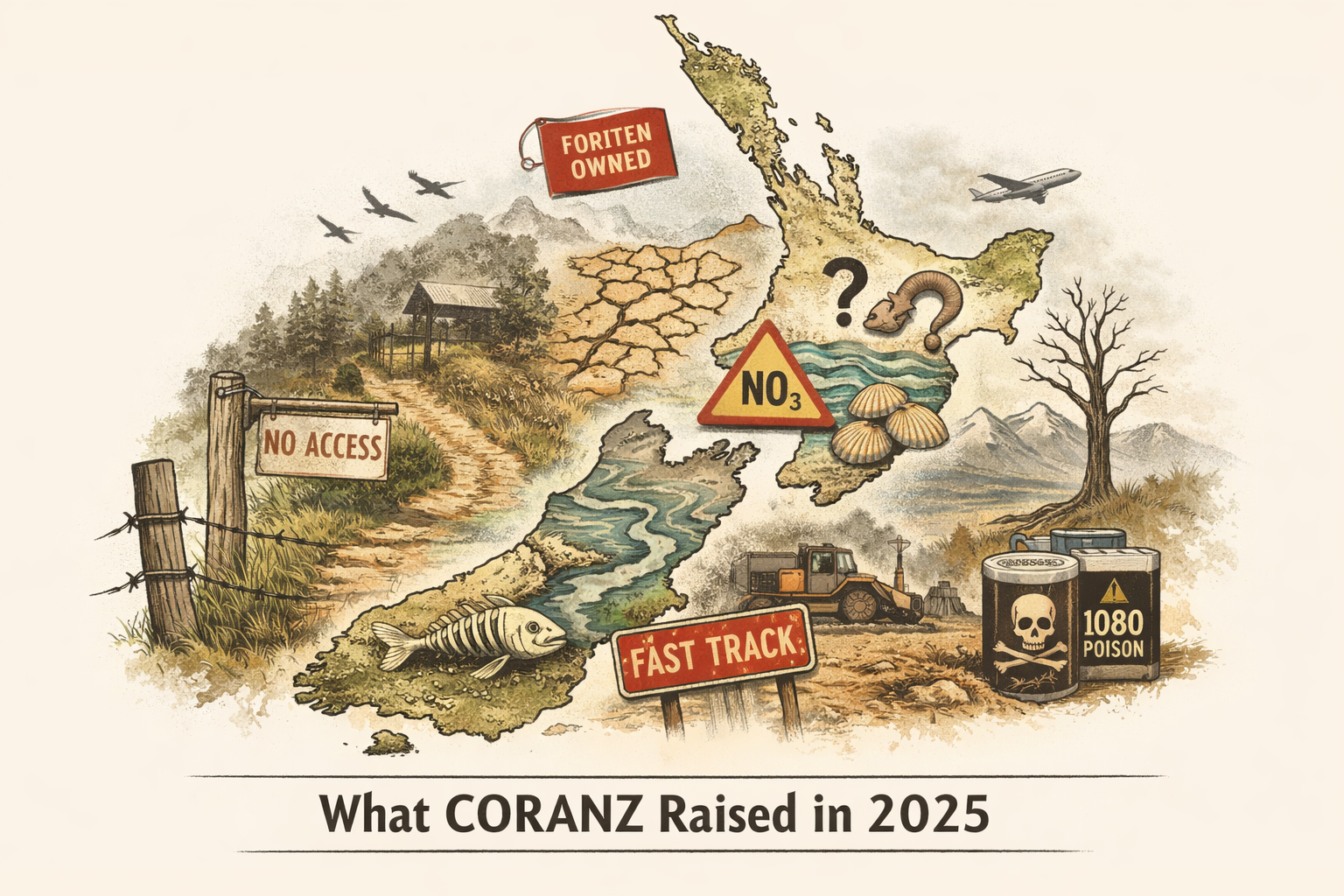
The value of advocacy is not measured by volume, but by consistency. Over the course of 2025, CORANZ published more than a hundred posts addressing land access, environmental stewardship, governance, and the long-term interests of outdoor recreation. Taken individually, those posts responded to specific events. Taken together, they form a coherent record of concern - and of warning.
This review does not attempt to revisit every post. Instead, it asks a simpler question: what did CORANZ repeatedly raise in 2025, and what picture emerges when those themes are viewed as a whole?
The answer is both consistent and instructive.
Access: the slow, quiet loss
One of the most persistent themes in 2025 was the gradual erosion of recreational access to land and water. Rarely dramatic, rarely headline-grabbing, access loss tends to occur incrementally: a gate closed here, a track reclassified there, a waterway deemed unsafe, a landholding sold to an owner unfamiliar with New Zealand’s access traditions.
CORANZ posts repeatedly returned to the same underlying concern: access in New Zealand has relied too heavily on goodwill, and goodwill is increasingly strained by legal liability, commercial pressure, biosecurity rules, and absentee ownership.
The result is not a single policy failure, but a cultural shift. Where access was once assumed unless clearly prohibited, it is now often denied unless expressly granted. That inversion matters. Once access is lost, it is rarely restored.
Environmental decline as an access issue
A second, closely linked theme was the recognition that environmental degradation and access loss are not separate problems. They reinforce one another.
Across freshwater, coastal, and terrestrial environments, CORANZ consistently highlighted how declining ecological health reduces public use. Rivers affected by nitrates or sedimentation become unsafe or unattractive. Coastal habitats smothered or degraded lose the species that draw fishers, divers, and families. Forests affected by poor pest control or inappropriate management lose both biodiversity and recreational value.
In 2025, CORANZ’s position was clear: you cannot preserve access to degraded environments, because people withdraw long before gates are locked.
Freshwater: evidence no longer in dispute
Freshwater issues featured heavily throughout the year, particularly nitrate contamination and the cumulative effects of land-use intensification.
What changed in 2025 was not the existence of the problem, but the quality of evidence. Long-term groundwater monitoring, national studies of private bores, and council data made it increasingly difficult to dismiss nitrate pollution as uncertain, localised, or speculative.
CORANZ posts avoided alarmism, but they were firm on one point: policy cannot continue to rely on reassurance where trends are demonstrably negative. Incremental mitigation without enforceable limits has not reversed groundwater decline. Continuing to present it as sufficient risks locking in permanent loss.
Governance and the “too-hard basket”
Another strong thread through 2025 was frustration with institutional reluctance to act where issues are complex, politically uncomfortable, or slow-moving.
Whether the subject was freshwater limits, marine biosecurity, or land-use planning, CORANZ repeatedly noted a tendency for agencies to defer action when certainty is incomplete or solutions are imperfect. Problems are acknowledged, studies commissioned, and time allowed to pass.
The parchment worm issue in the Marlborough Sounds exemplifies this pattern. Even where ecological harm is evident, uncertainty about origin or control tools becomes grounds for inaction. CORANZ questioned this logic directly: impact, not taxonomy, should guide response.
Environmental management has never required perfect knowledge. It requires judgement.
Native status is not a veto
Related to this was a broader challenge to the idea that “native” status should confer immunity from management.
CORANZ posts in 2025 pointed out that New Zealand already manages native species where impacts justify it. Native birds are controlled around airports. Native fish are excluded from sensitive habitats. Native vegetation is managed where it threatens infrastructure or ecological balance.
To argue that a species cannot be managed solely because it is native is inconsistent with existing practice. Stewardship is not abandonment, and protection does not require passivity.
Overseas ownership and cultural disconnect
Land ownership patterns featured repeatedly, particularly the effect of overseas ownership on access. CORANZ did not argue that foreign ownership is inherently malign. Rather, it observed a recurring outcome: owners arriving from jurisdictions without a tradition of public access tend to prioritise exclusion, liability avoidance, and commercial control.
The consequence is not always deliberate restriction. Often it is simply unfamiliarity with New Zealand norms. But the effect is the same: loss of access, loss of shared space, and a weakening of the informal arrangements that once defined rural recreation.
2025 posts consistently called for access to be treated as a public interest, not a courtesy.
Apolitical, but not neutral
One of CORANZ’s defining positions in 2025 was its insistence on remaining apolitical while refusing to be silent.
This distinction matters. CORANZ did not endorse parties or candidates. It did not frame issues through ideology. But it did speak plainly where policy choices affected land, water, and access.
That stance attracted criticism from some quarters - usually from those who equate criticism with partisanship. The year’s body of work makes clear that CORANZ’s concern is not who governs, but how decisions are made and whose interests are weighed.
What the year reveals when taken whole
Viewed as a single body of work, CORANZ’s 2025 output reveals a consistent message:
• Access is declining, quietly and cumulatively
• Environmental degradation undermines recreation before regulation does
• Evidence of freshwater harm is now strong and long-standing
• Governance systems struggle with slow, complex problems
• Uncertainty is being used to delay necessary action
• Cultural assumptions about access are eroding
• Stewardship requires intervention, not observation
These are not isolated complaints. They are interconnected observations about how New Zealand manages shared land and water.
Why this matters beyond 2025
The purpose of a review is not nostalgia. It is preparation.
Many of the issues raised in 2025 will not resolve quickly. Groundwater responds over decades. Marine ecosystems recover slowly, if at all. Access, once lost, is rarely regained without deliberate effort.
The question CORANZ implicitly posed throughout the year remains unresolved: are we willing to act early, imperfectly, and sometimes uncomfortably, or will we continue to manage decline politely?
That question will define outdoor recreation in New Zealand far more than any single policy or election cycle.
Conclusion
CORANZ’s 2025 posts did not argue for radical change. They argued for realism. They did not demand certainty before action, but responsibility before loss.
Taken together, they amount to a quiet but persistent warning: what we fail to protect deliberately, we will lose by default.
That is not ideology. It is experience.

Andi Cockroft, Chair, CORANZ
Wishing you all the very best for 2026, and may your support continue throughout what may prove to be a very trying year ahead.
Many thanks Andi for all your hard work, not to mention all the others who contribute behind the scenes. Hopefully this year will see an election of a government that will take the environment, public health and recreation seriously.
Appreciated Andi. Where are the “public service” organisations such as DoC, Fish and Game, Ministry for Environment, and others well funded with bureaucrats well paid.
CORANZ does a solid job, an example for those above to wake up to their obligations.
“Declining politely” as you put is in a word APATHY!
Too many selfishly live and slumber today with not a care for tomorrow and the legacy left to children and grandchildren.
Keep up the realism. Well done and a Happy new Year.