
Part Three of a CORANZ series on risk, competence, and access
By Andi Cockroft, Chair, CORANZ
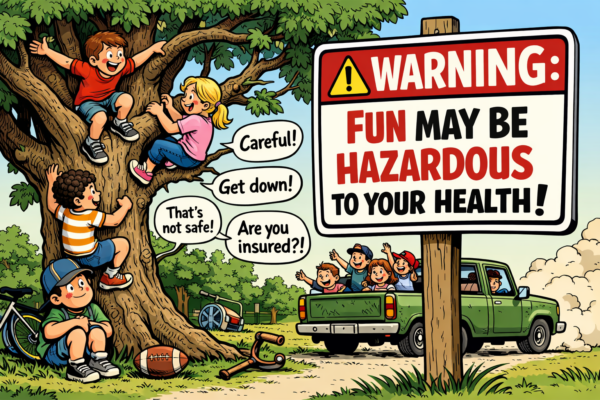
When I was a child, risk arrived early and often, without ceremony. We rode in the back of a ute or on a car trailer. We rode bikes without helmets. We disappeared after breakfast and were expected home by dark. We climbed trees. We played football in the street. Adults were nearby, but rarely hovering. Rules existed, but they were few, broad, and largely unenforced unless something went badly wrong.
This isn’t nostalgia. It’s a description of how risk entered daily life.
The question worth asking now is not whether those activities were safe by today’s standards, but what they taught. How did children learn judgement? How did they calibrate fear? How did they learn when to push and when to stop?
And perhaps most importantly: where do children learn those things now?

Risk, in those earlier years, wasn’t unmanaged. It was experienced. Limits were discovered through scraped knees, near-misses, parental disappointment, peer pressure, and self-correction. You learned how fast was too fast by wobbling. You learned how high was too high by feeling your grip weaken. You learned how far was too far when you realised you still had to get home.
No sign explained this. No adult worksheet captured it. It was absorbed, gradually, through doing.

At some point, that model began to unravel.
Supervision increased. Liability entered the conversation. Activities once seen as normal were reclassified as hazardous. The response was not to teach children how to manage those hazards, but to remove them from view. Trees were fenced. Streets were traffic-managed. Playgrounds were softened. Riding in the back of vehicles became illegal. Helmets became mandatory. “Just go out and play” was replaced with “stay where I can see you”.
Was this shift ever consciously chosen? Or did it simply accumulate, rule by rule, incident by incident?
What changed was not children, but adult tolerance of uncertainty. Risk moved from being something children learned to navigate, to something adults felt obliged to eliminate. Responsibility shifted upward and outward - from the child to the parent, from the parent to the school, from the school to the council, from the council to the insurer and ACC.
In that process, something subtle was lost.
If children are never allowed to assess risk for themselves, how do they develop internal judgement? If every environment is made safe in advance, how do they learn to read danger when it is not labelled? If adults intervene before failure occurs, how does learning take place?
These questions matter because childhood is where risk competence is formed. Not in training sessions or briefings, but in repetition. In unsupervised moments. In small decisions that carry small consequences. Without those experiences, judgement doesn’t disappear - it simply never fully develops.
And judgement, once absent, is not easily retrofitted.
This helps explain something we see repeatedly in adult outdoor life. Increasing reliance on signage. Growing expectation that hazards will be removed. Complaints when environments do not behave predictably. Demands for restrictions after incidents. A sense that risk should be managed for people, rather than by them.
Is that a failure of adulthood - or the legacy of a childhood where risk was always externally controlled?
Consider how often public authorities now assume the public cannot be trusted to assess conditions. Rivers are labelled unsafe rather than taught. Tracks are closed rather than maintained. Activities are restricted rather than contextualised. Each decision is defensible. Together, they suggest a loss of confidence in people’s ability to cope.

But confidence doesn’t arise spontaneously at age eighteen.
It is built early, or not at all.
There is also an equity dimension rarely acknowledged. Children with access to private land, confident parents, or informal outdoor opportunities still encounter risk. Others grow up almost entirely managed. When those children become adults, they enter the same public spaces - but with very different levels of competence.
Policy rarely accounts for that difference. Instead, it assumes uniform vulnerability and responds accordingly.
Is it any wonder that risk management increasingly favours exclusion?
None of this is an argument for recklessness. Children were hurt in the past. Some injuries were serious. Some outcomes were tragic. But the response to those risks used to be learning and adaptation, not removal of experience altogether.
At what point did preventing all possible harm become more important than teaching people how to live with uncertainty?
The irony is difficult to avoid. In trying to protect children from risk, we may have made risk feel more alien, more frightening, and more unmanageable later in life. When judgement is never practiced, it is easily overridden by rules. When rules fail, confusion follows.
This has direct consequences for outdoor access. When people lack confidence and competence, authorities respond by narrowing the environment. When environments narrow, participation declines. When participation declines, the cultural case for access weakens. The cycle reinforces itself.
Childhood used to act as a quiet training ground for outdoor life. Not formal, not structured, but effective. That training ground has largely vanished, replaced by controlled experiences and warnings.
The question is not whether we should return to the past. We can’t. The world has changed. Traffic is heavier. Legal frameworks are different. Expectations are not the same.
The question is whether we have gone too far in the other direction.
If children never climb trees, how will they judge height?
If they never fall off bikes, how will they understand speed?
If they never roam, how will they learn navigation, consequence, and return?
And if they never learn those things early, how will they manage risk later - when the stakes are higher and the margins thinner?
This series has looked so far at swimming lessons lost, and at risk management replacing skill. Childhood is where those threads converge. It is where competence was once quietly built, long before policies and signage became necessary.
The outdoors has not become more dangerous. Our relationship with risk has changed.
The next question for CORANZ - and for anyone who values access - is whether we can still rebuild a culture that teaches judgement rather than assuming its absence.
Because if we don’t, the future of outdoor access may be decided not by law, but by fear - learned early, reinforced often, and managed ever more tightly.
And that is a loss no warning sign can repair.