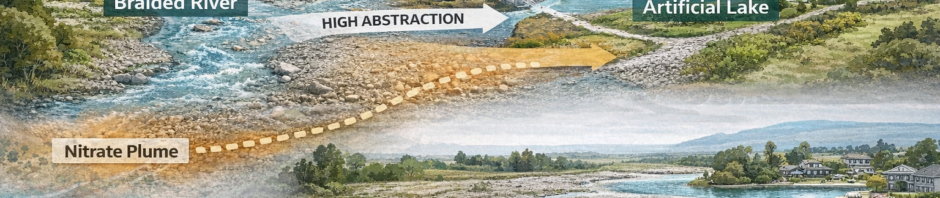
Braided rivers are not static channels.
They shift.
They split.
They flush.
They rebuild their own mouths.
Their health depends on variability - particularly seasonal high flows that reshape gravel bars and reopen estuaries.
When allocation increases and flows reduce, that natural dynamism changes.
And sometimes the first visible sign is simple: the river mouth closes more often than it once did.
Allocation Does Not Disappear - It Is Redistributed
In parts of Canterbury, water abstracted from braided rivers now supports:
- Irrigation schemes
- Storage infrastructure
- Artificial amenity lakes
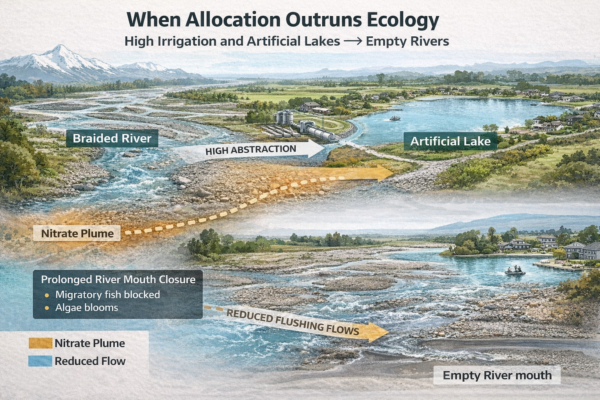
These lakes can provide recreation, residential value and localised boating access. They are often well landscaped and visually attractive.
But hydrologically, they represent a redirection of flow.
Water stored or diverted upstream is water not contributing to:
- Natural flushing events
- Sediment transport
- Estuarine connectivity
Braided rivers rely on episodic pulses. Storage dampens pulses.
Limits before tools.
Groundwater Connections Matter
Braided river systems are closely linked to groundwater.
Abstraction affects:
- Base flows
- Spring systems
- Hyporheic exchange
Artificial lakes often sit within shallow groundwater zones. They can alter local gradients, affecting how water moves between river, aquifer and surface.
These changes are complex and site-specific.
But they are not neutral.
Site-specific realities matter.
Amenity Is Not Ecological Substitution
An artificial lake can support:
- Kayaking
- Swimming
- Lakeside housing
It cannot replicate:
- A functioning braided channel network
- Spawning habitat
- Migratory fish pathways
- Natural mouth dynamics
When a river’s mouth closes more frequently due to reduced flushing flows, species that depend on open passage - such as smelt and salmon - are affected.
A lake does not replace that connection.
Public resource, public responsibility.
The Fisheries Question
Fisheries decline rarely has a single cause.
It may involve:
- Reduced high flows
- Sedimentation
- Nutrient enrichment
- Mouth closure frequency
- Habitat fragmentation
But when abstraction and storage increase across a catchment, ecological pressure becomes cumulative.
No single development explains the whole picture.
But cumulative allocation shapes it.
The Illusion of Stability
Artificial lakes can create the appearance of abundance.
Flat water.
Stable edges.
Predictable levels.
Braided rivers are not meant to look stable.
Their instability is their strength.
When variability declines, ecological resilience declines with it.
Rivers adjust slowly.
Recovery is slower.
A Structural Question
The real issue is not whether artificial lakes should exist.
It is whether ecological limits were set early and firmly enough to protect:
- Flow variability
- Mouth dynamics
- Fisheries connectivity
- Spring systems
Amenity and irrigation can coexist with rivers.
But only if ecological thresholds are recognised as primary, not residual.
Evidence before emotion.
What Remains
Braided rivers are among New Zealand’s most distinctive landscapes.
They are not ornamental water sources.
They are living systems built on movement, sediment and connection.
If allocation outruns ecology, the signal often appears where river meets sea.
And by then, reversing course is harder than holding the line earlier.
Man meddles, often for greed, and disrupts ecosystem and public rivers.
Braided river roamed about their flood plain and in big floods could change the actual river bed kilometres. Today they are confined between stop banks, prevented from spreading their depositions of silt and gravel naturally.
In time, how high can a stop-bank go?
Lake Hood is often presented as an amenity success story. What receives less attention is the hydrological context in which it exists.
The water ultimately comes from the Ashburton River system - a braided river already heavily allocated for irrigation. Braided rivers depend on seasonal flushing flows to maintain open mouths and ecological connectivity. When abstraction reduces those pulses, the system changes.
Artificial lakes create the appearance of abundance - flat, stable water levels - but they do not replace the ecological function of a living braided river. They do not restore migratory pathways. They do not replicate sediment movement. They do not breach shingle bars.
The Ashburton River mouth has closed more frequently in recent decades. Smelt and salmon runs have struggled. There is no single cause, but cumulative allocation must be part of the discussion.
Blending groundwater to meet drinking water standards may satisfy human thresholds. It does not automatically protect ecological thresholds.
Amenity and development can coexist with rivers. But only if ecological limits are recognised first, not retrospectively.
That is the structural issue here.
1. “We Operate Within the Law.”
My water takes are consented. They were granted through a legal process. I invested millions in infrastructure based on those consents. If limits change retrospectively, that undermines property rights and financial security.
2. “Irrigation Saved the District.”
In the late 1980s and 1990s, arable farming was barely viable. Irrigation and dairying kept farms solvent and rural communities alive. Without it, families would have gone bust.
3. “We’ve Already Improved Practices.”
Modern irrigation is more efficient than flood irrigation. We’ve invested in pivot systems, soil moisture monitoring, nutrient budgeting and riparian planting. It’s unfair to pretend nothing has changed.
4. “Rivers Are Affected by Many Factors.”
Fisheries decline cannot be pinned solely on irrigation. There are multiple pressures: sediment, habitat loss, climate variability, ocean conditions, predation. Allocation is part of the picture - but not the only part.
5. “Artificial Lakes Reuse Water.”
Amenity lakes often rely on stored or consented water. They are part of managed systems. They provide local recreation and economic activity.
6. “Food Production Matters.”
Irrigated agriculture underpins export revenue, jobs and regional prosperity. Urban populations rely on rural productivity.
7. “Any Change Must Be Predictable.”
If ecological limits are to shift, the transition must be gradual and economically realistic. Sudden clawbacks create hardship and instability.
What Farmers Say - and What Rivers Say Back
Debate over water allocation in Canterbury often hardens quickly. But understanding both sides clarifies the real issue.
What Farmers Say
Farmers will rightly point out:
Their water takes are legally consented.
Irrigation rescued many properties during difficult economic periods.
Modern systems are more efficient than those of the past.
Agriculture underpins regional jobs and export income.
Fisheries decline is multi-factorial, not attributable to a single pressure.
They also note that sudden clawbacks of allocation would destabilise businesses built around long-term consents.
These are not trivial arguments.
What Rivers Say Back
Braided rivers operate on flow variability.
They require periodic flushing to:
Move sediment.
Reopen river mouths.
Maintain migratory fish access.
Sustain habitat diversity.
When abstraction becomes cumulative, high-flow pulses diminish. Mouths close more frequently. Connectivity weakens.
Artificial lakes and stored water may provide local amenity, but they do not replicate the ecological function of natural flow regimes.
Limits before tools.
The Real Question
This is not a morality play.
It is a structural question:
Were ecological limits set early and firmly enough to protect river function before allocation expanded?
Because once allocation is embedded in infrastructure and property value, correction becomes politically and economically difficult.
Rivers respond slowly.
Recovery is slower.
If ecological thresholds are secondary to development, the consequences appear - eventually - at the river mouth.
That is where the debate should focus.
The RMA has been an environmental disaster. It allows people to what they want to do with their land. Management of land use is almost absent.
So monocultures are allowed to flourish.”Market forces” they call it. Money speaks or should I say greed flourishes.
So in Marlborough there are two monocultures-grapes mainly on plains, pine trees on hills and small valleys. No wonder streams dry up with the insatiable thirst of millions of pine trees and vineyards wanting irrigation.
No wonder the Wairau River in a normal Marlborough summer can dwindle to a trickle.
It’s an environmental disaster and it will worsen.
“Market forces”? Free market neo-liberal economics…what a lot of nonsense.
Just read your post Ned.
It is economic nonsense too.
Both the wine and forestry industries are 90% more of a little less, foreign owned.
The current downturn in the wine industry will see the big corporates, overseas owned, buying up smaller NZ owned vineyards.
Yes environmental disaster and economic disaster too.
Hi “Shiraz”, your comment about foreign corporates is so true. Corporates sole aim is to attain maximum profits and dividends for shareholders. To hell with any environmental consequences.