Regulation, Risk and Outdoor Responsibility
Guest Post by Dave Rhodes
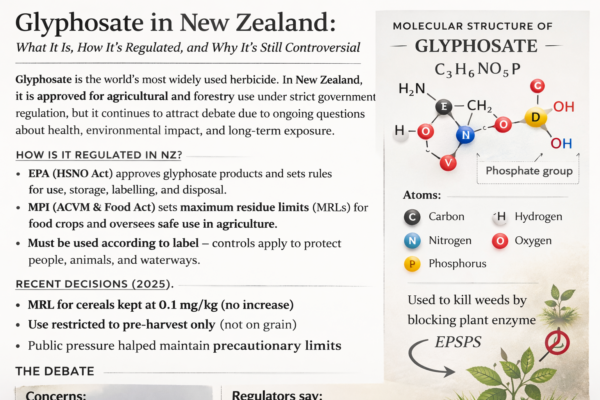
Glyphosate is the most widely used herbicide in the world. It is also one of the most debated.
In New Zealand it is approved for agricultural, forestry and amenity use. It is legal. It is regulated. It is common.
And it remains controversial.
For outdoor users - anglers, trampers, hunters, campers - the question is not ideological. It is practical: how is it controlled, what are the risks, and what does responsible use look like in a country that values both food production and ecological integrity?
How It Is Regulated Here
Glyphosate products in New Zealand are regulated under two main frameworks:
Environmental Protection Authority (EPA) under the Hazardous Substances and New Organisms (HSNO) Act.
The EPA sets approval conditions covering storage, labelling, application methods, environmental protection and disposal.
Ministry for Primary Industries (MPI) under the Agricultural Compounds and Veterinary Medicines (ACVM) Act and the Food Act.
MPI sets maximum residue limits (MRLs) for food crops and oversees agricultural use patterns.
Recently, MPI confirmed that residue limits for cereals such as wheat, barley and oats would remain at 0.1 mg/kg, and use is restricted to pre-emergence application rather than direct spraying on harvested grain. That decision followed public consultation and reflects a cautious regulatory stance.
New Zealand’s position aligns broadly with regulators in Australia, North America and the European Union, which have generally concluded glyphosate is safe when used according to label instructions. However, international debate continues - particularly following the International Agency for Research on Cancer (IARC) classification of glyphosate as “probably carcinogenic” in certain exposure contexts.
That divergence is part of the reason the issue does not disappear.
Outdoor Communities Should Pay Attention
For recreation groups, concern usually centres on three areas:
- Waterways – Runoff into streams, rivers and wetlands.
- Non-target species – Impacts on insects, birds and soil life.
- Public trust – Transparency around cumulative environmental effects.
Glyphosate is not acutely toxic to fish at typical environmental concentrations, according to most regulatory assessments. However, surfactants in some formulations and misapplication near waterways can increase ecological risk.
That is the distinction. It reinforces a principle CORANZ has consistently maintained: tools are not the issue; limits and competence are.
Misuse creates risk.
Overuse creates exposure pathways.
Poor buffer management threatens waterways.
Outdoor users see the results of both good and bad land management. Dead vegetation in spray corridors. Bare riparian margins. Drift damage where it should not occur. They also see effective, targeted control of invasive weeds that would otherwise choke native habitat.
Reality is mixed.
The Policy Balance
Agriculture, forestry and infrastructure management rely on herbicides. Mechanical alternatives are not always practical or carbon-neutral. Blanket prohibition is not currently government policy in New Zealand.
Then again, neither is complacency.
The regulatory framework requires adherence to label conditions, buffer zones around water, and approved application methods. Enforcement and monitoring sit with regional councils and national agencies. Distrust abounds.
The debate now is less about legality and more about confidence:
Are controls robust?
Is independent science regularly reviewed?
Are environmental effects transparently monitored?
Those are reasonable questions in any modern regulatory system.
The Principle for CORANZ
CORANZ does not align either with industry or activist positions. Our anchors are clearer:
- Ecological limits are non-negotiable.
- Public resources require public responsibility.
- Evidence should precede emotion.
- Proportionate response matters.
Glyphosate is an effective weed-control tool. That is not in dispute. The ongoing scrutiny surrounding it reflects public expectation that environmental and human health protections remain current and evidence-based.
Effective control of invasive weeds supports biodiversity and access.
Careless application undermines both.
The bottom line is steady rather than dramatic:
Glyphosate remains legal and widely used in New Zealand under structured controls. Ongoing scientific review and regulatory transparency are appropriate. Outdoor communities are right to expect both.
This is not a question of slogans.
It is a question of stewardship.
And stewardship applies to tools as much as to rivers.