There is something quietly liberating about a health expert saying: stop obsessing.
Dr Ezekiel Emanuel, oncologist and former White House health advisor, argues that the modern “wellness industrial complex” has distorted the point of healthy living. Diet tracking, longevity hacks, bio-monitoring, optimisation routines - all risk becoming the focus of life rather than a support for it.
Wellness, he says, should be habitual and largely unconscious. It should not consume our mental bandwidth.
For an outdoor recreation community, that lands close to home.
Because the outdoors has never really been about optimisation.
It has been about living.
Health Is Not the Hobby
There is nothing wrong with exercise, good nutrition or proper sleep. These are foundations. But Emanuel’s warning is that constant monitoring - calories, heart rate, steps, macros, longevity biomarkers - can crowd out the very experiences that make life meaningful.
We see it everywhere.
People hiking but staring at watches.
Cycling but fixated on performance metrics.
Fishing but checking notifications between casts.
At some point the tool overtakes the purpose.
Outdoor recreation offers something simpler: movement without obsession. Fresh air without analytics. Effort that feels natural rather than engineered.
You climb the hill because it’s there.
You walk the beach because it clears your head.
You paddle because the water draws you in.
Health follows.
The Missing Ingredient: Connection
Emanuel highlights what much of the wellness industry neglects - social connection.
Loneliness, isolation and disconnection correlate strongly with poorer health outcomes. Conversely, shared experience improves wellbeing in ways no supplement can.
That is something the outdoor world has always understood instinctively.
The shared hut.
The fishing competition.
The volunteer planting day.
The spontaneous chat at the boat ramp.
These are not side benefits. They are core benefits.
In fact, outdoor spaces may be one of the last arenas where strangers still talk to one another without agenda.
Longevity vs. Fulfilment
The modern longevity movement asks: how long can we live?
Emanuel asks a different question: why?
Most humans will not be inventing at 95 or scaling peaks at 110. There are rare exceptions, but biology has limits. Pretending otherwise fuels unrealistic expectations and anxiety.
Outdoor recreation does not promise immortality. It offers something more grounded: vitality in the present.
A 70-year-old walking a ridge line.
An 80-year-old casting into a river at dawn.
A grandparent teaching a child to tie a knot.
These moments are not about extending life indefinitely. They are about enriching the years we have.
Habit Over Obsession
Perhaps the lesson is this:
Eat reasonably well.
Move regularly.
Sleep properly.
Then stop thinking about it.
Use your mental energy on relationships, curiosity, contribution and experience.
Outdoor recreation fits that philosophy neatly. It builds strength without fixation. It lowers stress without apps. It fosters connection without algorithms.
The outdoors does not sell optimisation.
It offers participation.
And that may be the quiet antidote to both wellness obsession and digital fatigue.
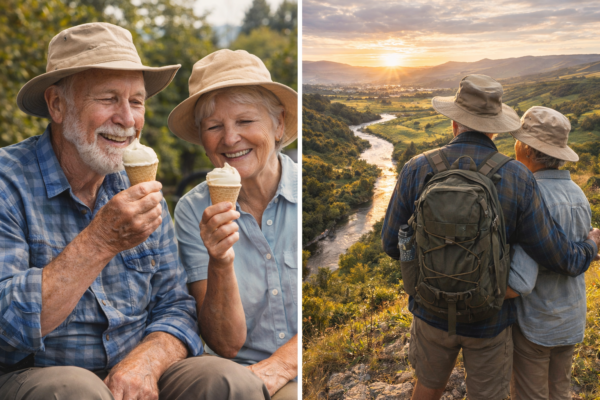
So yes - eat the ice cream occasionally.
Then climb the hill with friends.
Health was never meant to be the whole story.