New Zealand changed its electoral system in 1996 for a reason.
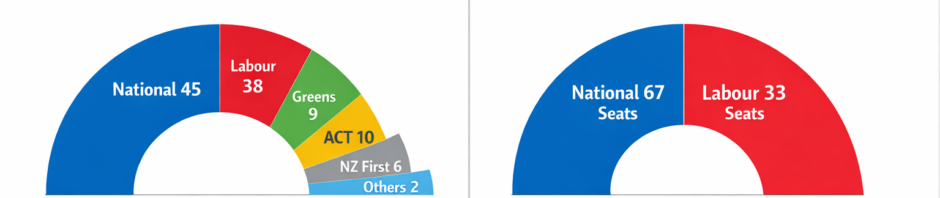
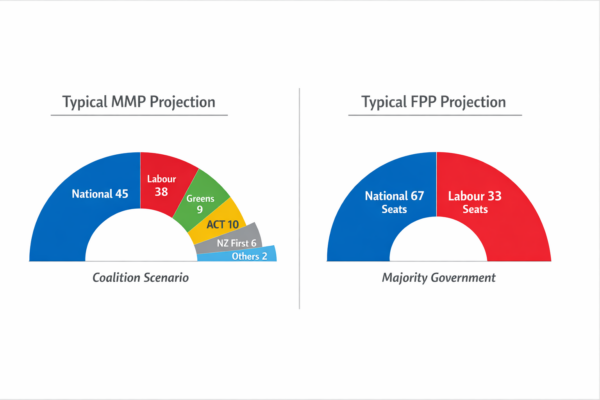
Under First Past the Post (FPP), governments regularly secured large parliamentary majorities on the back of minority vote share. In 1978 and 1981, the party that won fewer votes won more seats. Single-party governments exercised enormous power with few structural restraints.
Critics described it as “elective dictatorship”.
Mixed Member Proportional (MMP) was adopted to correct that imbalance. Its purpose was clear: Parliament should reflect how people actually vote. Representation should be proportional. Minority voices should not disappear.
Nearly thirty years later, it is reasonable to ask:
Has MMP delivered the accountability it promised?
Or has it introduced new distortions of its own?
This is not a partisan question. It is a constitutional one.
What FPP Delivered
Under FPP:
- The party with the most electorate seats formed government.
- Majority governments were common.
- Policy direction was clear and decisive.
- Voters knew exactly who governed.
The strength of FPP was clarity.
The weakness was proportionality.
A party could win 45 percent of the vote and control nearly 100 percent of executive authority.
That produced strong mandates - but not always broad ones.
What MMP Changed
MMP fundamentally altered the structure of power:
- Parliamentary seats reflect party vote share.
- Minor parties gain representation if they pass 5 percent or win an electorate.
- Coalition governments are the norm.
The system undeniably improved proportional representation. Parliament now more closely mirrors the political diversity of the electorate.
That is a democratic gain.
But proportionality is not the only measure of accountability.
Coalition Leverage and Mandate Clarity
Under MMP, minor parties can become decisive.
A party polling 6 to 8 percent can hold the balance of power. Coalition negotiations can reshape major policy commitments. Manifesto pledges can be diluted, exchanged, or deferred behind closed doors.
This is not illegitimate. It is how coalition systems function.
But it does create a question:
When coalition bargaining significantly alters a governing programme, whose mandate is being implemented?
Voters cast ballots for individual parties. They do not vote directly on coalition agreements.
Under FPP, voters knew the governing platform before the election and could reward or punish it clearly at the next one.
Under MMP, voters often discover the final governing agenda after coalition negotiations conclude.
Is that more representative - or less transparent?
Predictability vs Representation
FPP maximised decisiveness.
MMP maximises representation.
But accountability depends on predictability as well as proportionality.
When voters are unsure:
- Which party will form government,
- Which policies will survive coalition talks,
- Or how manifesto commitments will be traded,
the link between vote and outcome becomes less direct.
That does not make MMP unfair.
It does raise questions about clarity of mandate.
The Stability Question
Supporters of MMP argue it moderates extremes. Coalition partners must compromise. Policy shifts tend to be incremental rather than abrupt.
Critics argue that:
- Coalition leverage can amplify smaller parties beyond their raw vote share.
- Policy durability weakens when governments change.
- Major reforms can be reversed within a single electoral cycle.
Recent history shows examples of both moderation and instability.
Large reforms have passed - and been repealed.
Major promises have been reshaped through coalition negotiation.
Minor parties have secured disproportionate influence relative to their size.
Is that pluralism in action?
Or is it mandate distortion?
Reasonable people differ.
The Accountability Lens
The central question is not whether minor parties “have too much power”.
Minor parties represent real voters. Their voices matter.
The deeper question is whether MMP strengthens or weakens democratic accountability.
Accountability requires that:
- Voters understand what they are choosing.
- Governments can be judged against what they promised.
- Power can be removed clearly when performance disappoints.
Under FPP, accountability was blunt but direct.
Under MMP, accountability is diffuse but proportional.
Which better serves the public interest?
The Risk of Concentrated Power
It is worth remembering why FPP was rejected.
Strong majority governments passed sweeping economic reforms in the 1980s and early 1990s with limited institutional constraint. Many voters felt blindsided by policies that diverged sharply from campaign messaging.
MMP was introduced to prevent that concentration of unchecked authority.
If FPP is reconsidered, those lessons cannot be ignored.
Majority rule without proportional representation can deliver clarity - but also overreach.
The Risk of Fragmented Authority
Equally, if coalition bargaining obscures mandate clarity, public trust can erode in another direction.
When promises are traded post-election, voters may feel disconnected from outcomes.
When small parties hold decisive leverage, some perceive influence exceeding electoral weight.
Again, this is structural - not personal.
Thirty Years On
The question is not whether MMP was justified in 1996.
It was.
The question is whether, in 2026, it continues to strike the balance New Zealand intended.
Does it:
- Protect minority representation?
- Prevent elective dictatorship?
- Deliver stable and durable policy?
- Provide clear lines of accountability?
Or has it introduced new forms of opacity and leverage that deserve reassessment?
A Constitutional Conversation
Electoral systems are not sacred. They are tools.
FPP delivered decisiveness but risked over-concentration of power.
MMP delivered proportionality but introduced coalition complexity.
Every democratic structure involves trade-offs.
The mature question is not which system is perfect.
It is which system best protects democratic accountability in modern New Zealand.
That debate should be calm, informed and historical - not reactive.
Thirty years after the referendum, it may be time to ask it again.