
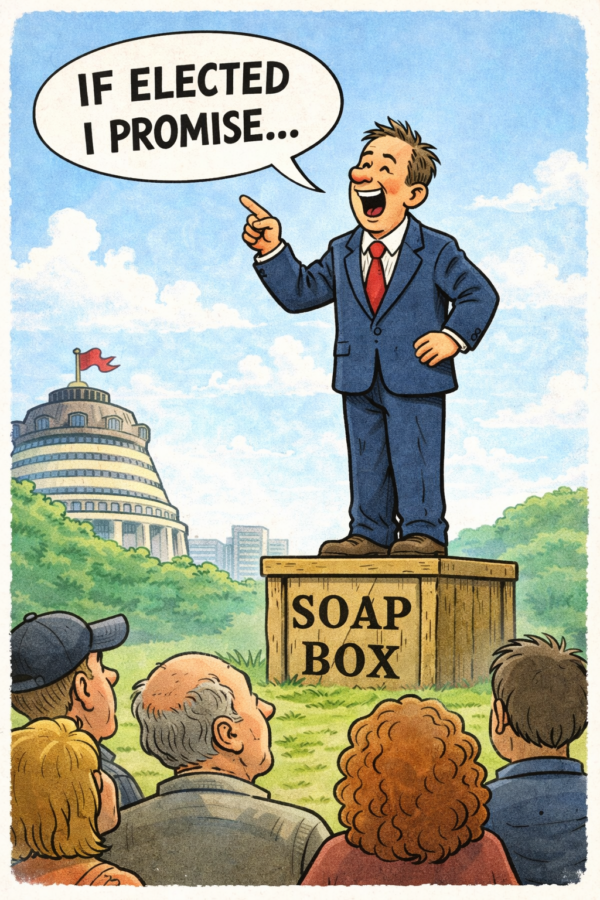
Every election cycle brings bold commitments.
Transformational housing programmes.
Infrastructure revolutions.
Environmental resets.
Tax reform.
Constitutional change.
Regional revival.
But how often do major promises translate into measurable delivery?
Before accepting new fast-tracked infrastructure, sweeping regulatory reform, or urgent structural change, it is worth examining recent history.
Below is a cross-party scorecard covering the last four New Zealand general elections: 2014, 2017, 2020 and 2023.
This is not a partisan exercise. It includes major and minor parties that held governing influence.
Criteria for inclusion:
- Explicit manifesto or leader-level campaign commitment
- National significance
- Measurable outcome
- Clear post-election trajectory
Delivery categories:
- Delivered – substantially implemented as promised
- Partially Delivered – implemented in altered or reduced form
- Not Delivered – not implemented
- Abandoned – formally cancelled
- Ongoing – still within governing term
2014 Election – National (John Key Government)
Return to Fiscal Surplus
Status: Delivered
Budget surplus achieved in 2014/15.
Partial Asset Sales Programme
Status: Delivered
Mixed-ownership model completed for energy companies.
Improve Housing Affordability (Auckland focus)
Status: Partially Delivered
Special Housing Areas introduced; affordability pressures persisted and worsened over the term.
Reduce Prison Population Growth
Status: Not Delivered
Prison population rose significantly during the term.
2017 Election – Labour / NZ First / Green Coalition
KiwiBuild – 100,000 Homes in 10 Years (Labour)
Status: Not Delivered
Approximately 1,500 homes delivered under the KiwiBuild brand before scaling back.
Regional Economic Revitalisation Fund (NZ First)
Status: Partially Delivered
Provincial Growth Fund allocated funding; long-term measurable transformation remains debated.
1080 “Gone by Breakfast” (NZ First campaign rhetoric)
Status: Not Delivered
No policy eliminating 1080 enacted; use continued under Department of Conservation and TB control programmes.
Reduce Child Poverty
Status: Partially Delivered
Child poverty measures showed some statistical improvement; targets adjusted over time.
Fees-Free First Year Tertiary Education
Status: Delivered (Term), Later Reversed
Implemented during the term; later modified and wound back by subsequent government.
2020 Election – Labour Majority Government
Auckland Light Rail
Status: Abandoned
Multiple route studies conducted; project cancelled after significant cost escalation.
Three Waters Reform
Status: Delivered (Term), Later Repealed
Legislation passed restructuring water governance; repealed after 2023 election.
Declare Climate Emergency
Status: Delivered (Symbolic), Partially Delivered (Substantive)
Declaration made; emissions reductions uneven and reliant on ETS adjustments.
Transform Mental Health Services
Status: Partially Delivered
Significant funding allocated; workforce and access constraints persisted.
2023 Election – National / ACT / NZ First Coalition
(Still within term - some policies ongoing)
Repeal Three Waters
Status: Largely Delivered
Legislation reversed; replacement framework progressing.
Reduce Government Spending
Status: Ongoing
Public sector reductions underway; long-term fiscal impact not yet fully realised.
Treaty Principles Referendum (ACT)
Status: Modified / Not Advanced in Original Form
Coalition agreement altered pathway; not proceeding as standalone binding referendum.
Remove Commercial Minimum Fish Size Limits
Status: Advanced then Reversed
Proposal introduced; sections withdrawn after public backlash.
Fast-Track Infrastructure Consenting
Status: Delivered (Framework Established)
Fast-Track Approvals regime enacted; multiple nationally significant projects referred.
Observed Patterns Across Four Elections
1. Large Numeric Promises Rarely Survive Intact
100,000 homes.
Transformational rail.
Wholesale water reform.
Scale often contracts once confronted by cost, logistics or political resistance.
2. Coalition Agreements Dilute Commitments
Minor party pledges frequently soften in negotiation.
3. Majority Governments Also Reverse Course
Even with a parliamentary majority, large projects can collapse under cost or public scrutiny.
4. Structural Reform Often Outlasts Its Architects
Three Waters passed, then repealed.
Fees-free introduced, then revised.
Policy durability depends on cross-party consensus - which is rare.
5. Urgency Does Not Guarantee Completion
Accelerated legislation does not ensure long-term stability.
What This Means
The pattern is not confined to one political philosophy.
National, Labour, NZ First, ACT, Greens - all have made major commitments that were:
- Scaled back
- Delayed
- Reversed
- Or abandoned
This does not imply bad faith.
It does demonstrate something structural:
Election campaigns reward boldness.
Governing rewards compromise.
There is often a measurable gap between manifesto ambition and implementation reality.
Does This Matter Now?
When governments ask for:
- Fast-track approvals
- Reduced consultation
- Urgent reform
- Sweeping restructuring
They often justify it on the basis of necessity and certainty.
Recent history suggests certainty is rare.
Infrastructure worth billions has been cancelled.
Housing revolutions have stalled.
Environmental frameworks have been reversed.
Major structural laws have lasted less than a single electoral cycle.
If delivery regularly diverges from promise, then public scrutiny becomes more important, not less.
Democracy is friction.
Friction exposes weaknesses in proposals before billions are spent.
A Reasonable Question
Before accepting that:
“This time will be different,”
voters are entitled to ask:
How often have major election promises of the last twelve years been delivered in full?
The answer, across parties, is: fewer than advertised.
The Lesson
Scepticism is not cynicism.
It is institutional memory.
The electorate does not owe automatic confidence to manifesto claims - regardless of party colour.
Ambitious policy may be necessary.
But ambition without durability has defined much of the last decade.
If political leaders want trust, the most powerful signal is not a bold promise.
It is a completed one.
The major worry with the analysis is that the public will be so dissolusioned that they won’t bother to vote and the chaos will continue.