
Recent reporting from the Cook Islands highlights a developing approach to deep sea mining that differs from many other resource debates. A long-term review of scientific data points to the potential for significant and lasting impacts on deep ocean ecosystems. The response has not been to accelerate activity, but to proceed cautiously within a structured regulatory framework. That approach reflects a broader issue.
What changes is not the presence of interest in seabed minerals, but how decisions are made in the face of uncertainty. The deep ocean remains one of the least understood environments on Earth, with limited knowledge of ecological processes and recovery times. The regulatory framework in place allows for exploration, but does not assume that exploration leads to extraction. Taken together, this separates information gathering from commitment to development.
This shifts the focus from opportunity to constraint. Where impacts are uncertain, and potentially irreversible, the ability to manage those impacts becomes limited. Regulatory settings that require environmental effects to be understood, avoided, remedied or mitigated create a threshold that cannot easily be met when knowledge gaps remain. In this context, delay is not procedural, but structural.
There is also a question of direction. Exploration is often viewed as a step toward development, but that pathway is not fixed. Where emerging evidence increases uncertainty rather than reducing it, the likelihood of progression can diminish. This introduces a feedback loop in which new information reinforces caution rather than enabling expansion.
The wider pattern is not consistent across all environmental issues. In some cases, known risks are identified but not fully addressed in practice. Here, the situation is different. Uncertainty itself becomes the controlling factor, shaping both the pace and the possibility of future decisions.
The principle is straightforward. Where impacts cannot be understood, they cannot be reliably managed. In such cases, restraint becomes a deliberate outcome rather than an unintended delay.
This is not about whether deep sea mining will occur. It is about how decisions are made when knowledge is incomplete, and whether uncertainty is treated as a reason to proceed carefully or a reason to pause altogether.
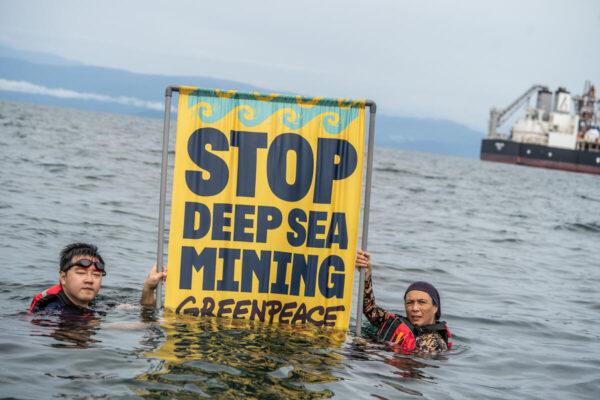
Uncertainty is often treated as something to be resolved before proceeding. In this case, it is treated as a reason to pause. That difference shapes the entire decision-making process.
The idea that “not proceeding” is a valid outcome is often overlooked. Decision-making frameworks tend to assume progression, even where conditions are not fully met. Recognising restraint as a legitimate endpoint changes that dynamic. It allows uncertainty to remain part of the system rather than something that must be resolved before moving forward. That may lead to slower decisions, but it also reduces the likelihood of unintended consequences where recovery or mitigation is not well understood.
There is a contrast here with other environmental issues where known risks are identified but not always addressed in practice. In this case, the limiting factor is not disagreement, but uncertainty itself. Where impacts may be long-lasting or irreversible, the threshold for proceeding becomes much higher. That does not remove the economic interest, but it places it alongside a requirement for understanding that may not yet be achievable. The result is a system that can pause without necessarily committing to a future pathway.
What stands out here is the separation between exploration and commitment. In many cases, exploration becomes the first step toward development almost by default. Here, that link is deliberately broken. Information is gathered, but progression is not assumed. That creates a different decision framework, where each step is reassessed as knowledge develops. It also avoids the situation where early investment creates pressure to proceed regardless of emerging risks. That structural separation is worth noting, as it changes how risk is carried through the system.
This is one of the few areas where uncertainty is being treated as a controlling factor rather than something to work around. That distinction is important. Where systems are well understood, limits can be set with confidence. Where they are not, those limits become assumptions. The deep ocean is still largely unknown, and that changes how decisions should be approached. Slowing down in that context is not hesitation, it is a recognition that outcomes cannot yet be predicted with any reliability. That approach is consistent with long-term stewardship rather than short-term opportunity.