
Advice on ageing well often centres on structured exercise. Programmes, routines, and training plans are promoted as the primary way to maintain health and independence. The benefits are well established, with research showing improvements in strength, balance, and longevity. That may be true, but it frames movement as something separate from everyday life, rather than part of it.
What changes with this framing is how activity is understood. Exercise becomes a scheduled task, often requiring time, equipment, or facilities. In contrast, many forms of movement occur naturally through daily use of land and environment. Walking uneven tracks, carrying equipment, working outdoors, and maintaining property all demand strength, balance, and coordination. Taken together, these activities provide a broad base of physical function without being labelled as exercise.
This alters how fitness is developed and maintained over time. Structured exercise tends to isolate specific functions, such as muscle strength or cardiovascular endurance. Movement embedded in daily activity integrates those functions, often in more variable and demanding ways. Uneven ground improves balance, load carrying builds strength, and sustained activity supports endurance. The result is not simply fitness, but capability.
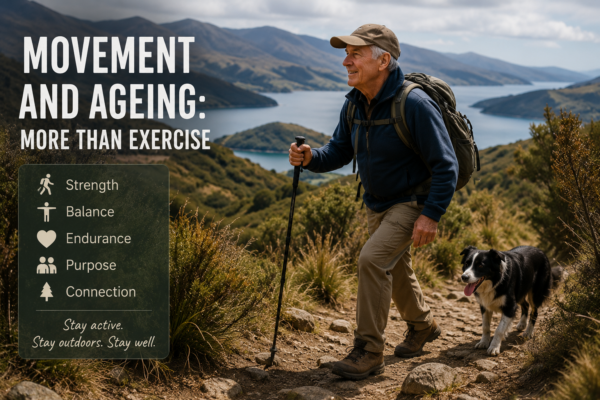
This pattern is familiar in outdoor settings. Tramping, hunting, fishing, and general land use all require a combination of movement types that adapt as conditions change. Individuals engaged in these activities often maintain functional strength and mobility well into older age. This is not because they follow formal programmes, but because movement is a constant requirement rather than an occasional intervention.
The principle is straightforward. Fitness does not depend solely on structured exercise, but on regular, varied use of the body in real conditions. Environments that support movement, access, and practical activity allow this to occur naturally. Where those opportunities are limited, exercise must be reintroduced in a more artificial form.
This is not about dismissing exercise or the benefits it provides. It is about recognising that movement can be built into daily life rather than added to it. The issue is not whether people exercise, but whether their environment supports ongoing, practical movement over time.