Six new aquaculture developments in Marlborough have been referred to the fast-track process, with proponents highlighting export growth, employment, and industry resilience. The surface narrative is one of economic opportunity and adaptation to changing conditions. That may be justified, but it sits alongside a long-standing and unresolved debate about the effects of existing marine farming in the region.
What changes in this case is not simply the addition of new farms, but the way expansion is being enabled. Additional nursery and farm space would extend an already extensive footprint across the Marlborough Sounds, while approval is accelerated through a centralised process. Taken together, increased spatial occupation and reduced scrutiny shift how marine areas are allocated and managed over time.
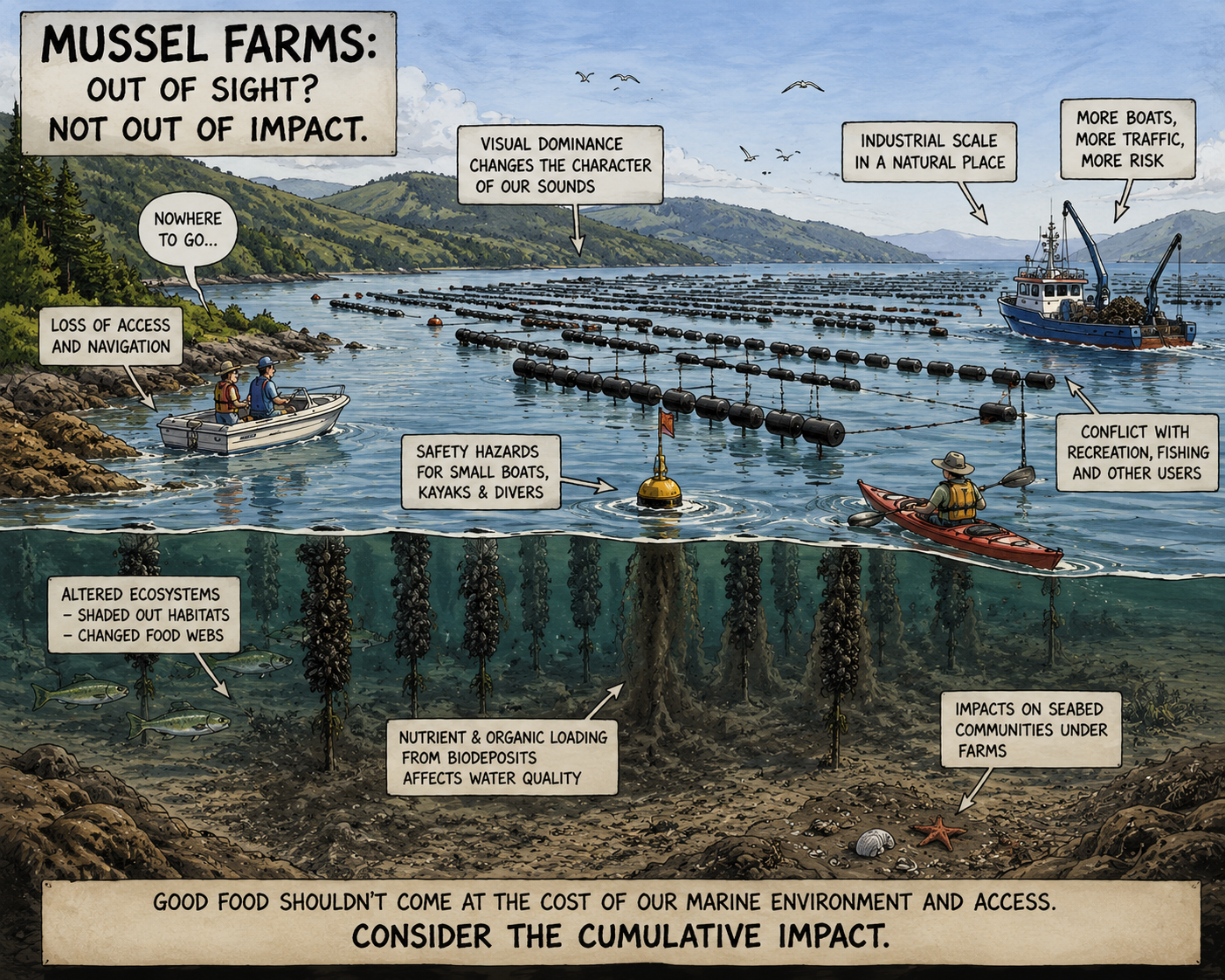
This has direct implications for the character and use of these environments. Marine farming occupies large surface areas and alters the water column and seabed beneath. It also changes how space is experienced and accessed, affecting navigation, recreation, and the visual and ecological qualities of coastal areas. Where expansion builds on an existing presence, the cumulative effect becomes the primary consideration rather than the impact of any single development.
This pattern is not new. The Marlborough Sounds have seen sustained growth in aquaculture over time, accompanied by ongoing concerns about environmental effects and access. Individually, developments may meet regulatory thresholds. Taken together, they redefine how shared marine space functions and who it serves. Fast-track mechanisms compress the time available to assess those cumulative effects.
Public marine space is a shared resource with multiple roles. It supports production, but also recreation, access, and ecological integrity. Decisions that allocate that space for long durations alter its availability and character in ways that are not easily reversed. Where an activity is already under scrutiny, further expansion requires careful and transparent assessment.
This is not about whether aquaculture should exist, or whether it contributes economically. It is about how much space it occupies, how its impacts accumulate, and how those decisions are made. The issue is not development alone, but whether marine space remains balanced between use, access, and long-term condition.