
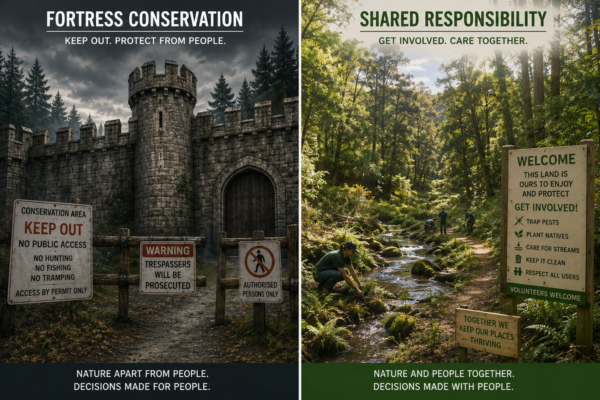
The recent Conversation article on conservation reform argues that New Zealand should move away from what it describes as “fortress conservation” – the idea that nature is best protected by separating people from it. It suggests a more relational model that recognises Māori values and partnerships in environmental governance. While this contributes to an important discussion, it also overlooks a group that has quietly supported conservation for generations: ordinary New Zealanders.
For many people, conservation is not an abstract legal or constitutional concept. It is the family that spends weekends trapping predators in a local reserve, the tramping club maintaining back-country tracks, the hunting groups controlling wild animals, the fishing club restoring stream banks, or the volunteers cleaning rubbish from beaches. These people are neither government agencies nor political advocates. They simply care for the places they use.
The debate is too often framed as a choice between preservation and development, or between one governance model and another. In reality, successful conservation depends on something far broader. Governments establish policy, DOC provides management, iwi contribute generations of local knowledge, scientists provide evidence, and communities supply thousands of hours of voluntary effort. None of these groups alone can achieve lasting conservation outcomes.
The proposed Conservation Amendment Bill has already demonstrated the importance of public engagement. Widespread opposition resulted in the proposed powers to sell or exchange conservation land being withdrawn. That was democracy working as it should. At the same time, broader concerns remain about proposals that would require DOC to give greater weight to economic development. Those issues deserve careful public scrutiny because conservation decisions often outlast the governments that make them.
The Conversation article rightly argues that conservation should reflect New Zealand’s unique circumstances rather than simply adopting overseas models. CORANZ agrees. But neither should we replace one narrow philosophy with another. Public conservation land serves many purposes. It protects biodiversity, preserves landscapes, supports recreation, respects cultural heritage, contributes to tourism and provides opportunities for education and scientific research. Good conservation recognises all of these values without allowing any single interest to dominate.
Ultimately, governance structures are only a means to an end. Whether land is managed by DOC, iwi, local communities or collaborative partnerships, the measure of success should remain the same. Are ecosystems healthier? Are native species recovering? Is public confidence increasing? Are future generations inheriting a richer natural environment than the one we enjoy today?
Conservation succeeds not because responsibility rests with one organisation or one philosophy, but because responsibility is shared. New Zealand’s greatest environmental successes have almost always been achieved when governments, communities, volunteers, recreational users, iwi and scientists have worked together. That remains the strongest foundation for the future of our public conservation estate.
I made the comment at a MAF Biosecurity Pest Management Strategy meeting a good number of years ago that “ there is an army of volunteers out there to help if the DoC didn’t piss so many people off “. The comment was received extremely well by many of the participants at the meeting which ironically wasn’t attended by the DoC or AHB they obviously already had their agenda sorted out and didn’t need anyones suggestions on what could be achieved.
I spoke to a select committee a few years ago and stated that DOC was the most despised and distrusted of all Government departments. I was amazed at how much agreement among the M.P.s that comment got. They certainly need to garner greater public support or the coalition will probably dissolve them as a separate group if re-elected.
Well then why don’t the MPs do something about DoC?