
Southland’s proposed AI data centre has sparked debate over water use, electricity demand and the rapid growth of artificial intelligence. Those are all important issues. Yet one question raised during the discussion may prove far more significant than the project itself.
The company has received resource consents allowing it to draw more than 600,000 litres of groundwater each day. At the same time, it says the facility will rely almost entirely on rainwater harvesting and Southland’s cool climate, requiring only small amounts of water for occasional cooling. If that proves correct, the groundwater consent may never be exercised. That naturally leads to an obvious question: why is such a large allocation required?
Resource consents grant legal rights, not statements of intent. Businesses change ownership, technology evolves, operating conditions shift and commercial priorities can alter over time. A consent issued today may still exist decades from now under circumstances very different from those described during the application process. That is why the scope of a consent deserves as much scrutiny as the applicant’s current plans.
This principle extends well beyond one data centre. Water, like conservation land, is a public resource. Allocating access to that resource should reflect realistic operational requirements while retaining sufficient flexibility for genuine contingencies. Consenting significantly more than is expected to be needed may sometimes be justified, but the reasons should be clear, transparent and capable of public scrutiny.
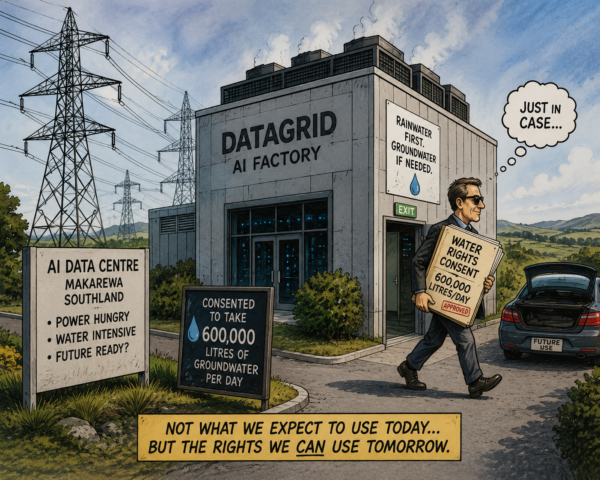
The issue is not whether Datagrid is acting in good faith. The company may genuinely expect never to draw significant quantities of groundwater. The issue is whether New Zealand’s consenting framework has adequately considered the legal rights being created. If circumstances change in ten or twenty years, can the consent be exercised to its full extent? Can the allocation be transferred to another operator or another use within the same aquifer? Is the consent tied exclusively to this development, or does it survive changes in ownership? If the groundwater is never required, are there review mechanisms to reduce or revoke the allocation? These are not criticisms of the company. They are reasonable questions whenever substantial rights over a public resource are granted.
Good environmental management depends upon durable decisions. Resource consents should provide sufficient flexibility for responsible operation while protecting public resources from unnecessary allocation. This is not about opposing artificial intelligence or industrial development. It is about ensuring that public resources are allocated on the basis of demonstrable need, not simply the maximum that might one day prove convenient.
AI is such a new innovation, although datacentres have existed for decades. This new breed is of an entirely new dimension.
We have no idea what will happen even in the next 5 years. If quantum computing kicks in, these megaliths will be obsolete overnight.
But the water rights will not. What happens to them?
Perhaps the water rights would be better on a much shorter timescale with options for review rather than 10 or 20 years – an age in computing circles.
AI is here to stay, like it or not, based on other global governments, New Zealand will follow suit or get left behind, regardless of the risk
Damned technology! Some benefits but a lot of negatives, the environment and resources being one of the major ones to suffer.
The allocation of such huge water rights and permission to build huge data centres without proper public scrutiny is outrageous. What are these data centres being used for used for? They are being used by multinational global corporations to collect data to control and exploit us. If you don’t know what one world government and agenda 2050 are all about you need to do some homework. Water is the new gold, it is in short supply worldwide, large corporations are trying to lock in low prices the same way Manapouri Power was sold to Rio Tinto’s Bluff Aluminium Smelter for 3 cents / kilowatt when NZ consumes were paying 7 cents a kilowatt in the 1960’s. We had Muldoon’s “Think Big” to thank for that and local politicians who were given sweetheart share deals. New Zealand is still a young rich country, full of resources. We are still being looted by big business in the same way as the New Zealand Company looted our resources in the 1840s and 1850s. Google Peter Theil and Black Rock and see the outrageous sums of money the head guys in these companies make. We should say NO to data centres and water right allocations until the true intentions of these overseas corporates are understood.
It seems like a lot of water bottles could be filled with that allocation. Does this mean they could resell their allocation? An explanation of the need for public water needs to be demanded, and a fair charge needs to be charged.