
The Government’s decision to abolish Mana Whakahono ā Rohe agreements has been welcomed by many New Zealanders who saw them as introducing an additional layer of influence into local government decision-making. Prime Minister Christopher Luxon has presented the change as part of a broader effort to simplify the resource management system while ensuring all New Zealanders are treated equally. Yet the Government has also confirmed that these agreements will be replaced by new, more narrowly scoped iwi participation agreements. That immediately raises an obvious question: what has actually changed?
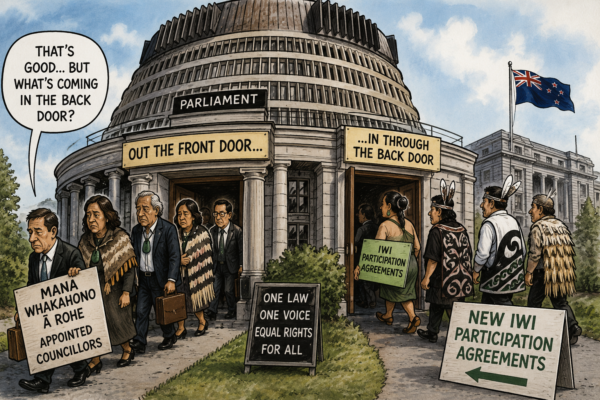
The concern is not simply that one set of arrangements is ending and another beginning. It is that the practical differences between the two have yet to be clearly explained. If existing agreements are to disappear but new agreements will perform similar functions, the public is entitled to understand precisely where the line has been drawn. Without that clarity, confidence inevitably suffers.
CORANZ has received considerable correspondence from members and supporters expressing concern that New Zealand continues to move towards governance arrangements based on ethnicity rather than equal democratic representation. Many believe decisions affecting public resources should be made through institutions accountable to every New Zealander, with every citizen having an equal voice regardless of ancestry. Whether others agree or disagree with that view, it represents a genuine and strongly held concern among many who use and value New Zealand’s public lands and waters.
The Government has stated that the new participation agreements will be limited to statutory planning processes and the implementation of existing Treaty settlement obligations. If that is the case, there should be no difficulty in publishing exactly how those agreements differ from the arrangements they replace. Good legislation should leave little room for uncertainty, particularly where questions of public representation and decision-making are involved.
This debate is not about denying the importance of Treaty settlements or the role of iwi in matters where Parliament has already established rights and obligations. It is about ensuring that any continuing participation arrangements are clearly defined, transparent and readily understood by the wider public. Confusion benefits no one. It creates suspicion where clarity should exist.
Environmental law, local government and public access all depend upon public confidence. When legislation is introduced, amended or replaced, New Zealanders should not be left wondering what has really changed. If the Government believes the new arrangements are materially different from those they replace, it should demonstrate those differences openly and in detail. Trust is strengthened by transparency, not by reassurance alone.
This from Hobson’s pledge today:
Dear Dave,
We have grounds for a celebration today and to be grateful to Hobson’s Pledge’s many supporters who have joined us in calling on the Government to end agreements between iwi and various councils across the country.
Called Mana Whakahono ā Rohe (MWAR) agreements, these are effectively a back door to co-governance of your councils, and certainly offend against equal rights – the ability for every ratepayer, regardless of race, to have their say equally.
While we are delighted to share this positive development with you, there are some notes of caution as well.
But first to the good news. Yesterday, RMA Reform Minister Chris Bishop and Parliamentary Under-Secretary Simon Court announced that the Environment Committee has reported back on the Government’s new planning legislation. As you know, the current Resource Management Act (RMA) is being replaced with two new Bills – the Planning Bill and the Natural Environment Bill.
Crucially, the Cabinet has agreed to an eleventh-hour amendment: existing and proposed Mana Whakahono ā Rohe (MWAR) agreements will completely terminate and will not transfer into the new planning system.
This is an enormous victory for equal citizenship, and the credit belongs to a powerful group of voices who refused to stay silent.
Hobson’s Pledge has been campaigning aggressively against these back-door co-governance arrangements for months, warning how activist iwi and weak-kneed local councils were rushing to lock them in before the RMA is officially repealed. When you wrote to the Minister and joined our campaign, you forced the decision-makers to listen.
But we do not claim this win alone. This was a triumph of collective pressure. We must acknowledge the vital role played by ACT leader David Seymour, who strongly advocated for scrapping these agreements, and Parliamentary Under-Secretary Simon Court, who did the hard yards behind the scenes. Ultimately, Minister Chris Bishop made the final call at the Cabinet table, and he deserves credit for listening to the overwhelming public concern and fronting this necessary decision.
We must also salute our friends at Federated Farmers and the Taxpayers’ Union. Federated Farmers led the charge with a robust select committee submission and successfully halted Environment Canterbury’s reckless attempt to ram through a massive suite of MWAR agreements just last week. It is immensely heartening to see major organisations standing shoulder-to-shoulder on this constitutional issue.
Similarly, we owe a debt of gratitude to local heroes like Councillor Davina Smolders in the Far North. Hobson’s Pledge was proud to amplify her brave stand against these rushed deals. She, along with other principled councillors around the country, have been warning that opportunistic iwi and compliant local authorities were quietly establishing parallel governance structures without proper oversight or genuine community engagement.
Thanks to our collective pressure, those undemocratic instruments are now dead in the water.
However, this significant win must also be tempered with caution.
While the Government has wisely taken MWARs off the table, they have simultaneously announced plans to replace them with a new mechanism: “narrowly scoped iwi participation agreements.” The Minister promises there will be “clear guardrails” to prevent scope creep.
But we have heard these hollow assurances before.
Have we learned nothing from history? Look no further than the Marine and Coastal Area (MACA) Act. Parliament was explicitly clear back in 2011 that the threshold for customary marine title was to be extraordinarily high. Yet, the courts performed spectacular legal acrobatics to completely subvert the intention of the law, opening the floodgates to vast tribal claims.
You will recall our very successful full front-page advertisements in the newspapers at the time, pointing out the obvious – that pretty much all New Zealand’s coastline could now be claimed thanks to the court’s ruling. In response to our advocacy, the Government amended the law to restore the original intention of Parliament, but even now, we have no doubt activists and lawyers are looking for new ways to subvert Parliament’s intent.
Once you open the legislative door even an inch, activist courts and ideologically driven councils will invariably seek to kick it wide open. The solution is simple – do not replace MWARs with ‘iwi participation agreements’ at all.
There is no need for such agreements, and we must reject the idea that such race-based arrangements are needed in the first place.
Every single New Zealander – regardless of when their ancestors arrived in this country – already has the absolute right to participate in local government and statutory planning processes. We elect our councils democratically. We submit on district plans equally. We can engage our mayors and councillors equally.
Why, then, does one specific group require a bespoke, separate, and privileged statutory pathway to participate?
The concept of “iwi participation agreements” is inherently flawed. In our modern, multi-ethnic democracy, we are meant to have equal rights. One person, one vote. Equal weight before the law.
So while we congratulate the Government on removing Mana Whakahono ā Rohe agreements, we here at Hobson’s Pledge think the Government needs to take these separate agreements entirely off the table and replace them with precisely nothing.
Together, we have won a major skirmish by ending MWAR agreements, but the broader battle for equal citizenship goes on. We cannot afford to become complacent.
Chip in here to continue our fight.
I want to extend my deepest thanks to every single one of you who have sent submissions, signed petitions, and financially supported Hobson’s Pledge alongside our allies. Together, we have proven once again that we can make the Government change course.
As these new Bills head towards their Second Reading, we still have much work to do, including ensuring that these “iwi participation agreements” do not simply become the old co-governance agenda under a new, sanitised name.
[If you are able, please consider making a financial contribution today so we can keep the pressure on Parliament.]
We have shown that our collective voice works – let’s ensure it stays loud enough to finish the job.
Thank you for your ongoing commitment to an equal New Zealand.
Yours sincerely,
Don Brash
Trustee of Hobson’s Pledge
P.S. The battle is far from over. We must act immediately to stop this new loophole before it takes root. If you can assist us, please consider making a financial contribution today.