CORANZ Commentary
Recent headlines about H5N1 avian influenza have reminded New Zealanders how quickly an animal disease can become a matter of national concern. Yet birds represent only one part of New Zealand’s biosecurity challenge. Every day, agencies work quietly to prevent the introduction of diseases and pests that could affect our rivers, forests, lakes, wetlands and coastlines. Most of us never notice their success because, quite simply, nothing happens.
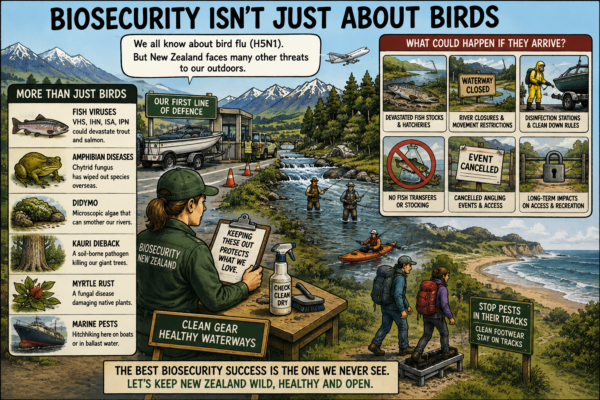
Few outdoor recreationists realise that overseas fish viruses capable of devastating trout and salmon populations are absent from New Zealand. Likewise, our country continues to battle threats such as didymo, kauri dieback, myrtle rust and a growing list of invasive freshwater and marine pests. Each presents different challenges, but they share one common feature: once established, eradication is often difficult or impossible.
The consequences extend well beyond wildlife. Imagine if an exotic fish disease were detected in a major catchment. Hatcheries could close. Fish movements would cease. Recreational fishing competitions might be postponed. Boats, trailers and fishing equipment could require mandatory disinfection before entering other waterways. Access restrictions, while unpopular, might become necessary to slow the spread while authorities assessed the risk.
No one welcomes such measures. Outdoor recreation depends upon access and freedom to enjoy New Zealand’s natural environment. Yet history has shown that early, proportionate action often prevents much greater restrictions later. Biosecurity is one of those rare fields where success is measured not by what happens, but by what never occurs.
This principle applies well beyond fisheries. Kauri dieback has changed how visitors move through some forests. Didymo has altered boating and fishing practices in parts of the South Island. Myrtle rust has affected native species and restoration projects. Each reminds us that protecting outdoor recreation sometimes requires adapting how we use the places we value.
The challenge is maintaining balance. Biosecurity responses should be proportionate, evidence-based and regularly reviewed as new information becomes available. New Zealanders are right to ask questions whenever restrictions are proposed, but they should also recognise that prevention remains our strongest defence against much greater disruption.
The best biosecurity programme is rarely noticed. Healthy forests, thriving fisheries, productive farms and unrestricted public access are often the result of countless quiet successes occurring behind the scenes. For those who enjoy New Zealand’s outdoors, biosecurity is not simply about protecting wildlife. It is about protecting the very places and experiences that define outdoor recreation itself.