
Special Report
According to reports from Australia Woolworths ceased the sale of a deadly line of pest control products from Saturday August 1. Brands of rodenticide like Talon Rat and Mouse Killer containing brodifacoum have been removed from shop shelves. Bunnings Warehouse has pledged to do the same.
A decade-of research spearheaded by Edith Coiwn University found the poisons were killing
It follows a March recommendation by the Australian Pesticides and Veterinary Medicines Authority (APVMA) that the five second-generation anticoagulant rodenticide (SGAR) chemicals be declared Restricted Chemical Products (RCPs).
A decade of research, spearheaded by Edith Cowan University, Western Australia, found the poisons were killing native birds and mammals, especially owls and eagles that eat rats and mice.
“Following a review of our product range, Woolworths will cease sale of Second-Generation Anticoagulant Rodenticide (SGAR) products from the end of July 2026,” said the supermarket giant in a press release.
Slow, Cruel Death
Poisons like brodifacoum are highly effective at killing rodents, but they do not kill them quickly. After eating poisoned bait, a doomed “zombie” rodent will remain alive for several days, potentially up to a week. During this time, their behaviour changes. Normally cautious, these nocturnal animals become slower, disoriented and far more likely to be eaten by predators such as owls and falcons or even a pet cat or dog.
Crucially, these poisoned “zombie” rodents can continue to eat more poisoned bait. By the time they die, they may contain very high concentrations of rodenticide.
Brodifacoum works by stopping blood from clotting which causes fatal internal bleeding.
Worse than 1080
But critics say the changes to rules do not go far enough. One source says “Australia has restricted public sales of certain dangerous rat poisons. These new rules target second-generation anticoagulant rodenticides (SGARs) to protect native wildlife. Rat poisons are not entirely banned, but regular shoppers can no longer freely buy the strongest types.
Brodifacoum is very arguably far more lethal than 1080 poison. The withholding period for 1080 is six months, for brodifacoum it’s 36 months.
In New Zealand brodifacoum is used by the Department of Conservation and regional councils and rat poisons are freely sold over shop shelves.
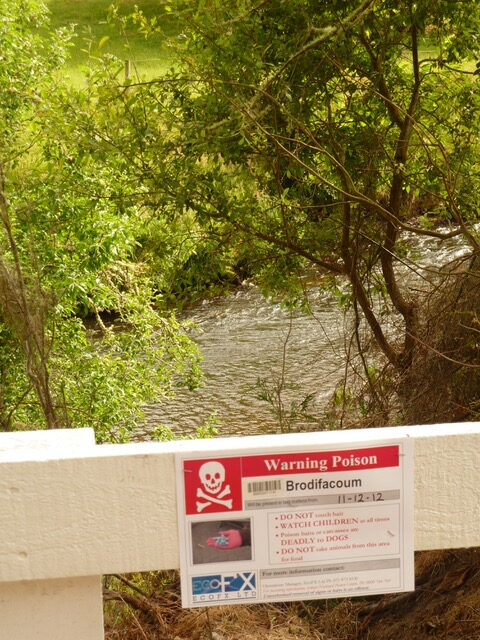
Brodifacoum is e xtremely cruel. RSPCA Australia says “these poisons are not considered to be humane due to their toxic effects including difficulty breathing, weakness, vomiting, bleeding gums, seizures, abdominal swelling and pain. In addition, the body of the poisoned rodent presents a significant risk if it is eaten by other animals, including native wildlife.”
In 2004, MPI noted detection of brodifacoum residues in liver samples of wild pigs particularly in areas such as the Marlborough Sounds where absent bach owners had scattered brodifacoum rat poison around their properties. Wild pigs either ate baits directly or ate toxic rat carcasses. No warning is given to pig hunters who could unknowingly be putting wild pork laced with brodifaoum poison on the family’s dinner plates.
Residues were still detected in some wildlife at least 24 months after brodifacoum use ceased.
Two dead eels found in a Southland waterway had brodifacoum in the gut contents of one and that “suggests the eel had recently ingested food containing brodifacoum, probably through scavenging the carcass of a poisoned possum.”
Well “Jasper” you can’t depend on DoC – or government – to show any concern about dangers to bird life or even to human health, but there’s another public group Fish and Game NZ who should be opposed to poisoins whether 1080 or brodifacoum.
In 2005 a paper in the New Zealand Journal of Marine and Freshwater Research, Volume 39, told of freshwater crayfish (koura) with significant 1080 concentrations and 1080 residues in eel tissue that were on average 12 times higher than the PMAV (provisional maximum acceptable level).
The INTERNATIONAL PROGRAMME ON CHEMICAL SAFETY Health and Safety Guide No. 93 said of brodifacoum “as a technical material – is highly toxic for fish”.
1080 is ecologically destructive and damaging to the ecosystem – but brodifacoum is far worse.
Regardless of where people stand on pest control, transparency is important. If one country is tightening controls because of impacts on native wildlife, New Zealanders deserve an open discussion about whether our own policies remain appropriate.
The real lesson from Australia is that environmental policy should evolve as new evidence becomes available. Reviewing old decisions shouldn’t be seen as criticism-it should be seen as good environmental management.
One thing I’d like to know is how often residues are actually monitored in New Zealand wildlife after brodifacoum operations. If we’re using these products, we should also be measuring their wider impacts.
It would be useful to see an independent comparison of 1080, brodifacoum and the newer non-anticoagulant rodenticides. We need to understand the advantages and disadvantages of each rather than treating every poison as if they’re all the same.
Australia’s supermarkets have decided the risks justify removing these products from general sale. That raises an obvious question: why is New Zealand still comfortable with unrestricted retail availability?
Good article. Whatever position people take on pest control, decisions should be based on current science and regular review rather than simply continuing past practice because “that’s how we’ve always done it.”
Outdoor users spend a lot of time observing wildlife. If secondary poisoning is affecting birds of prey and scavengers, that’s something everyone with an interest in conservation should be concerned about.
The issue isn’t whether rats should be controlled. They absolutely should. The question is whether there are safer methods available that don’t leave long-lasting residues in wildlife and the wider environment.
We often hear about the risks of 1080, but very little is said publicly about brodifacoum. If Australia can review its policies, surely it’s reasonable for New Zealand to do the same.
Australia seems to be recognising that pest control isn’t just about killing rodents, it’s about what happens further up the food chain. That’s a conversation New Zealand also needs to have.
Every few years I see the loss of my beautiful raptors, killed by secondary poisoning. Local predator control using a mix of 1080 and Brodifacoum on adjoining Council Controlled properties see the birds disappear overnight. It takes two or more years for them to return only to disappear a short time later as the cruel cycle is repeated.
I’ve never forgotten telling a local contractor (when I lived on the West Coast) that he was dropping 1080 on an area which included a local drinking water supply intake. No problem he reckoned – there’s a layer of shingle over the intake.
Typical of the ignorance promulgated by DoC and their contractor partners in crime.
Supermarkets are some of the biggest users of Broadificoum and related anticoagulent rodenticides in the world. Tha’s how they keep rats and mice out of their stores. It’s a bit rich that they no longer sell it to the public but no doubt give themselves an exception.
Both so these creul poisons should be completely banned from any kind on use in New Zealand and globally.
I can promise you that after hearing an animal screaming in agony after taking a bait, will be with you for the rest of your life