
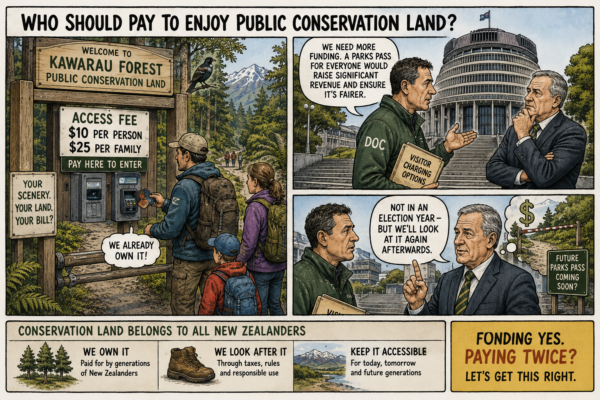
Lost among recent discussion about visitor counters, artificial intelligence and improved visitor management was a far more significant revelation. Department of Conservation papers show officials considered retaining the flexibility to charge not only international visitors, but New Zealanders as well for access to public conservation land through options such as a national parks pass.
For now, the Government has chosen a different path. The current proposal is to introduce charges only for international visitors at a small number of high-profile destinations such as Milford Sound, Aoraki/Mount Cook, Cathedral Cove and the Tongariro Alpine Crossing. Most New Zealanders would see this as a reasonable contribution towards maintaining facilities heavily used by overseas visitors.
However, the proposal also raises a broader question. If charging for access becomes an accepted principle, where does it end?
New Zealand’s conservation estate is unlike many national park systems overseas. These lands were set aside over generations for the benefit of all New Zealanders. They are managed by the Crown on behalf of the public and funded largely through general taxation. Public access has long been regarded as part of that social contract. While practical restrictions are sometimes necessary to protect fragile environments or ensure public safety, access itself has generally remained free.
There is no doubt that maintaining conservation land is expensive. Tracks, huts, bridges, toilets, pest control, visitor facilities and ecological restoration all require ongoing investment. DOC faces increasing expectations while managing an estate that attracts millions of visits each year. Identifying sustainable funding sources is therefore both understandable and necessary.
What deserves careful thought is not whether conservation requires funding, but who should provide it.
International visitors, who may experience some of New Zealand’s most iconic landscapes only once in their lifetime, can reasonably be asked to contribute towards the facilities they use. That is a policy many countries have adopted successfully.
Charging New Zealanders is a very different proposition.
Citizens already contribute through taxes to purchase, manage and protect the conservation estate. Introducing an additional access charge risks changing an important principle: from public land held in trust for the nation to a public asset that increasingly operates on a user-pays basis.
History suggests that once a charging mechanism exists, pressure often grows to expand it. Today’s international visitor levy can become tomorrow’s annual parks pass. A charge introduced for a handful of iconic destinations may gradually spread to other locations as maintenance costs increase and governments search for additional revenue. Whether or not that ultimately occurs, it is a possibility that deserves open public discussion before the principle becomes established.
Technology may help DOC better understand visitor numbers and improve management decisions. Better information should lead to better conservation outcomes. But technology should not distract from the more fundamental debate about public access and public ownership.
Conservation land is more than a tourism asset. It is part of New Zealand’s shared natural heritage. Sustainable funding is essential, but so too is preserving the long-standing expectation that New Zealanders should continue to enjoy reasonable access to the landscapes they collectively own.
The question is therefore not simply who should pay today. It is how long future governments will resist the temptation to extend user-pays charging to the very people who already own and fund these remarkable places.
Roads are a public asset, as are trains, buses, etc and yet we pay to use them through fares, road user tax, rates, and so on. A levy to cover maintenance ans Search & Rescue would seem fair enough.
I tend to agree with Rekindle but in saying that, when it happens and I believe ii will, it must be on a level playing field..