
Guest Post by Dave Rhodes
I live in a remote rural area. Narrow country lanes, no streetlights, no traffic to speak of. The nearest village is about eight kilometres away and most nights, driving home means having the road almost entirely to yourself.
Over the past two nights something unexpected happened on my drive after dark.
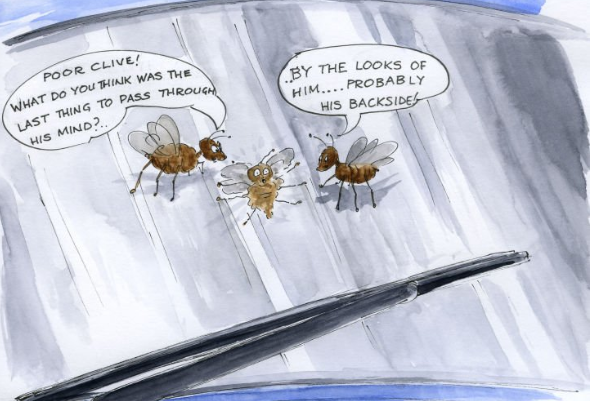
By the time I reached home, my windscreen was covered in flying insects. Not a few. Not the odd splatter. But enough to make me stop and clean the glass - something I haven’t had to do in years.
It was so unfamiliar that it took a moment to register what I was seeing.
For a long time now, the absence of insects has felt normal. Quiet summer nights. Clear windscreens. Fewer birds at dusk. We’ve talked endlessly about biodiversity loss, declining insect populations, collapsing food webs - but for most of us those ideas live in reports and headlines, not in daily experience.
Then suddenly, there they were again.
Remembering what “normal” used to be
Anyone who grew up rural will remember when this was unremarkable. Driving at night in summer meant wiping insects from headlights and glass. Swallows and martins skimmed paddocks. Bats flickered at dusk. Raptors patrolled roadsides, hedges and gullies.
Over time, those signs faded quietly. There was no announcement, no single moment where anyone said, “Something has changed.” It just became the way things were.
Until now.
What struck me wasn’t just the insects themselves, but what they represented. A baseline we’d forgotten. A reminder that abundance - even modest abundance - used to be ordinary.
Signs that arrive out of order
Last year, before the insects returned, something else changed. Raptors began to reappear. Harriers at first, then more consistent sightings. They didn’t arrive suddenly in numbers - just often enough to notice. Enough to suggest that the landscape was once again supporting prey.
Ecology tends to rebuild from the bottom up. Insects first. Then small birds. Then predators. The order matters, and it takes time.
That’s why this moment feels significant. Not because everything is suddenly “fixed” - it isn’t - but because the sequence makes sense. Food webs don’t respond to policy statements. They respond to conditions.
The long view nature insists on
This area was heavily treated with poison several years ago. 1080. Brodifacoum. The impacts were visible at the time - not always directly, but in what went missing afterwards.
What’s striking now is how long recovery has taken. Not months. Not a season. Years.
That’s worth sitting with.
Nature doesn’t operate on funding cycles, annual reports, or election timetables. It doesn’t respond to slogans or urgency. It recovers - when it can - slowly, unevenly, and locally.
And when it does, the signs aren’t dramatic press releases. They’re insects on a windscreen. Birds on a fence line. A sense that something has quietly shifted.
Resilience without complacency
This isn’t an argument that everything will sort itself out if we just wait long enough. Many systems won’t. Some losses are permanent. Others are conditional - dependent on restraint, patience, and time.
But it is a reminder that nature is more resilient than we sometimes allow for in our debates.
That matters, because much of today’s environmental conversation assumes fragility above all else. As if ecosystems are so delicate that any human presence is inherently destructive. As if recovery is impossible without constant intervention.
What I’m seeing suggests something more nuanced. Damage can be real and severe - and recovery, when it happens, is neither quick nor guaranteed. But given space, time, and a pause in pressure, systems can rebuild.
This really matters to outdoor communities
For those of us who hunt, fish, tramp, paddle, or simply spend time outside, these changes are not abstract. They’re felt. Observed. Lived.
Outdoor recreation isn’t separate from ecology - it’s often where ecological change is first noticed. Not in datasets, but in experience.
That’s one of CORANZ’s quiet strengths. We represent people who are present in landscapes year after year, not just when a project is launched or a policy is reviewed. We notice absence. And we notice return.
A cautious optimism
I don’t know if this recovery will last. I don’t know how widespread it is, or how fragile it may be. Local conditions matter. Timing matters. Pressure can return.
But for now, it feels worth acknowledging something we don’t talk about often enough: recovery is possible.
Not everywhere. Not all at once. Not on demand.
But sometimes, on a quiet country road, late at night, you notice it anyway.
And that’s worth remembering - especially in a world that so often tells us only what we’re losing.
Just a point Dave, I wonder if insects are developing a resistance to chemicals in pesticides? If so that will mean heavier concentrations of ugly chemicals.
Long term it’s not a good outlook.
Yes I’ve noticed more insects when returning after dark from hunting in local hills just like years ago because 10 years or so over several or a dozen years, insects were not to be seen. But like “Eco-Sense” I wondered about insect resistance because the local vineyards (too many of them..foreign owned largely) use a really vicious chemical called Karate. It’s lethal to aquatic life – Fish and Game, wake up and take note.
Anyone know of Karate?
It is lethal to any life that comes hear it.
How is it that such a chemical is legal to spray around.
Clean green NZ? Yeah right!
I spoke with a crop fertilizer rep a few years ago. I asked about the use of karate. He advised that it’s very rare and hardly used anymore. I stated I thought all vineyards used it. His exact words were karate has killed everything. Vineyards have completely wiped out all the insects they didn’t want and he doubted they would ever reestablish.
Disgusting outlook from a so called farm rep. He was pleased a product he sold had been involved in environmental ecocide
A real bugger
It’s encouraging to read of any positive signs albeit on a limited local area.
But given the number of – presumably local council employees – one sees spraying goodness knows what on roadsides and around random green spaces, it seems that spraying is a council addiction. And then there’s the spraying on town streets that occurs from the back of moving utes – and with no protective gear for the operators or anyone who happens to be walking past.
It suggests a variation on the old saying……..Engage brain before spraying.
Yes council spraying contractors sitting on back of a 4WD, waving a wand with a vapour of toxin and at times in windy conditions.
NZ clean and green-Ha! What a bad shameful joke.