
The Conservative Party New Zealand wants the practice of carbon farming stopped because of deep damage to agricultural production, rural communities and the environment.
Helen Houghton Conservative Party leader said the practice of carbon farming under the flawed Emissions Trading Scheme (ETS) was a failure economically and environmentally.
“The government tried to sell 3.9 million carbon credits last month. Nobody bought any,” she said.
It was the seventh consecutive quarterly auction where this had happened. While struggling to sell units domestically, Treasury estimates project a major national emissions shortfall, leaving the government facing multibillion-dollar costs if it has to purchase offshore carbon credits to meet international Paris Agreement targets.
“The economic failure also is seen in the depopulation of rural New Zealand and the decline in rural communities as employment is virtually zero in unmanaged forest blocks compared to a farming economy,” said Helen Houghton. “In addition there’s the loss of productive sheep and beef farms as speculators haphazardly plant pines. You can’t eat pine needles and cones.”
But the Conservative Party’s concern also centred on the despoiling of the environment.
“Pine trees have a insatiable thirst for water,’ said Helen Houghton. “Pine trees consume significantly more water than native vegetation, shrinking local stream flows or causing small streams to dry up. Parent rivers decrease in flow.”
Thirsty Pines
Pine trees consume large amounts of water-often absorbing roughly 38 litres of water per 2.5 cms (one inch) of trunk diameter daily. A mature pine can absorb up to 560 litres a day with an abundant water supply.
In addition, pines monocultures lack biological diversity and support a fraction of the wildlife found in native forests or farmland. Pine trees like contorta and pines radiata produce seeds that are windblown and currently are an increasing invasive threat to the high country as well as areas like the Marlborough Sounds.
Pine monocultures are a potential wildfire hazard. Pine needles increase soil acidity over time (lowering pH), which alters soil chemistry and harms native organisms. Rain washes acidic compounds from the soil into nearby rivers and streams, threatening aquatic life, native fish and trout when the pH drops below 5.5.
Bare pine forest floors absorb water less effectively than spongy native bush. This leads to flashier, heavier runoff during storms.
Disaster
Carbon farming is an economic failure and an environmental disaster,” said Helen Houghton. Helen Houghton said the current government was stupid to carry on with carbon farming.
“Even more stupid was the Labour government previously who relaxed the laws around foreign ownership resulting in overseas speculators to come in and profit at the expense of the economy and environment,” she said.
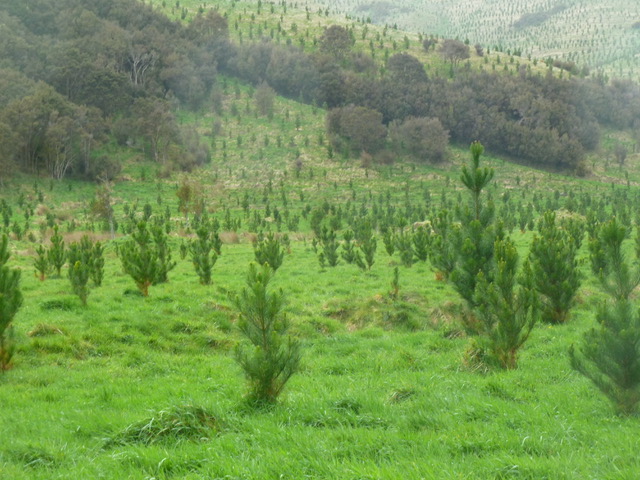
Newly planted pine trees for carbon farming, Wairarapa
How stupid is covering productive farm land with unmanaged pine plantations with all the inherent risks of fire in dry times and wilding pine spread??
Good to see a political party standing up for commonsense, sadly not in parliament though.
I’ve seen tributary streams – important trout spawning streams – dry up since pines were planted. As trees grow the water taken in increases dramatically.