
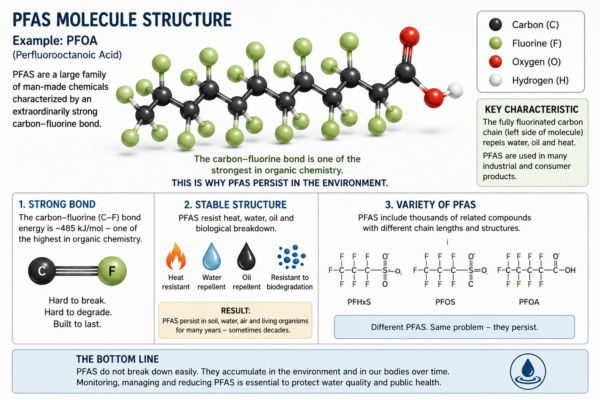
New Zealand is preparing for its most extensive testing yet of PFAS, commonly referred to as “forever chemicals,” in groundwater and drinking supplies. The scale of the programme reflects a growing awareness of these substances, which persist in the environment and are slow to break down. Earlier testing suggested low levels of contamination, but coverage was limited and results were described as only a baseline.
PFAS are not a single substance but a large group of compounds, numbering in the thousands. Their chemical stability makes them useful in industrial and firefighting applications, but that same stability means they remain in soil and water for extended periods. Testing to date has sampled a relatively small number of sites, and some results were later found to be affected by contamination in the testing process itself.
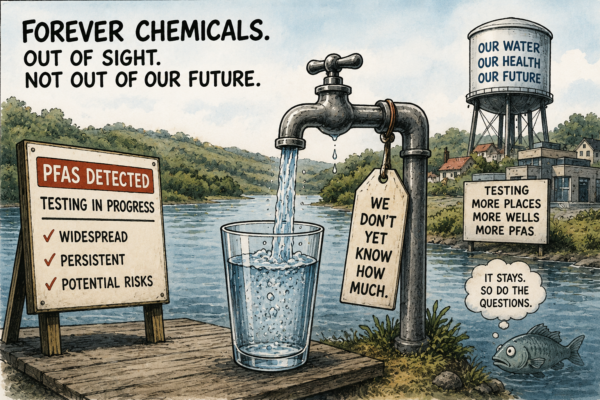
This shifts the focus from known risk to unknown extent. Low readings in limited locations do not necessarily reflect broader conditions, particularly where contamination is localised around specific activities such as defence sites or airports. Expanding testing will improve understanding, but it also acknowledges that the current picture is incomplete.
The pattern is familiar. Substances once considered low risk can, over time, reveal wider distribution or longer persistence than initially understood. Standards evolve, monitoring expands, and responses adjust accordingly. That progression reflects the nature of environmental management, where knowledge develops incrementally rather than all at once.
Water quality sits at the centre of both public health and recreational use. Confidence in that quality depends not only on measured levels, but on the robustness of monitoring and the clarity of what is known and not yet known. Where gaps exist, they are part of the system, not an exception to it.
This is not a question of immediate alarm. It is a question of understanding the full extent of substances designed not to disappear. The issue is not whether PFAS are present, but whether the systems used to measure and manage them are keeping pace with their persistence.
The majority are opposed to chlorine in drinking water but local bodies, under government orders still did it. Why didn’t the councils show some guts and tell the government to “get lost”?
Some MPs think they know better than the people. As an example, Shane Jones boasts of having a mandate. He is wrong and forgetful.
Shane Jones has contested electorate seats in three general elections: 2017, 2020, and 2023. Despite consistently running hard-fought campaigns, he has never won an electorate seat; instead, his parliamentary presence has been secured via his party list positions.
S.S., you don’t give Shane Jones credit as a “loser”. As best I can find out, he has stood five times for electorates starting in 2005 as a Labour candidate for Northland.
He was defeated.
In 2008 as a Labour candidate Jones stood in Northland again.
He was defeated.
In 2011 he stood in the maori seat Tamaki Makarau and was defeated.
In 2017 he jumped Labour’s ship and dog paddled to NZ First. He stood in Whangarei.
He was defeated.
In 2020 he stood in Northland.
Defeated again.
In 2023 he stood in Northland.
Defeated again.
You might think a “no win” situation wouldsee Jones as humble.
That arrogant attitude is not confined to Shane Jones.
It is a culture that is prevalent amongst MPs.
The public don’t want chemicals in their drinking water. MPs say “too bad’ you’re gonna get them.
Interesting topic. I wonder how much awareness there really is about these chemicals in outdoor gear.
Despite the good intentions of Andi to inform us little is ever achieved by using logic with the current coalition and their “big business” short-term gain approach. If forever chemicals are being increased they turn a blind eye and encourage it. The coalition must go. If Winston had any conscience he would agree to go with Labour. Let’s wait and see.