
A historical and future-facing analysis of New Zealand’s alpine parrot by Andi Cockroft, Chairman, CORANZ
Foreword
Following my thoughts on 1080 published earlier, it occurred to me that the mischievous Kea is almost a litmus test for what is actually happening to wildlife in New Zealand. 30 or 40 years ago, Arthurs Pass was full of Kea. They ripped windscreen wipers from cars and bent aerials. they were a nuisance – but in a good comedic way – at least to me. Yet last time I visited Arthurs Pass, not a single Kea was in evidence – something major has happened in those intervening years, but what?
Introduction
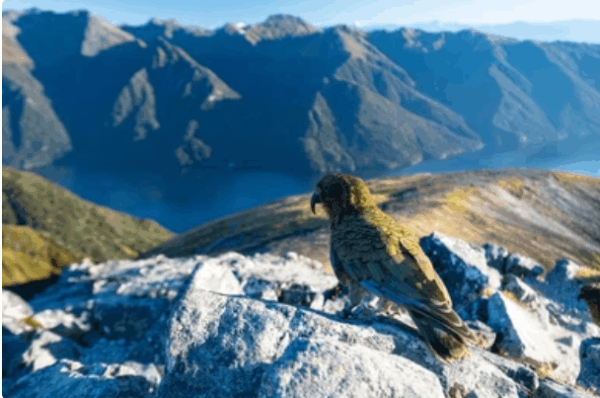
The kea (Nestor notabilis), the world’s only alpine parrot, occupies a unique space in the cultural, ecological, and historical story of New Zealand. Revered for its intelligence, feared for its mischief, and once hunted as a pest, the kea has undergone one of the most dramatic status reversals of any New Zealand species. For roughly a century, the government offered cash rewards for killing kea-an unthinkable situation today. Yet the effects of that long persecution, combined with modern hazards, continue to threaten the species’ survival.
The Mythical Kea: Trickster, Thief, and Mountain Spirit
Before Europeans arrived, kea lived largely in Māori oral traditions as enigmatic birds of the high mountains. Some Ngāi Tahu accounts regard kea as guardians of alpine passes. Early travellers told tales-often mythic or embellished-of kea predicting storms, guiding lost climbers, and stealing gold miners’ tools. This folklore cemented the kea as a symbol of intelligence, mystery, and playful danger.
Arrival of Europeans: From Curiosity to Enemy Number One
The introduction of sheep farming in the 19th century changed everything. Reports emerged of kea attacking sheep, particularly sick or stranded animals. Whether kea regularly attacked healthy sheep is still debated. Some accounts are likely true; others exaggerated or shaped by compensation incentives. Regardless, the belief exploded that kea were sheep killers, and in 1868 the first government bounty was introduced. Over the next century, more than 150,000 kea were killed.
Partial Protection and Slow Reform
By the early 20th century, concerns grew among naturalists that kea numbers were falling. Yet the bounty persisted until 1971. The Wildlife Order 1970 granted partial protection, but it was not until 1986 that kea received full legal protection. By then, vast areas of their former range had been emptied. The surviving populations were fragmented, depleted, and vulnerable.
Modern Threats: Persecution by New Means
Today, introduced predators-stoats, possums, rats, and cats-remain the leading killers of kea chicks. Lead poisoning from old huts and buildings is a major threat, with many kea showing dangerously high blood lead levels. Human conflict continues: kea tear rubber from cars, investigate buildings, and raid rubbish. Problem birds are sometimes lethally controlled, echoing the past. Tourist feeding also trains kea into risky and unnatural behaviours.
Conservation Efforts: Strategies but Slow Progress
In recent years, Te Rautaki Whakaora Kea (the Kea Recovery Plan) and programmes by the Kea Conservation Trust have targeted predator control, lead removal, and behaviour management. Where these measures are sustained, kea populations stabilise or grow. But conservation coverage remains patchy, and many regions still face decline.
What Happens if We Keep Repeating the Same Tactics?
If New Zealand continues with sporadic predator control, slow hazard mitigation, and reactive conflict management, kea will continue to decline. Local extinctions are likely. Kea may persist only in intensively managed strongholds. Continuing heavy reliance on toxins without kea-safe design risks ongoing accidental killings. Slow lead removal ensures poisoning will persist for decades.
A Different Future: Designing with Kea in Mind
A sustainable future requires a paradigm shift: landscape-scale predator control, complete removal of lead from alpine structures, kea-safe design standards for tourism and farming, and a shift in narrative from ‘kea as problem’ to ‘kea as partner’. Kea are not destructive by nature-they are highly intelligent birds responding to an environment filled with hazards and temptations. Good design can eliminate most conflict.
Conclusion
Kea have survived persecution, habitat change, and the impacts of human expansion. Their journey from ‘vermin’ to ‘endangered treasure’ mirrors New Zealand’s evolving relationship with nature. But their survival now depends on whether we continue the failing tactics of the past-or redesign our presence in the mountains to ensure they remain a living, laughing symbol of the Southern Alps.
Footnote
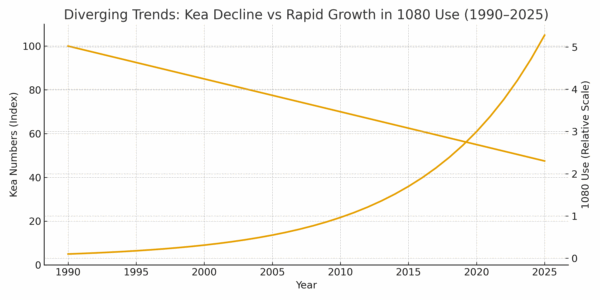
John Davey was havin difficulty inserting a graph into the comments so here it is in revealing simplicity
The first bounty placed on a Kea beak in 1868 was for £1 – that’s about $120 in today’s terms – a huge amount of money when you could easily get 10 a day they were so numerous.
See https://teara.govt.nz/en/artwork/14011/kea-on-a-sheep for 1882 propoganda
Last month 7 out of the nine tagged Kea monitored by radio tagging during the recent North Okarito aerial 1080 drop were found dead.
DoC assured the public that 1080 bait types had been modified so Kea would not be affected. In fact, we think all they did was to reduce the wax content of the manufactured pellets in the assumption that they would be hard enough to deter the birds from eating them.
The iconic parrots, Kea and Kaka have very powerful beaks they use to tear apart tree limbs to access food. GO FIGURE~!
“If New Zealand continues with sporadic predator control, slow hazard mitigation, and reactive conflict management, kea will continue to decline.” The current 1080 drops by DoC are saturating the western alpine wilderness of the Southern Alps with toxic poison.
Kea were abundant until the early 1990s just after DoC was formed and mega-1080 drops ramped up.
It is unbelievable that DOC and the cancerous forest n bird cannot see the correlation between the ten eighty poisoning regime and the decline in many species but especially the kea. Areas in the Marlborough sounds untouched by ten eighty have amazing bird sing and dawn n dusk chorus. I recently walked a ten eighty dropped national Park native forest, well off any beaten tracks. The forest was silent right even on lakes edge
When I was a kid in the eighties kea were in Marlborough and even used to visit us at our primary school on the outskirts of blenheim. 45 years later and near 1000km I need to travel to see this beautiful creature.
Shame on you DOC and your supporting cohorts
When possuming in the Matiri Valley years ago kea were numerous along with possums the kea once finding our lines destroyed many skins by pecking holes in them. Some years later while tramping in the same area I heard one kea for the week, it had been poisoned aerially with 1080. Only recently spent more time there and heard no kea and seen very few birds there was a 1080 poison warning sign-at the hut.
The continued use of 1080 poison will eventually see the demise of kea.
Why Does Nobody Come Out And Say It – 1080
For decades, nay centuries Kea lived with possums, stoats, ferrets, rats etc and still were in abundance. Even till 1971 having a bounty on their beaks they were that abundant. so what changed? Well DOC happened. We went from Acclimatisation Societies to DOC and overnight the emphasis changed. The mythical “Lets revert to pre-human” became the mantra. With their anti-exotic phobia, wanting to eliminate anything “non-native”, the emphasis switched rapidly to mass poisoning and 1080. Simply correlate Kea decline to 1080 application and cause and effect are so easy to observe. Rubbish about lead nails or feeding by tourists are simple diversions – lead nails have been around since Europeans arrived and Kea still thrived. Tourists feeding Kea probably did ramp up as both overseas an local tourism took off, but even they are only localised in places like Arthur’s Pass so only affect local populations. Put the blame where is belongs – DOC first and foremost. It’s also worth noting the zealotry that these factions attract – I remember the movements of the ’60s in peace and ban-the-bomb movements. The radical protests. Yet when the Berlin wall came down, their protest movement dried up – what to do with all that pent-up emotion? Greenpeace was born of that time, attracting failed peace campaigners with a new-found outlet for protest. That same group now urge more and more eradication of “pest” fauna – the Kea is simply a by-kill of attempts to erase dear, pigs, goats and possums.
Under the present 1080 poison prgram, the Kea will go extinct. If you look at the context currently behind the widespread use of 1080 in New Zealand, it has become the transfer of money from one group to another, and has very little to do with animal control.
The logical step to take now, is to take pest control in New Zealand out of the hands of D.O.C.
There is no place in New Zealand for the fanatical behaviour of senior D.O.C management.
And just remember that the D.O.C you may meet in a river bed is not responsible for the current distraction of our wildlife.
It is the senior management that needs to be removed, including the current Director General.
I asked AI to produce a graph detailing the increased use of 1080 since 1990 and the population decline of Kea. Leaving out all the wonderful research by “Interested Scientists” the negative correlation is hard to deny.
Just remembered another tramping trip, in an overnight stop at West Arm counted 16 kea on the hut roof ( have photos) and 5 more in a Beech tree. It would be interesting to know how many remain in that area.
Karl Lorenz is CORRECT with his Comments about sporadic predator control How so ? Much like washing the flor & leaving the porch, so all dirt & dust walks back in again ! Predator clean up work is done on DOC Estate ? only the Land next door is left full of Predators, that move in & re infest the cleaned up DOC Estate ! a never ending on going cycle & that ensures a Job for them . What is really needed is an NZ wide Predator program on all Non DOC Estate .>> With a modern method >>>”Incentive Payment ” ? the Pay goes UP as Predator numbers DROP that keep the Trappers KEEN !! could be funded with Lotto. Re Kea ? in the very near future the only Parrots will see in N.Z., is the Logo, on the Arnot’s Bickie Pack ! The Cook Islands are Light years ahead of us , as they used Reward to save their Native Lorikeet? IO8O these Days Like most AG/ Hort Chemical & Fert is OVER USED ! When the Bush Canopy is Bombed from above ? The TOXIC bait ends up high & dry ( not breaking down as quick, as on the Forest flor ) ,decorating the Native Birds nests, that are facing upwards ? Not Rocket Science to work out the Birds will bloody eat it! when served to them on a plate . The sporadic Predator Control is going on for real ? as Politicians are dragging the chain, by still NOT including Feral Cats in the Pest Free Program.