
A recent international report (here) attracted attention by arguing that wealthy countries should stop pursuing economic growth and focus instead on wellbeing, equality and environmental sustainability. Unsurprisingly, the proposal has generated considerable debate. Critics describe it as unrealistic and disconnected from human nature. Supporters argue that endless growth on a finite planet cannot continue forever.
Personally, I think both sides may be missing the more important question.
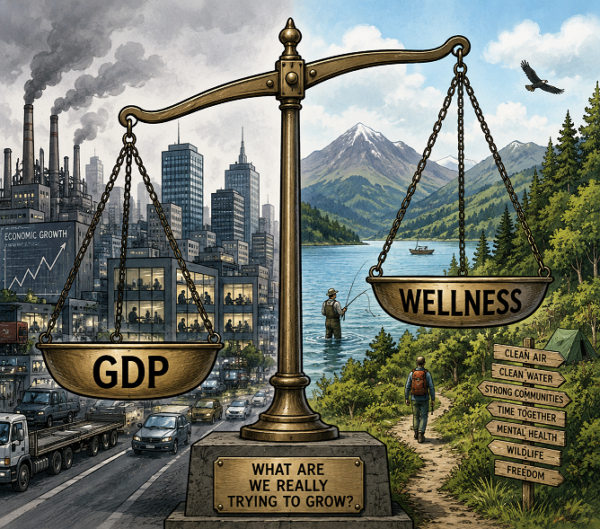
For decades politicians have spoken about economic growth as though it were an objective in its own right. Gross Domestic Product, or GDP, has become the default measure of national success. If GDP rises, we are told things are improving. If GDP falls, we are told there is a problem. Yet GDP measures economic activity, not necessarily quality of life.
I know this because I made a decision that made little sense if income was the only measure that mattered.
In 1989 I emigrated from Britain to New Zealand. In doing so I accepted an income that was around twenty percent of what I had been earning in London. Financially, it was hardly a rational decision. Yet I have never regretted it. Like many migrants, I came for lifestyle rather than money.
What I gained was difficult to measure in economic statistics. Access to open spaces. A less crowded environment. Opportunities to fish, camp, explore and enjoy the outdoors. A different pace of life. In short, many of the things that contribute to wellbeing but rarely appear in GDP figures.
That does not mean economic growth is unimportant. Far from it. Prosperity funds hospitals, schools, conservation programmes, infrastructure and public services. A healthy economy creates opportunities and provides the resources needed to address social and environmental challenges. The mistake is not pursuing growth. The mistake is treating growth as the destination rather than the vehicle.
Perhaps the question we should be asking is not whether GDP is rising, but what that growth is delivering. Are people healthier? Are communities safer? Is housing more affordable? Do families have more time together? Are our rivers, forests and coastlines improving? Are people able to enjoy the outdoors that make New Zealand unique?
Those outcomes matter because they reflect how people actually experience life.
Many New Zealanders instinctively understand this. People choose where to live, work and raise families based on far more than income alone. They value recreation, community, security, environmental quality and personal freedom. These are not luxuries. They are part of what makes life worthwhile.
Economic growth remains important. But growth should never become the measure of success itself. The real measure is whether prosperity is helping people live longer, healthier and more fulfilling lives. If we lose sight of that distinction, we risk becoming wealthier on paper while becoming poorer in ways that matter most.
Sadly not everybody has the choices that you were able to make. Amagine somebody living in Gaza with only the choice of refugee camp or rubble for shelter. The economic growth option only applies to part of the world’s population anyway. The change has to be made by those in Europe, North America, and a few others who have become inbred with the “selfish gene”.
We in the western world are governed by to many politicians that have collectively brought there country’s to there knees,, I’ll use the entire European landscape other than Poland that are in a current criss state with immergration issues, Australia also has a huge problem i Sydney and Melbourne, people that there own ideologys and will never simulate, if theres anybody in New Zealand that think that these problems wont start in New Zealand, have there heads stuck where the sun don’t shine.