
Guest post by Dave Rhodes
The Government’s proposal to scrap minimum legal size limits for commercial fishing operators is not reform. It is a breach of public trust.
For generations, New Zealanders have understood a simple principle: small fish go back. Minimum size limits exist so juvenile fish have the opportunity to mature and spawn. That principle is drilled into every recreational fisher.
Now the Government proposes that for commercial operators, that rule no longer applies.
Recreational fishers must still release undersized snapper, trevally, tarakihi and others. They can be fined if they retain them.
Commercial vessels, under this bill, will be able to land and sell those same juvenile fish.
Two rules. One resource.
Officials argue that counting undersized fish against quota creates a “disincentive” to catch them. That shifts protection from a biological boundary to a financial calculation. Sustainability becomes an accounting mechanism rather than an ecological safeguard.
If accountability were the true objective, the bill would require that every fish caught must be landed, weighed and counted. No discards. No exceptions. Full transparency.
Instead, the proposal expands discard flexibility, limits public access to onboard monitoring footage, and reduces avenues for legal challenge.
That combination does not build confidence. It erodes it.
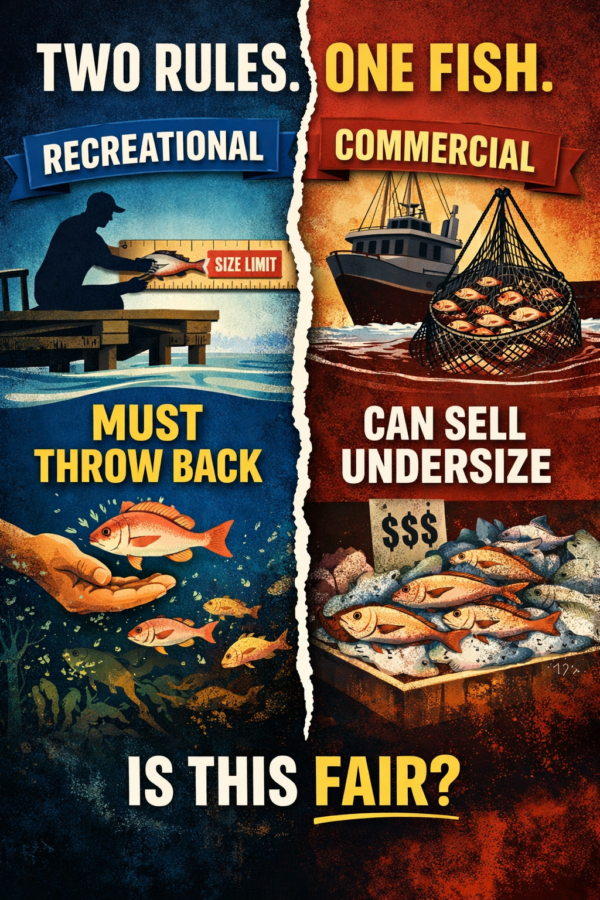
The optics are unavoidable. Children are told to measure their fish carefully and release the small ones. They can then watch those same-sized fish legally sold in a market.
Whether intended or not, the cumulative effect of recent fisheries decisions is a perception of regulatory tilt. Minister Shane Jones cannot ignore that perception - he must confront it openly.
Try explaining that at the boat ramp.
This proposal does not exist in a vacuum. It follows controversy over ring-net exemptions in high protection areas and a pattern of regulatory changes that have increased commercial flexibility. The Minister has been open about his support for the fishing industry. That makes it all the more important that decisions are visibly balanced and defensible.
Instead, this change fuels the perception that industry convenience is being prioritised over biological principle and public equity. Whether that perception is justified or not, it matters. Fisheries management depends on trust.
Fish under the Quota Management System are not corporate property. They are a public resource held in trust for present and future generations. Quota grants access within limits. It does not remove the obligation to protect juvenile fish.
Minimum size limits are a bright line. They provide clarity that financial incentives alone cannot, remove them and you normalise the harvest of fish that have not yet had a chance to reproduce.
That is not stewardship.
MPs from all parties must examine this bill carefully. If they believe in equity, transparency and long-term sustainability, they should oppose the removal of commercial minimum size limits in its current form.
This is not a partisan issue. It is a principle issue.
If Parliament cannot defend the simple rule that small fish deserve protection, it will struggle to defend the integrity of the entire fisheries system.
Members of Parliament now face a clear choice.
Stand with the long-standing biological safeguards that protect a public resource - or explain to the public why two rules for one fish is acceptable.
This is blatant corruption and to even propose this move is absolute madness
It doesn’t surprise me given Fisheries Minister Shane Jones close association with the corporate “fat cats”. Conflict of interest for the Minister?
Jones is the shock jock for the far right; once called fascists. He is in his element here politically. Of course it prioritizes commercial interests. That is the agenda of the current coalition.
If I was a less than honest boat fisherman I’d buy a couple of undersize fish and use the receipt to justify my undersize catch.
Dave Rhodes is right it undermines the concept of integrity in government.
Basic logic tells us that removing juvenile fish destroys next season’s harvest. It signals that the industry is only interested in “The Now”. I’ll be interested to see how that goes down with the voters in November; especially in the Hauraki Gulf and Bay of Plenty electorates.
I think it is a great idea. As an ex commercial fisherman I would not fish on a juvenile ground. Yes there are areas that are renown for juvenile fish that in the past in desperation to catch fish we would trawl through and only take the size we wanted and dump the rest. With cameras this would not be possible. Everything that comes on the boat would need to keep. At the factory the fisherman would be penalized for taking in the small that would end up fish mealed.
The fisherman would thus avoid juvenile grounds like the plague or go broke very fast.
Recreational guys. Which I am as well these days. Need to think outside the box. This proposal is not for the old boys club. Nor is it a Shane Jones back hander. It is a great way to build the stocks up I MHO There will be zero dumping. Once quota for the area is gone for the year it’s gone. If the fisherman handed in a lot of juvenile fish he didn’t get paid for he will be gone. Only the good fisherman will remain.
While I was fishing we never depleted an area. We protected our income with passion. It will be the same today. The guys want to be there again tomorrow so they will protect it today
Ridiculous. Shane Jones is just plain dangerous in all aspects of accountability to the NZ public. He just doesn’t care.