What New Zealand Must Learn
Post by Andi Cockroft, Chair, CORANZ
Prompted by the article from RNZ, https://www.rnz.co.nz/news/national/584692/warzone-east-coast-flooding-damage-comes-to-light, further commentary and digging seemed appropriate:
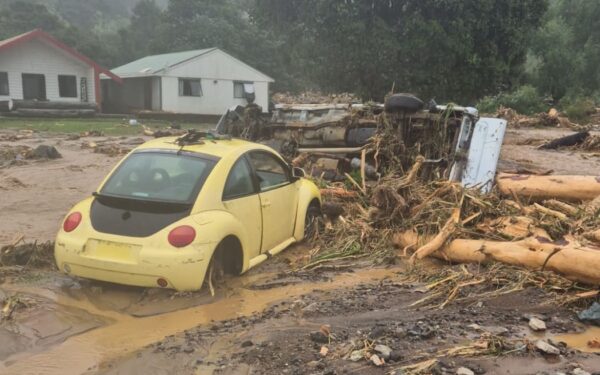
Heavy rainfall and flooding continue to dominate headlines across New Zealand, from devastating slips to widespread inundation of homes and roads. The recent tragedy at Mt Maunganui Holiday Park, where several people are missing after a slip triggered by rain, is the latest reminder that extreme rain events are a clear and present danger to many communities.
But the physical reality of weather is only one part of the equation. How we manage the land - especially large areas planted in exotic forestry - has a massive influence on how rainfall translates into runoff, slips, and flood damage.
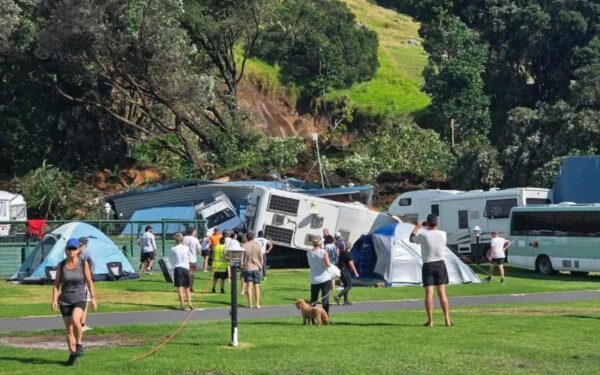
The Mt Maunganui Slip - and a Pattern Across New Zealand
The Maunganui event is a tragic manifestation of saturated soils on steep terrain giving way under prolonged rain. While individual slips can be triggered by local conditions, the reporting of the frequency and severity of rainfall events in recent years are increasing. Whether due to natural climate variability or longer-term trends, or simply headline-grabbing, what matters for communities is the risk profile - and that appears to be rising.
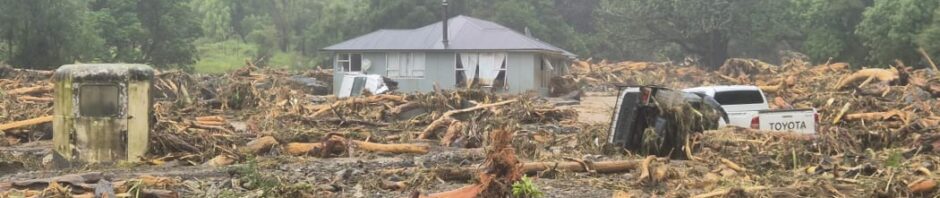
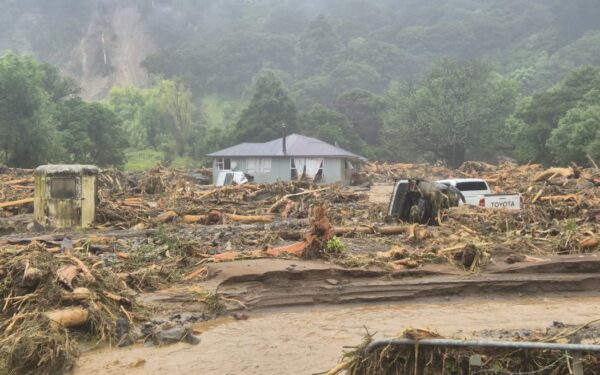
While not every adverse event is directly attributable to forestry, there is a clear pattern emerging in several parts of the country where exposed forestry slash - the leftover branches, tops and debris from logging operations - has exacerbated flood and slip damage.
In the Bay of Plenty, Gisborne, Hawke’s Bay and parts of the West Coast, residents have documented how:
- hillsides stripped of soil-anchoring vegetation after harvesting
- slash that is not properly managed or removed
- networks of skid tracks and logging roads
have contributed to acceleration of surface flow, increased sediment loads in rivers, and amplified slip impacts during heavy rain.
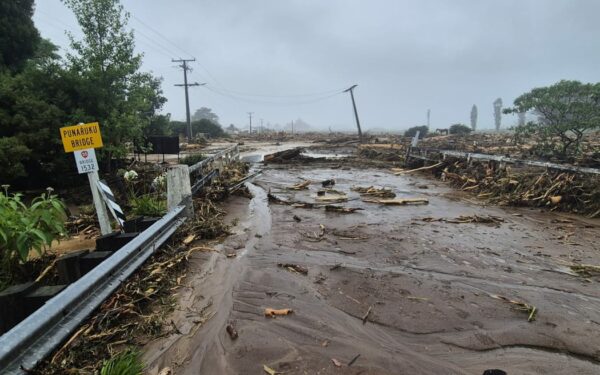
In extreme rainfall, slash can act like combustible debris on a hillside - mobilised downslope in torrents, adding destructive force and deadweight at a moment when the land itself is already stressed.
Why This Is Not Just a Weather Story
Heavy rain is a natural hazard. But the impact of heavy rain is a land-use hazard.
Natural forest - with mixed age canopies, deep rooting systems, and understory - slows rainfall, stabilises soil, and absorbs water. Plantation forests, particularly when logged and left with residual slash:
- have shallower root systems during key phases of the rotation cycle,
- lose much of their water-buffering capacity,
- and can shed water rapidly into gullies and streams.
When forestry operations clear large tracts of land, they alter the hydrological response of hillsides. Rain that might previously have been slowed and absorbed now becomes rapid runoff, raising river levels faster, carrying more sediment, and increasing slip risk.
This isn’t theoretical - it’s what engineers and land-management experts have observed post-harvest following multiple major rain events.
The Governance Gap
New Zealand’s regulatory frameworks have historically treated plantation forestry as an agronomic or commercial land use, not a landscape-altering activity with direct public safety implications.
Forest practice standards (including how slash is managed, how skid tracks are built, and how harvested slopes are left) vary by region. In some regions, the rules are stringent; in others, enforcement is weak or ambiguous. The result is a patchwork of outcomes, with communities left to bear the consequences.
Meanwhile, state responses focus on weather hazards - rain warnings, flood alerts, emergency response - without integrating land-use responsibility into the risk equation as strongly as it should be.
This disconnect fuels frustration in rural and peri-urban communities that watch their roads wash out, their rivers choke with debris, and their insurance premiums rise while the forests above them change more quickly than the policies that govern them.
Land Use and Community Exposure
For many Kiwi communities, forestry is an economic contributor. But for communities downstream of intensive harvest areas, the risk is real and tangible: roads cut by slash flows, riverbeds raised by sediment, properties inundated not just by rainwater but by forest debris mobilised by that rain.
These outcomes are not inevitable - they are a function of:
- how forestry is regulated,
- how slash is managed,
- and how land owners are held accountable for downstream effects.
In Australia and parts of Europe, forestry regulation increasingly incorporates runoff modelling, post-harvest obligations, and bond systems to ensure that the costs of risk are internalised by the industry rather than externalised onto communities and infrastructure.
New Zealand does not yet have a consistently applied, effective equivalent.
What Needs to Change
Major rain events will always occur. What we can - and must - do is reduce vulnerability:
- Better slash management standards, tailored to slope, soil type, and rainfall patterns.
- Mandatory post-harvest remediation where forests sit above communities.
- Integrated catchment planning that treats forestry, farming, urban development and flood infrastructure as interconnected.
- Stronger enforcement and monitoring of forestry practices with penalties tied to risk outcomes.
- Public transparency on where high-risk land uses lie relative to population centres.
These changes are not anti-forestry. They are pro-community safety, pro-sustainable land use, and pro-evidence governance.
A Wider Lesson
As a nation reliant on both our natural environment and on sectors like forestry for economic activity, we face a fundamental tension: how to balance land-use freedoms with public safety and environmental stewardship.
Heavy rain events do not discriminate - but policy that ignores land-use risk does. Communities do not need more alarmism; they need responsibility embedded in regulation, clarity in standards, and predictable outcomes that protect lives and livelihoods. They also need regulation and standards that are enforced!
Floods and slips are part of living in a dynamic landscape. But when we habitually respond only to the aftermath and ignore how land use amplifies harm, we are choosing vulnerability over resilience.
The problems with forestry slash and extreme rainfall are decades old and still unresolved. This isn’t just about sudden heavy rain - it’s about how we manage land use and forest residues on steep, erosion-prone ground.
Communities up and down the East Coast and Bay of Plenty have been calling attention to slash-related flood damage for years. In June 2018, severe rain in the Tolaga Bay catchment washed an estimated one million tonnes of forestry debris onto properties and roads, costing locals millions and leading to charges against forestry companies for breaching consent conditions.
Cyclone Gabrielle in 2023 brought the issue into even sharper focus when slash was blamed for devastating flood damage, washing out bridges and isolating towns. A government inquiry was launched into slash practices after widespread damage in Tairāwhiti and Hawke’s Bay.
Despite this history, there is still no consistently applied national approach to managing or mitigating slash before storms hit. The cumulative effects of poor slash management - combined with heavier rainfall events - means we keep seeing the same consequences, in different places, decade after decade.
It’s past time we treated forestry slash not as an unfortunate by-product, but as a risk that must be managed before it becomes a destructive force downstream.
Quite right! What still isn’t being answered is why forestry companies are so rarely held meaningfully responsible for the downstream damage caused by slash.
We’ve seen this before - repeatedly. Bay of Plenty and East Coast communities were raising the alarm years ago, long before Cyclone Gabrielle, after slash washed through properties, roads and waterways following heavy rain. Reports, reviews and promises followed - but little changed on the ground.
If a farming operation allowed tonnes of debris to escape and damage neighbouring land, accountability would be immediate. With forestry, responsibility too often dissolves into “weather events”, shared blame, or weak consent conditions.
Until slash management failures carry real financial and legal consequences, the incentive to change will remain low - and communities will keep paying the price for risks they didn’t create.
Sadly nobody is pointing out the poor return in forestry for investors. A recent forest harvest after 30 years yielded the investors and land owners less than 4%/annum – and this was in a year of “better” prices. That investment is only 1% better than inflation over the 30 years, The only people making money out of forestry today are those who do the harvesting. Almost all other common forms of investment can better 1% above inflation so why bother ….. and why do governments push it?
The argument that the slash will eventually decompose and return nutrients Papatuanuku is classic greenwashing of forestry’s equivalent of fly tipping. Lets see some investment in processing the slash – even if it requires subsidies to get it off the ground. The subsidies could come from levies on the big players.
Carbon farming where pines are left to grow wild and unmanaged, is another forestry shambles. It’s a playing field for speculators often of the syndicate or corporate kind. It will become an environmental disaster growing to become a seed-bank for wilding pine invasions already a major problem in the high country.
On commercial producing forests, NZ exports the raw logs to India to process and then India exports it back to NZ as ready to use processed timber. Why?
Is this coalition government going to shut down the ridiculous carbon farming? Labour under Ardern/Hipkins regime, started it, coalition government has done stuff-all to close down the rort.
New Zealand’s efforts over Climate Change relies on covering landscapes and converting production farms with unmanaged highly flammable monocultures of pine trees. This ‘off-setting’ is high risk, bad socially, bad ecologically and bad economically.
Major polluters see planbting carbon forests as a licence to continue to pollute, e..g Air NZ..
Carbon offsetting pine plantations a create very few jobs, displace productive sheep and beef farming, and depopulate rural communities at risk of collapse. They are boring monocultures, vulnerable to fires and unddermine bio-diversity.
For heavens sale you public servant MPs, stop the rot!
let’s make something useful from all the slash – biochar!
We bought a property with 3 forestry blocks that had been recently clearfelled and as far as I can tell, there was no inspection from any authority at the end… Loads of wood trash, lots of erosion, litter, and tracks that had been ripped through in multiple places. From what I heard, the owner of the trees made a huge profit and so would the logging company. Easily, some of this profit could/should have been used to repair the land somewhat afterwards to prevent the slips and erosion… am in Southland where the seller/farmer (not owner of trees) says there are no slips in Southland!?