
How Language Quietly Rewrites Public Power
Post by Andi Cockroft, Chair, CORANZ
Language shapes reality long before legislation does. The words used by government agencies, ministers, councils, and media do more than describe policy – they condition the public to accept it. Over time, everyday phrases quietly reframe ownership, authority, and consent. Rights become permissions. The public becomes an afterthought.
For organisations such as Council of Outdoor Recreation Associations of New Zealand, this matters deeply. Outdoor recreation sits at the intersection of public land, public authority, and public participation. When language drifts, outcomes soon follow.
“DOC land”: a revealing case study
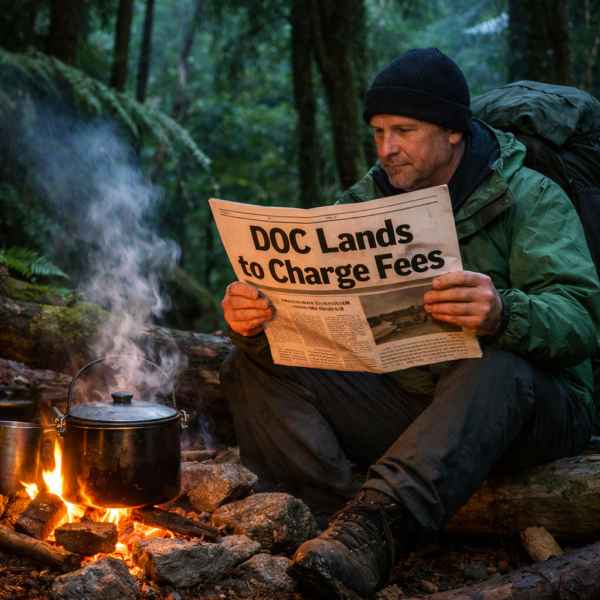
Few phrases are as casually misleading as “DOC land”. It is used routinely by officials, media, and even recreationists themselves. Yet it is wrong.
The Department of Conservation does not own land. It administers public land on behalf of New Zealanders. When we call it “DOC land”, we unconsciously transfer ownership from the public to an agency. The shift is subtle – but powerful.
Once an agency is linguistically framed as an owner:
- access feels like a privilege,
- restrictions feel natural,
- the agency feels empowered
- and decisions feel discretionary rather than accountable.
More accurate language already exists:
- public conservation estate
- public lands entrusted to DOC administration
- public land administered by DOC
- Crown land held in trust for the public
These phrases do not weaken conservation. They strengthen democracy by reminding everyone who the land ultimately belongs to.
Authority inflation: how office-holders are elevated
The same linguistic drift appears in how we speak about power. Ministers are routinely described as if they occupy an elevated status: “the Minister has allowed,” “the Minister has granted,” “the Minister has decided.”
In reality, ministers are temporary office-holders, accountable to Parliament and ultimately to the public. They are not benevolent patrons dispensing favour. They are senior public servants exercising delegated authority.
The same applies to bureaucrats and councils. Councils are not sovereign bodies; they are delegated authorities. Officials are not guardians of the public interest by default; they are employees tasked with serving it.
When language elevates institutions and diminishes the public, accountability quietly erodes.
The everyday distortions we stop noticing
This is not confined to land or titles. Consider how often these terms appear – and what they imply:
- “Stakeholders” instead of citizens or communities
- “Users” instead of owners-in-common
- “Compliance” instead of cooperation
- “Enforcement” instead of stewardship
- “Managed retreat” instead of forced withdrawal
- “Expert advice” used to end debate rather than inform it
Each phrase narrows the space for public agency. None is neutral.
Language that sounds technical or managerial often serves one function: it reduces contestability. Once people internalise the framing, resistance appears unreasonable, even selfish.
Why outdoor recreation feels this first
Outdoor recreation is often the canary in the coal mine because it touches land, risk, and environment – areas where bureaucratic caution and ideological certainty are most tempting.
When recreationists are framed as “users”, access becomes conditional. When land is framed as agency-owned, closure becomes the default response. When human activity is framed primarily as harm, restriction becomes virtue.
By the time formal processes begin, the outcome often feels preloaded. The language has already done the heavy lifting.
This isn’t pedantry – it’s power
Critics will say this is semantics. It isn’t. Control the language and you often don’t need to control the argument.
Words determine:
- who feels entitled to speak,
- who feels permitted to object,
- who is in control,
- and who feels responsible for outcomes.
Rights that are not named correctly do not remain rights for long. They quietly decay into permissions.
Intent doesn’t cancel consequence
None of this requires bad faith. Much of it arises from bureaucratic habit, legal defensiveness, and institutional self-protection. But good intentions do not neutralise bad outcomes.
When public agencies consistently adopt language that centres themselves and sidelines the public, trust erodes. Participation drops. Cooperation weakens. That is not good for conservation, safety, or community resilience.
What can be done
The remedy is not complicated – but it does require discipline.
CORANZ and its members can:
- use precise language in submissions and correspondence,
- politely but consistently correct misleading terms,
- reassert public ownership and public interest,
- refuse “permission language” where rights exist,
- and model better framing in public communications.
This is not about winning arguments. It is about keeping the ground of debate honest.
Final thought
Perception really is everything. Once language quietly rewrites public power, reclaiming it becomes far harder than preventing the drift in the first place.
Outdoor recreation depends on more than access and environment. It depends on a public that still recognises itself as the owner, the participant, and the authority – not merely the audience.
Quotes about perception emphasize that our reality is shaped by viewpoint, highlighting how changing perspective can alter experience, with famous sayings like Marcus Aurelius stating, “Everything we see is a perspective, not the truth,” and Anaïs Nin noting, “We don’t see things as they are, we see them as we are,” while Deepak Chopra adds, “Our minds influence the key activity of the brain… they’re all a projection of you,” showcasing perception as a powerful lens for understanding the world.
Attached are a thought from Einstein
Manipulating all of this provides employment for a whole army of public servants often called “spin doctors”.
Doc3
A truly perceptive opinion, thank you Andi Cockroft and CORANZ.
If I may be so bold as to enter the “Maori” and “Pakeha” where the words “indigenous” and “native”is manipulated to include only those with Maori ancestry, no matter how little it might be, perhaps a mere 1/16th.
Many dictionaries define “indigenous” or “native” as born in a particular country. So ancestry does not come into consideration. If one is born in New Zealand then that person is “native” and “indigenous” to New Zealand.
In the article you refer to the manipulation by constant reference to “DOC land.” Instead it should be “public land” or the “public estate”. Thank you once again.
Heaven forbid should ownership of wilderness be given to the Department of Conservation. DOC is simply the caretaker of the lands.
I always correct people who refer to public land as DoC land if everyone did the same maybe it would make some people think a little more.
… yep, well said! Perfectly encapsulates the insidious notion of the “slow cooked frog” and disenfranchised of our people. Kudos !