
Guest post by Dave Rhodes
Pine plantations have become an increasingly dominant feature across New Zealand’s rural landscapes - not just in traditional forestry regions, but in high-country areas, marginal farmland, river corridors, and even places long valued for recreation and public access.
Driven by carbon credits, private investment and short-term financial incentives, exotic pines now shape more and more of the outdoor areas New Zealanders rely on for hunting, fishing, tramping, camping, and landscape enjoyment.
For CORANZ, the rapid expansion of pines raises important questions:
What happens to public access? What happens to the character of our outdoors? And what kind of countryside do we want future generations to inherit?
🌲 The Access Issue: When Land Becomes Pine, People Get Shut Out
Unlike native bush or pastoral landscapes, commercial pine plantations are privately controlled production zones, usually with:
- locked gates,
- limited access windows (often restricted during fire season),
- no-go days during harvesting operations,
- health-and-safety barriers to foot access,
- and lease arrangements that exclude the public entirely.
In many regions, land that once offered informal access - to rivers, ridgelines, hunting blocks, or camping areas - is now planted in pine and effectively removed from recreational use.
This shift is happening quietly but rapidly across:
- parts of Canterbury and Otago high-country,
- coastal farmland in Hawke’s Bay and Wairarapa,
- significant areas of Northland,
- and increasing chunks of marginal hill-country previously used for walking, fishing or pig hunting.
As forestry expands, access shrinks.
The Government’s carbon-driven afforestation strategy risks accelerating this loss by encouraging large foreign and corporate owners to plant entire stations in pine - locking out public users for at least 30 years at a time.
For an organisation dedicated to outdoor opportunities and public rights, this trend is deeply concerning.
🏞️ The Landscape Problem: Monocultures Replace Open Country
New Zealand’s outdoors is defined by open, varied landscapes: tussock basins, river flats, rolling farmland, native bush margins and wide, scenic valleys.
Large-scale pine planting converts these diverse areas into uniform, dark, single-species stands. The effects are visual and cultural:
- iconic vistas are lost beneath dark-green canopies,
- skyline views become serrated rows of identical trees,
- open access land becomes visually enclosed and unwelcoming,
- the “sense of place” that defines regions is diluted.
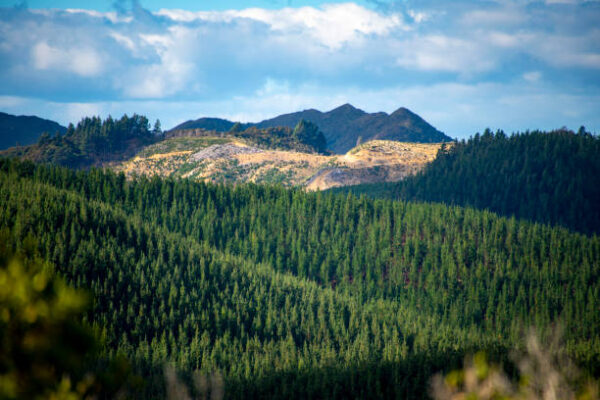
Whether anglers walking into a river, hunters stalking deer, or families looking for picnic spots, the character and natural feel of the outdoors suffers every time a valley or ridgeline is turned into pine.
🚷 River Margins and Access Corridors Are Quietly Disappearing
In many districts, forestry companies buy entire farms and plant right down to river edges. When this happens:
- former stock-access and walking corridors vanish,
- informal tracks get closed,
- anglers face locked gates where they once parked,
- and public foot access becomes legally ambiguous or prohibited.
Even where legal access strips still exist, navigating rivers lined with tightly planted pines can become:
- hazardous (loose slash, unstable soils, fire risk),
- unpleasant (dense shade, no visibility), and
- physically obstructed (fallen trees, brash piles, harvest debris).
In effect, riparian access becomes a maze - and in some cases, an impossibility.
🔥 Fire Risk: A Direct Threat to Public Safety and Recreation
Pine plantations carry high fire risk, particularly:
- during dry summers,
- on east-coast hill country,
- or where trees have been recently thinned or harvested.
This leads to:
- seasonal closures,
- entire forests being shut off for months,
- cancelled recreation access,
- higher costs for rural fire services and councils,
- and increased risk for nearby settlements.
In short: when pine-dominated landscapes dry out, the public often loses access entirely.
🌱 What About Water and Wildings? (A Brief Note)
While freshwater and ecological issues are not the core area for CORANZ, they intersect closely with outdoor recreation:
- Pines reduce water yield, leading to shallower rivers, harder fishing conditions, and degraded swimming spots.
- Clear-felling sends sediment pulses into streams that once ran clean and clear.
- Wilding pines spread into high-country landscapes valued for recreation - smothering tussock, blocking tracks, and altering open vistas.
- Wildings also choke off river flats and access points that anglers, hunters and trampers depend on.
These pressures ultimately compound the main concern: the outdoors becomes less accessible, less attractive, and less ecologically stable.
🚜 Rural Communities Are Also Affected
Outdoor recreation thrives in vibrant rural communities. Yet large-scale afforestation often leads to:
- loss of arable and pastoral land,
- fewer working farms,
- reduced rural populations,
- declining local services and hunting/fishing clubs,
- and increasing landownership concentration in fewer private hands.
When entire districts convert to pine plantations - especially for carbon farming rather than timber - the countryside becomes quieter, emptier and less welcoming for ordinary New Zealanders seeking outdoor opportunity.
🎣 Why CORANZ Should Be Concerned
Pine afforestation is not merely a land-use change. It is a public access change, a landscape change, and a recreational opportunity loss.
For CORANZ, the risk is clear:
- fewer public access corridors to rivers and lakes;
- fewer walkable ridgelines and open basins;
- less legal access to private land converted to forestry;
- visual and experiential degradation of outdoor environments;
- and increased physical hazards and closures.
Across New Zealand, outdoor recreation is already pressured by subdivision, private leasing, absentee foreign ownership, and expanding exclusion zones. Pine plantations pose yet another squeeze - one that is accelerating under current economic incentives.
🧭 What Needs to Change
CORANZ can advocate for several key measures:
1. Mandatory, permanent public-access corridors in new forestry projects
Particularly along rivers, ridgelines and historical tracks.
2. Limits on whole-farm conversion to pine in high-recreation-value regions
Ensuring key landscapes remain accessible and multi-use.
3. A national review of carbon forestry incentives
To prevent “carbon farming lockouts” in the high country.
4. Strong wilding-pine eradication in recreation hotspots
Before tramping, hunting and angling areas become unusable.
5. Recognition that forestry is not a substitute for open space
Outdoor values must carry real weight in land-use planning.
🌄 Conclusion:
New Zealand’s Outdoors Should Not Be Turned Into a Forest of No-Entry Signs
Pine plantations have their place - but that place is not everywhere, and it is certainly not wherever financial incentives make planting attractive for absentee owners or carbon speculators.
For outdoor recreationists, anglers, hunters and families, the rapid conversion of diverse open landscapes into closed-access pine estates represents a silent erosion of the core Kiwi birthright: the ability to walk, fish, hunt and explore the country we all share.
CORANZ stands for the protection of those rights.
Now is the time to speak up - before more valleys, hillsides and river corridors disappear under commercial pine and behind locked gates.