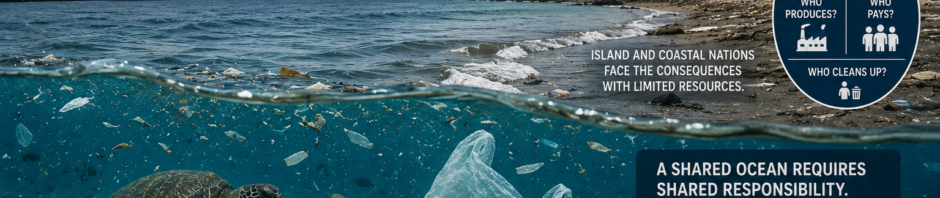
Negotiations are continuing at the United Nations to establish a legally binding treaty on plastic pollution. The focus has shifted toward funding, with debate centred on who should contribute and how support should be distributed. Pacific nations have made clear that while they face the consequences of plastic pollution, they are not major producers. That position highlights a tension that extends beyond the treaty itself.
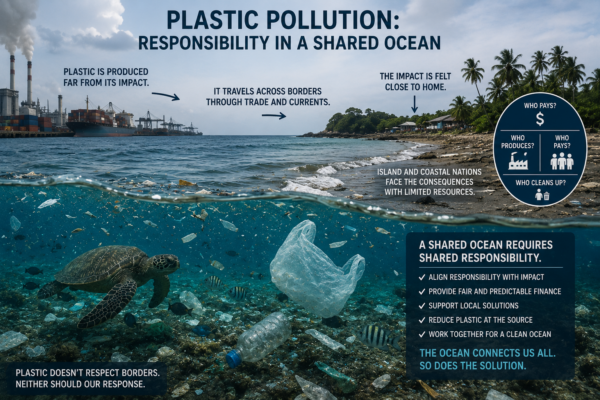
This discussion is the framing of responsibility. Plastic is produced, exported, consumed, and discarded across multiple jurisdictions, often far removed from where it ultimately accumulates. Financial mechanisms are being proposed to bridge that gap, but agreement remains unresolved. Taken together, production, distribution, and disposal form a system where cause and consequence are separated by distance.
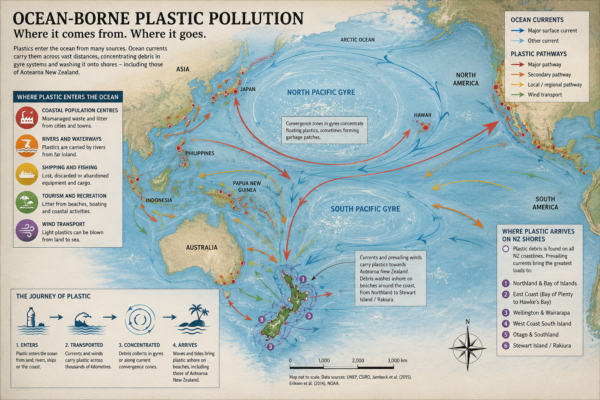
This separation has practical implications. Coastal and island environments receive disproportionate impacts from materials they do not manufacture. Waste management capacity varies widely, and local systems are often expected to absorb external pressures. Where responsibility is unclear or contested, response becomes uneven and dependent on negotiation rather than alignment.
This pattern is not unique to plastics. Similar dynamics exist in water quality, fisheries, and land use, where local environments carry the effects of broader systems. Individually, each case appears manageable. Taken together, they reveal a consistent challenge in linking responsibility to outcome across shared resources.
The principle is straightforward. A shared ocean does not imply shared responsibility unless it is clearly defined and applied. Environmental systems operate without regard to jurisdiction, but governance does not. Where those two realities diverge, gaps emerge in both accountability and action.
This is not about the existence of plastic alone, nor about international negotiation processes. It is about whether responsibility is aligned with impact in a system that crosses boundaries. The issue is not shared use, but whether shared responsibility is properly established and maintained.
This problem will never go away, plastic is here to stay, there was a western world push a year or so ago to minimize plastic bags, super markets leading the way by removing plastic grocery bags great start, but they all continue to wrap or bag pruduct in plastic, theres not a government any on the planet the has the balls to ban plastic wrappings or bags, its basicaly, STUFF the planet