
The construction of a community-funded seawall at Port Waikato is being presented as a local success story. Residents, facing ongoing coastal erosion and limited institutional support, organised, funded, and built a structure to protect their homes and maintain access. The immediate outcome is clear: the coastline has stabilised, and the community has regained a degree of certainty. The underlying issue, however, sits beyond the wall itself.
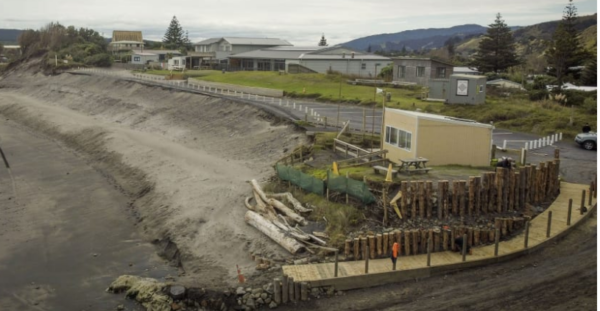
What has changed is not just the shoreline, but the decision pathway. Over several years, residents encountered delays, objections, and procedural hurdles while erosion continued. The eventual solution did not come through a streamlined process or coordinated response, but through persistence outside it. Taken together, this reflects a system where action can be slowed by process, even when the problem is visible and advancing.
The structural implication is that responsibility has shifted. Coastal protection remains a public issue, yet delivery in this case has been carried by the community. That raises a question about where capability sits. Local knowledge, urgency, and direct experience drove the response, while formal systems struggled to match that pace. When this occurs, regulation risks becoming an obstacle rather than a framework for effective action.
This pattern is not isolated. Across a range of issues-water infrastructure, access, and environmental management-there is a recurring tension between centralised process and local capability. Communities are often closest to the problem, yet furthest from decision-making authority. Where those two do not align, delays and frustration follow.
The principle is straightforward. Stewardship and use can coexist, and competence at a local level has value. Systems designed to manage risk should not remove the ability to act where that competence exists. Public resources and shared environments require oversight, but they also require practical responses grounded in real conditions.
The issue is not whether rules are needed. It is whether they enable timely, proportionate action, or whether they defer it until communities act regardless.