
Rakiura is not a large place.
It is small, remote, and socially close-knit. When something shifts in the mood of that community, it is noticeable.
Environment Southland has reported “emerging tensions” on Stewart Island following recent pest control operations. Staff say access to properties is becoming more difficult. Conversations are more challenging. The mood has shifted. Residents are rebelling.
This is not about pest fauna. It is about trust.
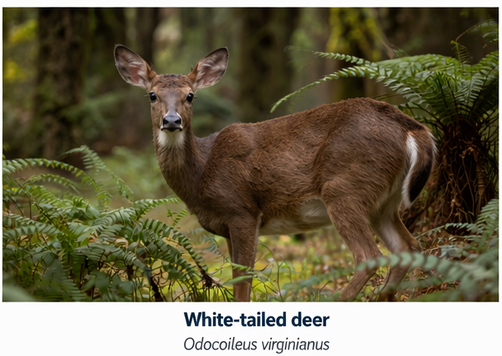
Last month the Department of Conservation confirmed that an August 1080 drop killed more white-tailed deer than expected. Cameras recorded a 75 percent reduction where repellent was used and a 97 percent reduction where standard bait was deployed.
Those numbers are dramatic.
DOC’s stated objective was to protect pukunui / southern New Zealand dotterel. That goal is legitimate. Predator control is part of conservation management across New Zealand.
But conservation does not occur in a vacuum. It occurs within communities.
When 97 percent of a species is removed from an island ecosystem, the effect is ecological - and social.
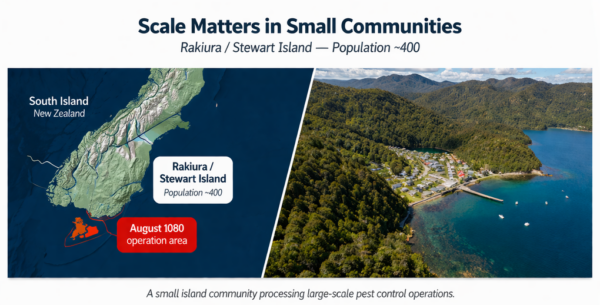
Rakiura residents live alongside these landscapes. Some hunt. Some farm. Some guide. Some simply value having a say in what happens where they live. When pest control operations expand in scale and intensity, the community absorbs the consequences long after the helicopters leave.
The reports are telling for what they do not say outright. The tensions are not directed at council pest plant officers. Yet those officers are feeling the impact. That is how institutional strain manifests. One agency acts. Another absorbs the fallout.
Conservation policy that does not carry durable social licence weakens itself.
This is not an argument against predator control in principle. It is a reminder that methods matter, scale matters, and consent matters.
Rakiura has experienced successive large-scale eradication programmes over the past decade. Each one may be technically defensible. But when operations are perceived as imposed rather than agreed, confidence erodes incrementally.
That erosion shows up in subtle ways first - hesitancy, resistance, strained conversations. Over time, it hardens.
New Zealand’s conservation model relies heavily on tools such as aerial toxin deployment. These tools are powerful. Arguably they produce measurable results. But measurable results are not the only metric that counts.
Long-term stewardship depends on community partnership.
If pest control becomes something done to a community rather than with it, fracture is inevitable.
Rakiura is a useful warning.
Environmental policy cannot rely solely on operational success. It must sustain legitimacy. Once trust weakens, every future project becomes harder to implement - even those unrelated to the original action.
Conservation that divides communities does not strengthen conservation.
It weakens it.
The lesson from Rakiura is straightforward: ecological goals must be pursued with durable consent. Otherwise, the short-term gains risk long-term instability.
Will any lessons be learnt?
The whole poison concept is ridiculous. Scientific studies show rats will boom in breeding with survivors of 1080 drop, having abundant food. The boom carries on. After 18 months rat numbers are back to before poison.
At 3 years there’ll be 3 times more rats.
Don’t believe me? Go dig in research. DOC is too lazy or deliberately ignoring science.
The kill on deer is unforgivable. But it does prove deer repellent doesn’t work.
Bob,those daft top top layer DOC minions already knew that Deer repellent didnt work.on multiple times they “Trialled” it,and found out real fast it wasn’t working. But as their aim is to be rid of all non native critters they pressed on. Sadly the ones who are going to wear the pain of this are all those who relied on Hunters booking huts/Blocks,transport food etc . Now this has been kicked out from under them. Im of the opinion DOC acttually wants the humans OFF Stewart Island too. To turn the Island into smog park with nothing but pre human animals. Thereby allowing them to trumpet heir success. SHAME ON ALL DOC WHO WERE INVOLVED WITH THIS .
Filling the environment with new toxic chemicals is sacrilege yet so many so called environmentalists sanction it. It goes back to the single species approach taught by nice middle class teachers under the heading of “Nature Study”. It is more important to consider dynamic interactions within ecosystems. That every action has an equal or opposite reaction applies in Biology as much as in Physics, but then I’m talking here to the converted.
I would give DoC credit for truthfully publishing the disastrous results of this operation on the unique whitetailed deer herd on Rakiura. However, they deserve no credit for stating categorically to the Stewart Island community that deer repellent would ensure a minimal by-kill of deer.
DoC needs to go back to the drawing board on how to maintain viable dotterel populations on the Island. They have been there for over a hundred years after possums, rats, cats etc were introduced to the island. Why are the dotterels “disappearing” now? Maybe something else has been adversely affecting dotterels lately. Maybe that something else is DoC’s “management” efforts, which are highly intrusive on the nesting birds and their habitat.
Be the first time DoC have been honest about anything to do with 1080.
It’s not only the locals that are getting pissed off.
Cant stress how bad I feel for the way those poor animals have suffered by eating 1080, this is paid for by Tax payers unbenowence to alot of NZers it is a very inhuman way for anything to die I am not sure how anybody who works for DOC can go to work the next day knowing the knock on effect of this dangerous substance and the effects it has on any living thing, wish I could help.