Southland’s latest groundwater report is not dramatic in tone. It does not declare catastrophe. It does not introduce new data.
What it does is consolidate a long trend into one clear picture.
Seventy-one percent of monitored groundwater sites show increasing nitrate concentrations over the past two decades.
That is not noise.
That is direction.
The Real Threshold Debate
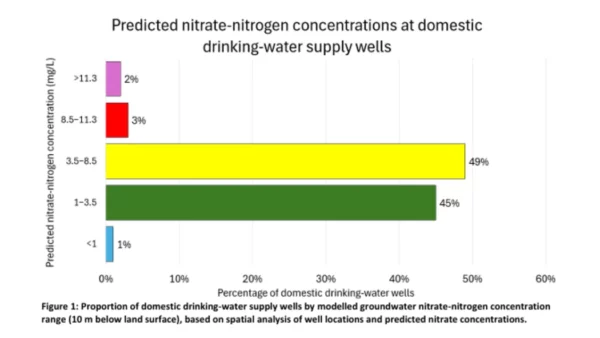
The public conversation often centres on the drinking water Maximum Acceptable Value (MAV) of 11.3 mg/L nitrate-nitrogen.
Some Southland sites exceed it. Many sit below it.
But here is the critical point:
Drinking water standards are not ecological standards.
Ecological impacts begin at far lower concentrations. Numerous freshwater systems show biological stress at levels around 1–3 mg/L. Periphyton growth, invertebrate community shifts and long-term nutrient enrichment do not wait for 11.3 mg/L.
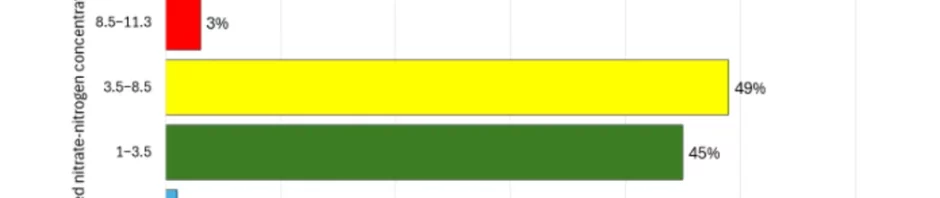
The report notes frequent exceedance of 3.5 mg/L.
That is not trivial.
Evidence before emotion.
Groundwater Is Not Isolated
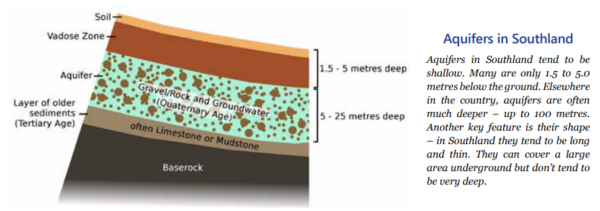
Groundwater does not remain underground indefinitely.
It discharges into:
- Springs
- Base flows
- Lowland streams
- Estuaries
In regions like Southland, where groundwater contributes significantly to surface water flow, nitrate accumulation in aquifers eventually expresses itself in rivers.
There is often a lag of years or decades between land-use intensification and full aquifer response.
Which means today’s readings reflect yesterday’s decisions.
And today’s decisions will shape tomorrow’s rivers.
Limits before tools.
Intensification and Scale
Between 1990 and 2022, Southland’s dairy herd increased by more than 1,600 percent.
Land-use change at that scale inevitably alters nitrogen loading.
This is not an attack on individual farmers.
It is a structural observation.
When stocking intensity increases across a vulnerable aquifer, nitrogen loss risk rises. Even with improved management practices, cumulative load matters.
Legal compliance does not automatically equal ecological sustainability.
The Emergency Question
Calls to declare a “nitrate emergency” are politically charged. Federated Farmers reject that language. Regional councils point to existing plans and monitoring.
The more useful question is not whether the word “emergency” is appropriate.
It is whether current trajectories are compatible with:
- Long-term drinking water security
- Ecological integrity
- Recreational confidence
When 71% of sites trend upward, the burden shifts from proving harm to demonstrating credible reversal.
Public resource, public responsibility.
What Matters Now
The report brings together vulnerability mapping, health framing and long-term monitoring.
It confirms three uncomfortable realities:
- Nitrate levels are rising in most monitored sites.
- A significant population relies on groundwater in vulnerable areas.
- Ecological effects occur below drinking water limits.
This is not a crisis headline.
It is a cumulative signal.
Groundwater systems respond slowly. Recovery is slower.
If trends are to reverse, nitrogen losses must decline - not simply stabilise.
The science is not new.
The consolidation of it is.
And the longer upward trends persist, the narrower the options become.
Related reports & background
- Groundwater and Nitrate Movement - Environment Southland science report (PDF)
- Southland groundwater monitoring & science reports - Environment Southland
- Current state of waterways - Southland’s Water Story assessment
- Nitrate in groundwater - background and facts (ES)
If we later get a direct PDF of the “Nitrogen Contamination in Southland Groundwater 2026” report from the region’s website or ESR/ES lab we will post that as well
This is a thoughtful appraisal of the slow upward creep of nitrates. While New Zealand’s dairy industry remains the country’s top primary export earner, with export revenue forecast to reach over $27 billion in the year ending this coming 30 June, there is a cost to this growth.
How many New Zealanders want slime infested rivers and streams in exchange for the dollar values and rivers which are ecologically dying?
Water is a public resource.
While people are granted the right to use it .. nobody has the right to universally contaminate it.
Decades of agricultural use, compounded by increased agricultural intensification, appears to be resulting in pockets of universal contamination.
The bottom line .. the inescapable truth .. is that combined agricultural use (including levels of intensification), as it is currently practiced, particularly in Canterbury and Southland .. appears unsustainable.
Eventually, water supplies will become contaminated, and unable to support life.
This will be a disaster .. somewhere down the track.
I guess in the meantime .. we might as well stick our heads in the sand, and ignore it just like everybody else?
Certainly, those who have strived to bring the matter to public attention .. don’t seem to get widespread acclamation.
Quite the opposite is often the case.
Isn’t that weird?
It’s a no win for the environment and the people in Southland when you have Meager in bed with federated farmers, they simply don’t care
The public health risks alone are enough to declare a nitrate emergency. How many people have to get colon cancer for the bureaucrats to take notice?
With 54% of the population drinking water above the colo-rectal cancer threshold from the Danish study it is no wonder Southland (with Canterbury) has the highest rates of bowel cancer.