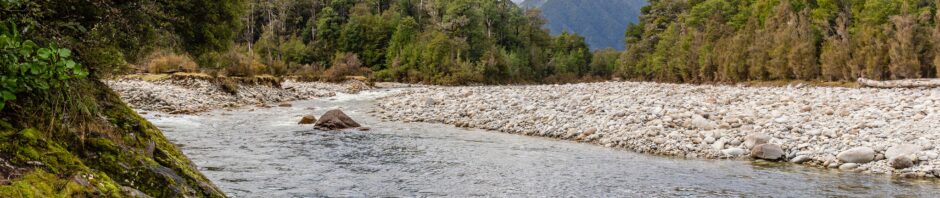
Victoria Forest Park occupies a large tract of forested land between the Lewis Pass and the Buller Gorge. It is one of the country’s largest forest parks, yet it rarely features in promotional narratives. There are no marquee viewpoints, no single defining destination, and little sense of arrival.
That absence is part of its character.
The nature of the park
Victoria Forest Park is defined by continuity rather than contrast. Forest, river, and valley extend over distance without interruption. Tracks, huts, gravel roads, and river corridors exist as part of a working landscape rather than a curated one.
This is not a park shaped around a highlight. It is a place shaped around use.
Ways of using the park
Victoria Forest Park supports a wide range of outdoor activities, often overlapping in time and space:
- tramping and multi-day hut travel
- river fishing and swimming
- hunting
- cycling on formed routes
- vehicle access on designated tracks and roads
- backcountry camping
No single activity dominates. Use is shaped by season, weather, and familiarity rather than prescription.
That balance has endured because the park allows people to find their own scale within it.
Effort and choice
The park accommodates a wide range of effort levels. Some valleys allow relatively gentle travel close to roads or rivers. Others extend deep into backcountry terrain where time, fitness, and planning become essential.
Crucially, these choices are not ranked. The park does not reward only those who go furthest. It allows people to engage at a level that suits their capacity and intent.
That flexibility is increasingly rare.
What this place asks
Victoria Forest Park asks for:
- self-reliance
- respect for weather and river conditions
- navigation beyond signposted loops
- acceptance that services are limited
It does not ask for performance or completion. It offers opportunity rather than instruction.

Who this place suits
This is a place well suited to people who:
- value forest and river over landmarks
- prefer dispersed use to crowded nodes
- engage in multiple forms of outdoor recreation
- return repeatedly rather than seek novelty
It also suits groups with mixed abilities, as access can be scaled without diminishing the experience.
Why Victoria Forest Park belongs in “Places”
Victoria Forest Park belongs in this series because it exemplifies ordinary backcountry at scale.
It shows how:
- large landscapes can absorb use without being overwhelmed
- multiple activities can coexist without formal separation
- access can be permissive without being unmanaged
- outdoor recreation can persist without constant promotion
In a time when attention often narrows to iconic destinations, places like this quietly carry the weight of everyday outdoor life.
A park that does not ask to be noticed
Victoria Forest Park does not demand recognition. It functions regardless of whether it is named, photographed, or promoted.
That quiet persistence - and the access it preserves - is precisely what makes it worth recording.
Getting there
Access to Victoria Forest Park is primarily via state highways and gravel roads branching off the Lewis Pass and the Buller Gorge. Entry points are multiple rather than singular, and arrival is often gradual rather than announced.
There is no gateway experience. People enter the park as they would any large piece of country: by choosing a valley, a river, or a track and beginning there.
This dispersed access spreads use naturally and avoids concentration.
There’s some interesting trout streams there and on the way up river you can come across some relics of the gold mining history way back in the bush.
Interesting article. There are some nice day or half day walks off the Reefton- Springs Junction highway. Beautiful forest.