
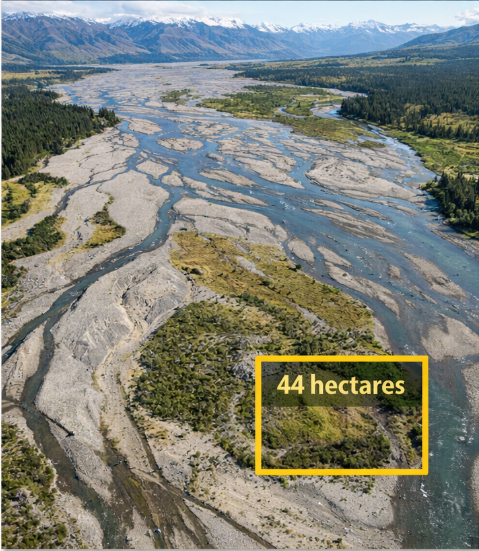
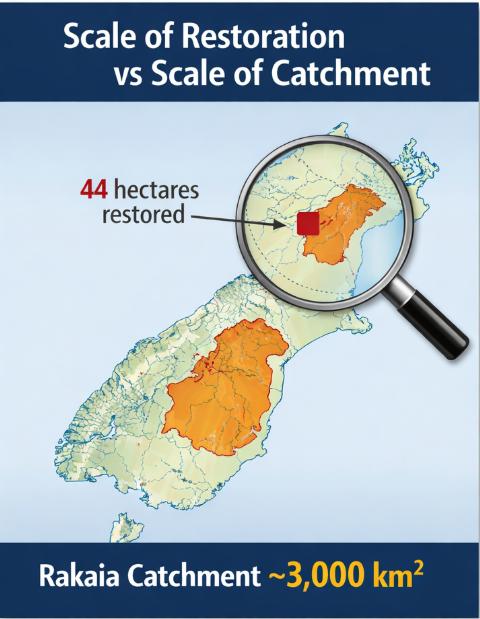
The announcement of a $784,000 taxpayer contribution toward restoring 44 hectares of wetland on the Rakaia is being presented as a turning point.
It is not.
It is an admission.
For seventy years, Glenariffe Stream - once responsible for roughly 18 percent of returning wild Chinook salmon - was diverted to drain farmland. For decades, intensification marched across the upper catchment. Braided river margins were cultivated. Wetlands were drained. Irrigation expanded.
Now, after salmon numbers have collapsed to historic lows, we are told that restoring 44 hectares represents meaningful recovery.
Let us be clear.
Forty-four hectares does not compensate for decades of habitat loss across an entire catchment.
It does not reverse sedimentation, altered flows, nutrient loading, or the cumulative impact of high country tenure review and land-use conversion.
It is better than nothing. But it is not proportional to what has been lost.
Taxpayers are contributing $784,000. That figure sounds substantial until it is placed beside the scale of agricultural profits generated across Mid-Canterbury over the past three decades. Billions in export revenue have flowed from intensification in this region.
If salmon habitat once contributed internationally recognised runs, and if it has been degraded in parallel with agricultural expansion, then restoration should be structural and catchment-wide - not symbolic and tributary-specific.
Why only the Rakaia?
Why only one stream?
Where is the comprehensive programme for the Rangitata, the Waimakariri, the Waitaki?
Where is the acknowledgement that small, isolated projects cannot repair systemic change?
We are repeatedly told that salmon declines are driven by “ocean conditions.” Ocean survival certainly plays a role. But when freshwater habitat is diminished, resilience collapses. In poor ocean years, degraded systems fail first.
Habitat is the lever we control.
And control is exactly what has been loosened elsewhere.
At the same time as this modest restoration is celebrated, Parliament is advancing sweeping changes to environmental legislation. The replacement of the Resource Management Act. Expanded fast-track approvals. Reduced public oversight.
Those reforms will shape land use far more profoundly than a single wetland project.
You cannot weaken environmental guardrails at the national level while pointing to a 44-hectare restoration as proof of stewardship.
That is not strategy. That is optics.
Real recovery requires:
- Protection of braided river margins.
- Enforceable flow regimes.
- Limits before irrigation expansion.
- Wetland protection as standard practice, not compensation after loss.
Salmon are not nostalgic symbols. They are biological indicators of catchment health. When they decline, something structural has shifted.
If this government - or any government - is serious about restoring East Coast salmon fisheries, it must move beyond isolated projects and address the drivers of degradation at scale.
Anything less is tokenism.
And tokenism will not bring the Rakaia back. Funny this happening in an election year!

The area restored originated because North Canterbury F&G received a bequest for this purpose (approx $450,000) for this purpose. It was linked to the Rakaia. The land owner was also positive about selling the land at a reasonable price. Two other areas in the Rakaia catchment also have cooperative land owners who provide at least some level of protection for spawners.
We must recognise that there are other factors that have harmed the fishery; namely the abstraction being so high that the remaining water heats up too much for the salmon, and the ridiculously inefficient fish screens on most off-takes, etc. Detractors blame global warming. I am still of the opinion however that this is only one factor. Commercial interests are still able to grow salmon smolt in the lowland Kaiapoi area.
Glenariffe stream once housed a government owned hatchery that supplemented the natural spawning. F&G have turned their back on supplementing spawning and want to leave it to nature. From what I read they seem to see it all as a long term scientific experiment which may, or may not, work.
Nature in that area is “owned” by ECan who are hell bent on beggaring it up with one water extraction consent after another an apparently colluding with the power company to manipulate flows in ways that make salmon migration difficult. God help us if the new RMA makes commercial exploitation even easier.
there is more than 44 ha more like over 200 ha with other land high country landowners have retired from farming. it is a first step as far salmon are concerned. no point in boosting a run by other means if there is nowhere suitable for them to spawn when they come back. failed fish screens are important and need to be addressed to preserve all river life. We found from an experiment on the Waimakairi river that warming water that we thought removed oxygen was the main problem with low flows however oxygen meters showed other wise. turned out low flow over the substrate actually increased oxygen levels which was a surprise. the other thing is releases from the hatcheries was responsible for somewhere between 20 and 30% salmon harvest in lower rivers. and that helped protect up river spawning have numbers for the Waimakariri. Also when costs for the hatcheries was calculated it did not take into account the 100,000’s of rainbow and brown trout raised at the same time that cost 50% more than salmon as they needeed 50% more time to grow before release.