
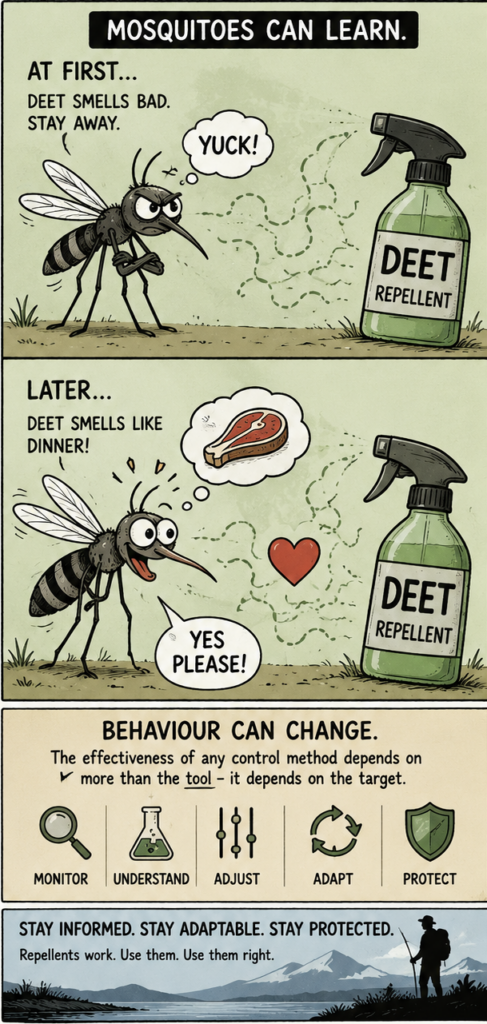
A recent study has suggested that mosquitoes can learn to associate the smell of a common repellent with food. In laboratory conditions, some insects exposed repeatedly to the chemical began responding to it as a signal rather than a deterrent. The finding does not overturn the effectiveness of repellents, which remain widely used and reliable. It does, however, introduce a different way of thinking about how control methods operate over time.
The study shows that behaviour is not always fixed. Mosquitoes exposed to repeated conditioning altered their response to a substance previously understood as purely repellent. While this work was conducted under controlled conditions and may not translate directly to the wild, it highlights a capacity for adaptation that is often assumed to be limited or absent.
This changes how long-term effectiveness is understood. Control methods are often treated as static tools, expected to deliver consistent outcomes under similar conditions. If the target species is capable of learning or behavioural adjustment, the interaction becomes more dynamic. The tool remains the same, but the response to it may shift.
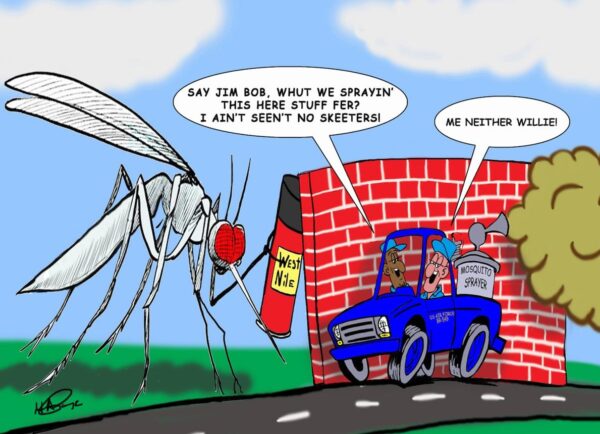
This pattern extends beyond mosquitoes. Whether managing pests on land, fish in rivers, or access to shared environments, pressure tends to produce response. Systems that assume fixed behaviour can become less effective over time if they do not account for that response. Adjustment may be gradual, but it can alter outcomes in ways that are not immediately visible.
Environmental management depends on evidence and observation rather than assumption. Tools that work well today may continue to do so, but their performance should be monitored rather than presumed. Where behaviour can change, understanding that change becomes part of the management process.
This is not about abandoning effective tools. It is about recognising that the interaction between method and target is not fixed. The issue is not whether a tool works, but whether it continues to work in the same way over time.
Well, surprise, surprise
Deer seem to be taking to 1080 baits laced with “repellent”
Who wudda thunk!
The best repellent for mossies and sand flies was always said to be vitamin B1 and B12. University results suggest otherwise but it worked for me. Go figure?
There definitely a few polys that need spraying or a good old fashioned slap 🤔