
CORANZ commentary
By Andi Cockroft, Chair, CORANZ
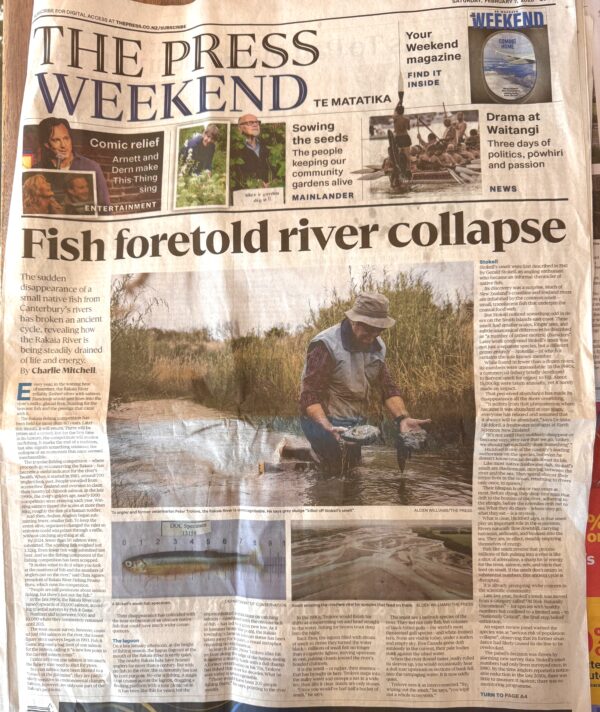
Front-page coverage in The Press of the collapse of native fish in the Rakaia River marks a moment many in the freshwater community have waited a long time to see. It is overdue recognition that something fundamental has gone wrong - and that the warnings were there well before the damage became undeniable.
See here https://www.thepress.co.nz/nz-news/360943787/native-fish-foretold-rivers-collapse (Paywalled)
CORANZ congratulates Peter Trolove, immediate past chair of New Zealand Federation of Freshwater Anglers, for his persistence in raising these concerns over many years, often in the face of indifference, dismissal, or quiet avoidance. As a veterinarian with a lifetime of experience in fisheries and river systems, Peter has not been speculating. He has been observing, documenting, and warning - consistently and responsibly.
The tragedy is not that the Rakaia is now in trouble. The tragedy is that the signals were clear, the science was available, and the system failed to respond while there was still time to act.
The disappearance of Stokell’s smelt - a small, easily overlooked native fish - is not an isolated curiosity. It is a biological alarm bell. Smelt are exquisitely sensitive to changes in flow, sediment, temperature and habitat. When they vanish, it is because thresholds have been crossed. Their loss foretells wider collapse: food webs unravel, invertebrates disappear, birdlife thins, and the river’s ability to renew itself is compromised.
That is why this matters beyond any single species.
For years, Peter Trolove and NZFFA have been warning that the Rakaia, and other Canterbury rivers, were being slowly drained of life and energy. Not through one catastrophic event, but through cumulative pressure: excessive abstraction, weakened braided structure, fine sediment smothering spawning gravels, and summer flows pushed ever lower. These were not hidden processes. They were visible to anyone who spent time on the river and understood what they were seeing.
Yet again and again, those warnings went unheeded.
Water Conservation Orders were meant to provide a backstop - a legal mechanism to protect outstanding rivers from precisely this kind of degradation. Instead, they have too often been treated as flexible instruments, reinterpreted, diluted, or worked around. Extraction limits have been set at levels that assume resilience which no longer exists. Enforcement, where it occurs at all, has been timid. Monitoring has continued, but action has lagged.
This is the heart of the failure.
Monitoring is not protection. Data does not save rivers if it is not acted upon. Early-warning species do not recover simply because their decline is documented. At some point, responsibility must shift from measuring loss to preventing it.
The Press article makes clear that the Rakaia’s decline did not happen suddenly. It happened steadily, predictably, and in plain sight. Veteran anglers describe a river they barely recognise. Scientists point to the loss of braided channels and the coating of stones in fine grey sludge. The river still flows, but it no longer gives back. It has become a conduit rather than a living system.
That outcome was not inevitable.
CORANZ’s role here is not to restate the science - it is to stand with a member organisation whose long-standing advocacy has now been publicly vindicated. NZFFA has consistently argued that rivers cannot be managed solely as water supply infrastructure without consequence. It has warned that when ecological limits are ignored, recreation, biodiversity and cultural values all erode together.
Those warnings were inconvenient. They conflicted with development priorities. They required difficult decisions. And so they were deferred.
Until the fish were gone.
It should not take front-page headlines for authorities to act on sustained, evidence-based concern. Yet history shows that this is often what it takes. Collapse must become visible before it is acknowledged. By then, the options are fewer, the costs higher, and recovery uncertain.
Peter Trolove deserves recognition not because he was right in hindsight, but because he was right in advance - and kept speaking when it would have been easier to stop.
CORANZ is proud to support NZFFA in calling for accountability. That means more than expressions of concern. It means honest examination of how Water Conservation Orders have been applied, why extraction limits have repeatedly failed to protect ecological function, and why enforcement has been so weak. It means asking whether the governance framework for freshwater is fit for purpose when early-warning signs can be ignored for decades.
It also means acknowledging that anglers and river users are not obstacles to good management. They are often the first to notice change, precisely because they spend time in these places and understand what a healthy river looks like. Treating them as stakeholders to be managed rather than partners to be listened to has been a costly mistake.
The Rakaia is not alone. Similar patterns are emerging in other rivers. If the lesson drawn from this moment is simply that “more monitoring is needed”, then nothing will change. If the lesson is that warnings must be acted upon when they are given - not when collapse becomes undeniable - then this painful episode may still have value.
CORANZ congratulates Peter Trolove for finally receiving public recognition for work that has long deserved it. We also acknowledge the many others who have raised the same concerns without the benefit of headlines. The question now is whether those in authority will listen, reflect, and act - or whether this recognition will arrive, as so often before, just as the window for meaningful protection closes.
Rivers do not collapse overnight. They fail because warnings are ignored. The Rakaia has spoken clearly. It is time those responsible listened - and did something more than take notes.
The element missing from Charlie Mitchell’s article is the fact that several substantive reports such as the multiple studies by MAF Fisheries Research on the Lower Rakaia River from the late 1970s to mid 1980s signaled water abstraction for irrigation would lead to increased deposition of sediment, increased algae, and higher water temperatures.
A comprehensive report by the Agricultural Economics Research Unit of Lincoln University “Water and Choice in Canterbury” 1983 predicted the salmon fishery would be significantly diminished by what are now the BCI and CPW irrigation schemes.
Worse the affirmed “expert opinion” of Trustpower’s witnesses on the ecological effects of amending the Rakaia River NWCO at the 2012 Lake Coleridge Hearing was incomplete and inadequate. Certainly it did not justify the chorused claims of “minor or less than minor effects” as we now know from the state of the Lower Rakaia River today.
While I have been assisted by NZ several freshwater ecologists including Dr Mike Joy, I gained a strong platform for assessing the evidence and reports from completing a fish vet course in Scotland. I was greatly assisted by Dr J G Williams, a fish biologist based in Davis California, who had first hand experience of the inadequate models and evidence presented at water allocation hearings in New Zealand.
Finally I have my late father to thank for my experiencing 67 years angling in Mid Canterbury including catching my first Rakaia River salmon 62 years ago.
Thanks Peter for highlighting the state of the Rakaia River
Unfortunately, the mighty Rakaia is no more.
• It’s astonishing that people believe removing 20–50% plus of water from braided rivers like the Rakaia (protected by a Water Conservation Order (WCO) in 1988), would not affect this river’s unique values, character, or health.
• The river has passed a tipping point, worsened by the approval of the CPW irrigation water take when the amended Rakaia WCO was granted as a result of the 2012 RMA hearings.
• The decline of the Rakaia was also predicted in a deputation to ECan Councillors in 2020 by the NZSAA and Future Rivers for a cap on water abstraction for the Rangitata River. The presentation explained how lowering water flows harms braided rivers (slide 23) and detailed how the cyclic impact of lowering natural water flows harms braided rivers.
• The Rakaia decline is also detailed in the NIWA report – Perceptions of change: Recording observations over decades for Canterbury hāpua Jan 22 (a report presented to ECan) and can be summed up in the final comment:
“The convergence of opinions from a diverse but experienced group of anglers about physical and biological changes they have noticed during their decades of involvement with one of the three hāpua, provide compelling evidence of change. Unfortunately, almost all such changes have been negative.”
• The soon to be released Rakaia Angler oral histories tells the same story, but in more detail.
• The Rakaia River salmon fishery, and sea-trout fishery has collapsed as evidenced by the continued absence of Anglers for the last few seasons and continued reductions in spawning counts.
• Stokell’s Smelt, a keystone native fish in the Rakaia River, has nearly disappeared in a little over ten years, which has disrupted the lower river’s food web and sped up the ecological decline.
• The impact of the broken food web has also rippled through the lower Rakaia River causing the decline of fish and bird populations, including the once large breeding colonies of Black Billed Gulls, (the most endangered species of gull in the world).
• ECan staff advised Councillors they could increase minimum river flows above the WCO minimum to help restore the river (during a deputation by the NZSAA about the Rakaia Declarations), if they wished.
• Why has it taken over 25 years to replace all the ineffective fish screen facilities on the main salmon rivers in Canterbury with no comprehensive plan in sight yet including the Rakaia?
• Why haven’t DoC, ECan, NCFG, irrigators, and power companies regularly studied and reviewed the Rakaia’s physical and ecological values to confirm that there are no significant negative effects since the WCO amendment?
• Why hasn’t ECan developed a management or monitoring plan to restore and then protect the Rakaia River’s ecological and physical health?
As to why it has got to this point…..
Eulogy to the Rakaia River
I could have saved the river today,
But I chose to look the other way.
It wasn’t that I didn’t care;
I had the time, and I had been there.
But I didn’t want to seem a fool,
To argue over a water rule.
I knew they hadn’t worked before;
If I spoke up people might get sore.
I took the chance; I closed an eye;
And with that act, I let the river die
I could have saved the river today,
But I chose to look the other way.
Now every time I see the river strife,
I know I should have saved its life.
That guilt is something I must bear;
But it isn’t’ something you want to share.
When you see the river today and then walk away,
Hope you never have to say,
“I could have saved that river today”
Source unknown but I thank them
So, what are we going to do about the state of the Rakaia and all the other braided rivers in Canterbury?
Are we going to stand and fight for the river or walk away? Yes i mean you – every single one of you, that’s 150,000 + license holders has a vote to tell FG, and the new Minter that environmental advocacy is not on the table for discussing its removal. You also need to remind both that salmon, trout and native fish need to remain detailed in the new RMA, as it was in the old RMA legislation. If you don’t you can kiss it all goodbye because you dont care enough to do something about today.
From my perspective he is a cup of concrete harden up.
Paul Hodgson
President NZSAA
What a wonderful job Peter Trolove has done over the many years, work that has fallen on deaf ears, and reading through the Bill simple reflects that we haven’t had a governance in New Zealand that see the environment as a life line, rather than a financial headache
And I must also mention how very very quiet the iwi are, what have they been promised
It should not be forgotten the 2010 actions of the National John Key-led government when he and Nick Smith spearheaded the move by the State to take over a democratically elected Environment Canterbury and install their sycophantic puppet commissioners. ECan never recovered from that gutting.
What Key and Smith should’ve done was to make ECan hold a democratic election instead of a communistic takeover which was repugnant.
What has happened to the Rakaia River .. has long-since happened to other lowland Canterbury rivers.
And it is a monumental, national disgrace.
Of epic proportions.
Totally foretold.
Utterly avoidable.
Those responsible should be hanging their heads, in shame.
But they won’t.
Because they’re too busy.
Chasing the mighty dollar.
And to hell with the consequences.
The Rakaia River existed .. even flourished .. alongside low-intensity agriculture, for much of the past 150-odd years.
But then, along came agricultural intensification.
Increased surface and artesian water abstraction.
Led by dairy conversion.
Resulting degradation of Canterbury rivers has been a rapidly unfolding, catastrophic issue.
Hidden in plain sight.
Swept under the carpet.
Bellwethers ignored.
As so often happens, those who have tried to raise the alarm haven’t just been overlooked.
They’ve been belittled. Labelled. Discredited.
While only trying to illustrate reality, and tell the truth, all along.
Early pioneers of the Canterbury dairy industry had a fair idea what they would do to our Canterbury rivers.
Their risk mitigation strategies were thinly veiled.
They infiltrated .. and practically took over .. the local territorial authority responsible for environmental impacts.
Environment Canterbury.
People have lamented that the Resource Management Act has been too burdensome. Too unwieldy. Too stifling of economic progress.
But the environmental evidence around water quality in Canterbury shows .. it hasn’t always been enough.
It has not prevented us .. from continuing to slowly strangle the goose that lays the golden egg.
It’s not just agricultural intensification, per se, that has accelerated decline.
New Zealand’s attendant love affair with chemicals and poisons has been another, significant, contributing factor.
As well as pouring insecticides on our crops .. we rain Aerial 1080 into the headwaters and catchments of all of our rivers.
With gay abandon.
As if tomorrow will never come.
Well, tomorrow always comes.
Our species is a toxic force.
And the consequences inevitably catch up.
100% Pure New Zealand.
What a joke.
What a con.
What a bald-faced lie.
We use it to pat ourselves on the back.
So we can keep on fiddling.
While Rome burns.
And what do our politicians do?
Local government?
Central government?
Not enough.
If you want something screwed up .. put politicians in charge.
And then there’s a fair chance of it (being screwed up).
Some people would struggle to organise a piss-up .. in a brewery.
While the rest of us .. well, we just suffer the consequences …
Sadly sometimes the drones who live off the capitalist bee hive guard the honey with such vigour that the workers and common grubs cannot get their share of benefit from it. Perhaps we need a new king/queen bee. A queen be who looks after all the bees not just the fat “lazy” drones; a queen bee which can see that the system is broken.
What was failed to be mentioned is that this is the norm for the entire country. There are action groups all over New Zealand fighting for their own piece of paradise and nearly all are being ignored.
Sadder fact of the matter is that unless you get iwi involved the talking heads of council or Central government ignore you. The race card is the only way to get noticed it now seems.
For years I have stated it doesn’t take science to prove what we already know, it only takes local knowledge from our elders that can very accurately describe the decline.
For years T Orman, myself and others fought for recognition and saving of our beautiful Marlborough sounds. Very little headway was made but a few minor victories were achieved. Unbelievable even after paid science by our council only reinforced what we were saying. One such study showing that in ten years on time monitored sites 90 percent of biodiversity had been lost
It only took us 40 years to wipe out our sounds but will take more than a century to repair.
It is so far past the point of needing to remove these weak pollies and place brave outspoken members of the regular public in to make the simple but very bold decisions needed to save our many in dire danger environments.
It’s time to put the environment in front of big business