CORANZ commentary
By Andi Cockroft, Chair, CORANZ
Federated Farmers this week called on the Government to rule out any form of “water tax” in the proposed RMA replacement legislation. Their concern centres on wording in the Natural Environment Bill that would allow Ministers to auction, tender, or levy charges on the use of freshwater.
We do not take our policy cues from Federated Farmers. Nor do we dismiss the issue lightly.
This matters.
There are two separate questions buried inside the rhetoric.
The first is constitutional.
The second is ecological.
Ministerial Power
Recent history has shown what can happen when environmental decision-making becomes concentrated and political. Canterbury’s rivers carry that lesson. When allocation, limits, and consents are shaped by central direction rather than firm ecological bottom lines, the results can endure for decades.
Fast-track legislation already compresses process and centralises authority. If the RMA replacement also grants Ministers sweeping discretion to auction or levy freshwater allocations, that power deserves scrutiny. Not because today’s Minister intends misuse, but because legislation outlives individuals.
Environmental limits should be durable.
River health should not fluctuate with electoral cycles.
Expanding ministerial discretion without clear statutory guardrails invites future instability. That is not alarmism. It is institutional memory.
Pricing Water - The Wrong Question?
At the same time, the phrase “water tax” oversimplifies a more nuanced issue.
Water in a river is not a commodity in the usual sense. It is a public resource. It sustains ecosystems, recreation, cultural values, and downstream users. Charging for the existence of water would be a conceptual mistake.
But charging for exclusive abstraction rights is something different.
When large volumes of river flow are diverted, pumped, or stored, public value is reduced. Habitat changes. Flow regimes alter. Recreational opportunity narrows. Those effects are not hypothetical; they are visible in catchments across the country.
It is difficult to argue that removing significant quantities of a public resource should carry no cost whatsoever.
This is not anti-farming. It is recognition that abstraction is not neutral.
The real question is not whether pricing mechanisms exist. It is how they are framed, constrained, and applied.
Limits First, Tools Second
Pricing cannot substitute for ecological limits. A river cannot be over-allocated simply because someone is willing to pay more. Environmental bottom lines must come first and be non-negotiable.
Only within those limits does the discussion of allocation tools make sense.
If levies are used, they must be:
- Transparent.
- Hypothecated to restoration or management.
- Structured to prevent perverse incentives.
- Insulated from political revenue-raising temptation.
If auctions or tenders are contemplated, they must operate within fixed ecological caps that cannot be traded away.
Otherwise pricing risks becoming a licence to extract more, not a tool to manage demand.
Public Resource, Public Responsibility
Freshwater is not privately owned. Consents grant permission to use, not ownership of the resource itself. When rivers degrade, the public absorbs the loss - in diminished fisheries, reduced swimmability, and ecological decline.
It is reasonable to ask whether abstraction should reflect its true environmental cost.
It is equally reasonable to insist that no Government should hold unchecked discretion to manipulate that system without clear safeguards.
Both principles can coexist.
The Position CORANZ Takes
We are cautious about expanding ministerial power over environmental allocation. History suggests caution is wise.
We are equally cautious about rhetoric that frames all pricing mechanisms as illegitimate taxation. Exclusive extraction from a public river is not the same as taxing rainfall.
Rivers require limits that are firm and enduring.
Allocation tools must operate inside those limits, not replace them.
Discretion must be constrained by statute, not goodwill.
Water is too important - ecologically and culturally - to be governed by slogans on either side.
The conversation should not be about killing a “water tax.”
It should be about protecting river health while ensuring fairness in how public resources are used.
Who controls the tap matters.
So does who bears the cost when rivers run thin.
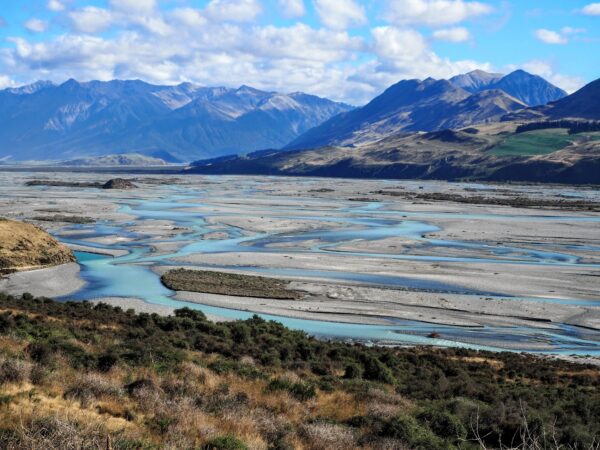
From GNS 2003, forewarning the death of the Rakaia:
The Rakaia and Rangitātā are the only two major rivers in New Zealand that originate from high-altitude glacier-dominated mountain sources. They flow more than 100 kilometres across the Canterbury Plains to the sea. The mean annual flow in the Rakaia is 221 cumecs (cubic metres per second), but it is estimated that by 2018 it may be as low as 76 cumecs, because of water taken for irrigation. During a flood, it can be as high as 3,700 cumecs.
I am confused.
Irrigated land with the highest security of supply commands the highest value, around $60,000 per ha.
In Canterbury which has 70% of New Zealand’s Irrigated land area, an “irrigation” ECan councilor convinced his council that water should be free. He based his argument on his assertion that Canterbury has excess water. That a market for water would create a market driven deficiency as water owners sought to maximize value.
I feel there is a disconnect here when ECan has stated in its reports that my district of Selwyn is 130% allocated.
I am concerned that the “excess” water in Canterbury will only become “excess water” after taxpayers fund further water storage to supply the “free water”.
To sell water you must first establish that you own it. If you own it then you must be responsible for any damage it cases. Insurance companies and land owners can then sue you for the damage that the water does. Interesting thought?
The Australians can give us a good look at what the future might hold. The Murray Darling Basin fiasco has gone on for decades, with a minority of rural landowners scooping up financial benefits by abusing water resources: https://www.edo.org.au/2023/03/30/60k-fine-for-illegally-taking-2-billion-litres-of-water/
They also have a market in water takes (https://www.reddit.com/r/AskAnAustralian/comments/176houf/does_australias_water_market_work_well/).
Finally, add to the mix inter-state competition for water and a bunch of politicians who are so corrupt they have to screw their socks on.
Another link from Australia that is worth reading: https://www.bloomberg.com/graphics/2023-australia-water-trade-drought/
It shows big investors get rich from treating water as a tradeable commodity.