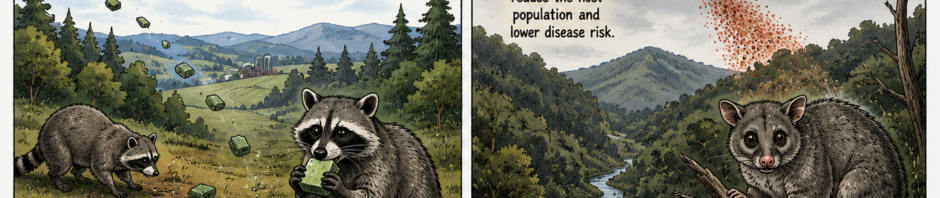
In parts of the United States, wildlife disease is managed using a highly targeted approach. Aircraft distribute edible vaccine baits across rural landscapes, allowing animals such as raccoons to immunise themselves as they feed. The aim is not to eliminate the host species, but to interrupt the spread of disease by building immunity within it. It is a largely invisible system, operating at scale but with minimal direct impact on the animals themselves.
New Zealand takes a different approach to wildlife disease where bovine tuberculosis is concerned. Possums act as a reservoir for the disease, and control efforts focus on reducing their population across large areas. Methods include aerial toxin application, trapping, and ground-based control. Taken together, the objective is not to manage the disease within the host population, but to reduce the host population itself.
These approaches reflect the tools available and the nature of the diseases involved. Rabies is a viral disease for which oral vaccination is effective and can be delivered through bait. Bovine tuberculosis is a bacterial disease, and while research into vaccination exists, it has not translated into a comparable large-scale field solution. The result is a divergence in method, even where the underlying challenge - wildlife acting as a disease vector - appears similar.
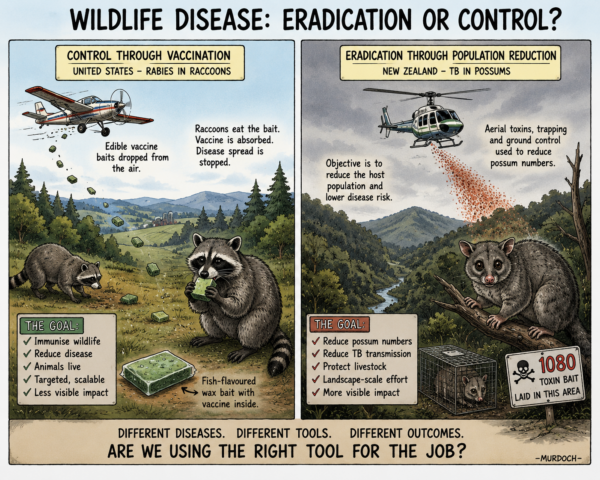
The difference is not only technical. It also shapes how intervention is experienced. Vaccination programmes operate by altering disease dynamics within a population. Population reduction programmes operate by reducing the population directly. Each carries its own implications for scale, visibility, and public acceptance, particularly where interventions occur across shared landscapes.
This pattern reflects a broader principle in environmental management. The choice of tool often defines the nature of the response. Where non-lethal, targeted tools are available, they tend to be preferred. Where they are not, more direct methods are used. Over time, those choices shape both outcomes and expectations.
Wildlife disease management sits at the intersection of ecology, agriculture, and public interest. The issue is not whether one approach is universally better than another. It is whether the tools being used remain proportionate, effective, and open to improvement as alternatives emerge.
The tb industry will not vaccinate. It believes vaccination stops nit only the disease spreading but means they can not test for the disease.
If this is a particular issue and I don’t believe it is. Tb would be a thing if the past. Oh yes it is a thing if the past.
Possums rare until you reach Fox and head south. No Tb.
They are everywhere.
Further North rarely see possums now and still bs testing.
NZ do not want a solution or they would remove persistently infected herds.
No tb on farms, none the bush.
Tb in farm animals, tb in the adjacent bush.
Australia got rid of Tb by getting rid of of tb infected livestock, plenty of possums there and no tb.
Vaccination is definitely an option, certainly better than the inhuman use of 1080, rual New Zealand has very little employment opportunity, pest control would create employment, it’s would prove as a valuable industry
Viruses can sometimes be used but only have permanency if “islands”. Populations with no interactions with their distant relatives. It was used in the Pacific Islands to exterminate Rhinoceros Beetles but failed with rabbits. Firstly Myxomatosis need rabbit fleas to transmit it and NZ’s rabbits did not come with resident fleas. The other failure was RHDV1 in 1997. Its immediate hit was often followed by reinfestations from neighbouring areas plus some apparent development of resistance. RDHV2 in 2017 had some success also but there are still rabbits around in the areas where it was used. True elimination only seems to occur when control methods are integrated: shooting, poisoned baits, the release of the virus, and parallel control by ones’ neighbours.
The worst pest control blunders have to be 1080 and the introduction of ferrets, stoats and weasels to control rabbits. It failed miserably as easier prey was plentiful.
In the 1960s an American consultant called Howard Howard urged the introduction of mountain lions into the Southern Alps to control wild deer. Fortunately the government agencies were not convinced. Visions of missing sheep and trampers seemed to be invoked.
It’s doubtful possums were ever the problem they were vilified as, when it comes to the spread of TB in New Zealand.
2016 Parliamentary Figures:
Former Agriculture Minister Nathan Guy disclosed in Parliament that out of 124,000 possums autopsied over a 10-year period, only 54 tested positive for bovine TB. Furthermore, out of 9,830 possums autopsied in the 12 months preceding the disclosure, zero had TB.
I understand NZ’s current rate of TB infection falls below international thresholds whereupon NZ is considered TB-free.