
Election years sharpen everything.
Promises become louder. Statistics become selective. Headlines become sharper. Every party claims evidence is on its side.
This is not new. It is the rhythm of politics.
But it raises a serious question: how confident can the public be that what they are hearing is complete, balanced, and fair?
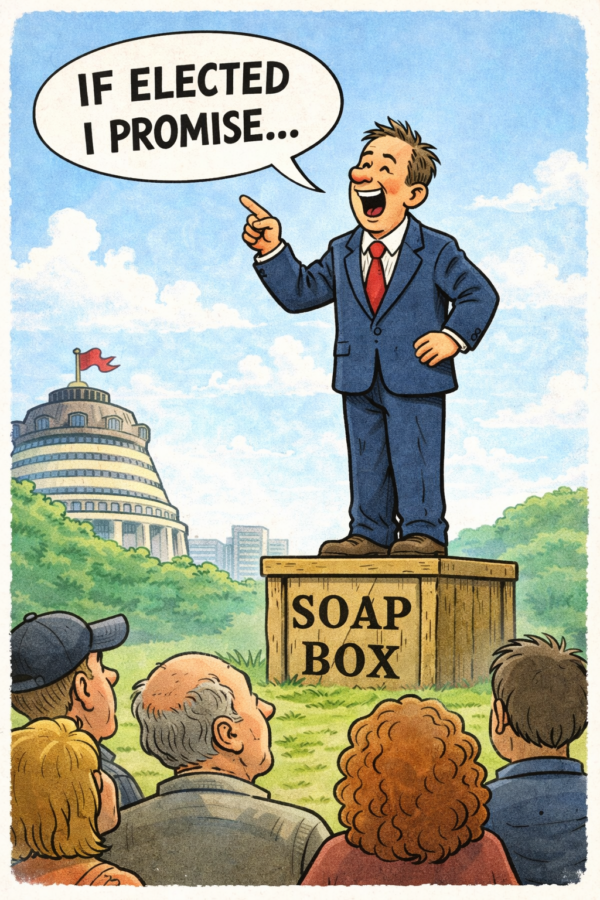
New Zealand relies largely on self-regulation when it comes to political advertising. The Advertising Standards Authority can require corrections or removals. Section 199A of the Electoral Act makes knowingly false statements in the final 48 hours a criminal offence. On paper, the guardrails exist.
The challenge is not always outright falsehood.
It is selective framing.
Economic numbers can be presented in real or nominal terms. Baselines can shift. Timeframes can be shortened or stretched. Environmental data can be framed around best-case or worst-case years. Each may be technically accurate. None may tell the whole story.
Those tricks are as old as the hills.
For organisations concerned with rivers, fisheries, access and ecological integrity, this matters. Environmental policy is data-heavy. Water quality metrics, fish stock estimates, nutrient loads, irrigation volumes, biodiversity indices - all can be quoted honestly while still misleading the public through omission or context.
Trust in democratic process depends on more than the absence of lies. It depends on clarity.
This is especially important in environmental decision-making. Rivers do not respond to rhetoric. Fish stocks do not respond to press releases. Long-term ecological systems require durable, evidence-based policy insulated from electoral cycles.
Election campaigns compress complex issues into slogans. That is understandable. But the public must resist being satisfied with slogans.
The responsibility does not sit solely with politicians.
Media must interrogate claims quickly and consistently. Watchdogs must act decisively. Voters must read beyond headlines. Advocacy groups - including ours - must hold all sides to the same evidentiary standard.
This is not about favouring one party over another. Every government, past and present, has used statistics to its advantage. That is the nature of political competition.
The question is whether we allow competition to erode confidence.
Environmental governance depends on public trust. If voters conclude that information is routinely manipulated, confidence in institutions weakens. Once that trust erodes, rebuilding it is difficult.

Election year should not mean suspension of standards.
It should mean higher standards.
New Zealand’s democratic system remains robust. But robustness is not automatic. It requires scrutiny, memory, and independence.
As debates intensify over water reform, fisheries management, infrastructure, and land use, the public would do well to ask one simple question of every claim:
What is the full picture?
In election year, scepticism is healthy. Cynicism is not.
It would be great if some respected journalist could list the promises made by the last two governments with the assessments of how well these were kept. A very thoughtful article Andi especially the point about distinguishing between skepticism and cynicism.
Every election we hear plenty of promises that are rarely followed through, I theres some good in bad in the 4 party’s that are worth my consideration, Nat, ACT, First and even Labour’s without Napkins.
The Nats need to lose Biship and Meager, then you might see some positive governance from the Nats, Winston without Jones is a no trainer, ACT treaty Bill was common sense to me, I simply can not believe that the out come was honest, Labour’s still want to sell Kiwis out to the Maori hierarchy how pocket the money for themselves, the Greens are a joke and don’t really need a mention