
Government Treaty Minister in the 1990s Doug Graham once said that “Maori had spiritual feelings for lakes and mountains and rivers that Pakeha people neither shared nor understood.”
I would be surprised if Doug Graham had much to do with the outdoors and particularly with trout or salmon fishing and just going with the flow out there with the river. But those “spiritual feelings” he attributes exclusively to Maori are wrong and arguably racist.
Besides what exactly is a Maori? There are no full blooded Maoris in 2023 according to most. But anyhow, many of those involved in Maori advocacy have a minority of Maori ethnicity. It has been said Sir Tipene (Stephen) O’Regan for example is 1/16th Maori. So when Doug Graham talks of Maori’s “spiritual feelings for lakes, mountains and rivers” is he saying that Tipene O’Regan’s 15/16th European heritage has no emotional attachment to lakes, mountains and rivers, but the 1/16th has?
When I go trout fishing, I don’t have to catch a trout to have a great day on the river. I have no Maori bloodlines.
“Maori” friends
Yet I have closely associated with some New Zealanders with strong Maori heritage, but i saw them as just people and personalities in their own right, many very admirable.
“Spiritual feelings” to do with rivers, mountains and lakes can be felt by anyone, regardless of ethnic background.
Noted historian Michael King rightly challenged Treaty Minister Doug Graham’s racial claim and would have none of the racial exclusivity to the emotion and in fact laid claim to the emergence of an analogous Pakeha spirituality. “Such a feeling among Pakeha people is now widely shared and as our Pakeha culture puts down even deeper roots into the soil of this country and as those roots become more hallowed by the passage of time, those feelings will become more intense.”
Pioneer Emotions
But then did the first European pioneers have that spiritual appreciation of lakes, mountains and rivers? Perhaps it never had to “emerge” as Michael King suggested because it already was there among the first and subsequent waves of English settlers arriving in New Zealand?
After all, the European pioneers must have had strong attachment to fishing rivers for almost immediately they set about releasing trout into rivers, streams and lakes and instilling into new laws, in line with the egalitarian society they wished to set up in the new colony, the right of all regardless of wealth or ethnic background, to go fishing.
Thus both the Fisheries and Wildlife Acts prohibited the selling of fishing, hunting or shooting rights. In doing so, the pioneers had shed the feudal system of the Home country where the right to catch a trout or salmon or stalk a deer, was by dint of access fees, the preserve of the wealthy upper class.
“A River Never Sleeps”
One trout fishing writer whose prose captured the feelings of being as one with a river was Roderick Haig-Brown. Few men know rivers so intimately and fondly as did Roderick Haig-Brown. No one, before or after 17th century author of “The Compleat Angler” Izaak Walton, has written of these long and deep-running friendships more lyrically, more eloquently, than Haig-Brown in his wonderful book, “A River Never Sleeps.”
And why not recollect Roderick Haig-Brown’s expression of that spiritual attachment to rivers, that anyone may experience and develop?
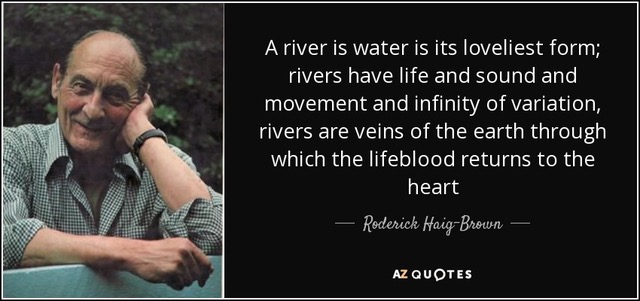
Roderick Haig-Brown and Englishman by birth who emigrated to Canada wrote “A river is water in its loveliest form; rivers have life and sound and movement and infinity of variation, rivers are veins of the earth through which the life blood returns to the heart.
Love a River
“One may love a river as soon as one sets eyes upon it; it may have certain features that fit instantly with one’s conception of beauty, or it may recall the qualities of some other river, well known and deeply loved. One may feel in the same way an instant affinity for a man or a woman and know that here is pleasure and warmth and the foundation of deep friendship. In either case the full riches of the discovery are not immediately released–they cannot be; only knowledge and close experience can release them. Rivers, I suppose, are not at all like human beings, but it is still possible to make apt comparisons; and this is one: understanding, whether instinctive and immediate or developing naturally through time or grown by conscious effort, is a necessary preliminary to love.”
Inevitable Love
Understanding of another human being can never be complete, but as it grows toward completeness, it becomes love almost inevitably. One cannot know intimately all the ways and movements of a river without growing into love of it. And there is no exhaustion to the growth of love through knowledge, whether the love be for a person or a river, because the knowledge can never become complete. One can come to feel in time that the whole is within one’s compass, not yet wholly and intimately known, but there for the knowing, within the last little move of reaching; but there will always be something ahead, something more to know.”
His favourite two rivers were the Campbell and the Nimpish both on Vancouver Island, British Columbia. But the Campbell was his favourite. “The Campbell is the simpler river of the two, easier to know and understand for all those reasons. Nimpkish is more wonderful, more impressive, more beautiful; but Campbell–and not simply because I live within sight and sound of her–is the better of the two to love.”
This reminds me of “For the Love of Rivers,” where stream ecologist Kurt Fausch writes of their beauty and mystery, but he also uses his many years of experience as a field biologist to explain the underlying science connecting these aquatic ecosystems to their streamside forests and the organisms found there–including humans.
Spiritual feeling for rivers has nothing to do with ethnicity, but sensitivity to water and wilderness.
Did Doug Graham have a feeling for rivers? Hmmmm—
Here’s another quote by Roderick Haig-Brown, a wonderful writer.
“I have never seen a river that I could not love. Moving water… has a fascinating vitality. It has power and grace and associations. It has a thousand colours and a thousand shapes, yet it follows laws so definite that the tiniest streamlet is an exact replica of a great river.”
The issue is not who can feel a connection to a river, but whether people have the opportunity to develop one.
The historical reference to public access is relevant. Systems that allow participation across a wide range of people tend to build a broader base of engagement. That engagement is what sustains long-term interest in protecting and maintaining these environments.
There is also a link between access and stewardship. People who spend time in these environments tend to notice change more readily and respond to it. Where access is restricted or reduced, that connection can weaken. Over time, that may have wider implications for how rivers are valued and managed.
The idea that attachment to rivers grows with understanding is well made. Whether through fishing, walking, or simply observing, repeated experience builds a level of awareness that is difficult to achieve in any other way. That awareness tends to lead naturally to care. It is a gradual process rather than something that can be defined or assigned.
Connection to rivers is something that develops through time spent on them rather than background or identity. Regular exposure builds familiarity, and familiarity builds attachment. That process appears to be consistent regardless of who is involved. Access plays a key role in that, because without it the opportunity to form that connection becomes limited. Maintaining open and practical access is therefore not just about recreation, but about sustaining that relationship over time.
Get with the program.
In modern New Zealand rivers are viewed as “water management units” (WMUs).
Canterbury rivers have been compelled to “pull their weight” with water allocation hearings setting “bottom line” minimum flows based on the demands of local irrigation schemes.
Of course security of supply and the economy must take precedence.
The minimum flow for the Ashburton river was set at 12 cumecs in 2010 thanks to Ian Jowett’s habitat modelling supported by John Hayes.
After twice running his model in response to a collapsed trout fishery, Jowett found fault with the river for not conforming to his model.
[It was apparently incidental that the river no longer had a connection with the sea over dry summer months]
ECan has now set the minimum flow for the Ashburton River at 6 cumecs at SHWY 1.
The retired dairy farmers with their water side homes at Lake Hood have patriotically accepted not being able to swim or water ski in a lake plagued by toxic algae.
The Ashburton District Council has earmarked $millions to find bureacratic solutions for both the polluted lake and polluted community water supply.
No doubt they will document an aspirational solution.
Hart’s Creek, the Lower Selwyn River, the Hinds River and Silverstream in the Waimakariri District all contain a gutsy 8 – 9 mg/L NO3-N.
Surely if Cantabrians are happy to have a Nitrate Emergency and take massive losses in in the region’s trout fishing, the least the remainder of New Zealand can do is to follow suit.
After all it is the economy stupid – according to Bishop and Jones.
Sadly this is not a joke.
Yes too many see rivers flowing into the sea as “wasted water”. I have been at farmers’ meetings and have heard some lament “all that water flowing into the sea.” Perhaps we need to sow seeds in the young kids at school about the environment, interrelationships about food chains and Nature’s predator-prey relationships instead of wonky wokey ideas about letting drag queens into schools.